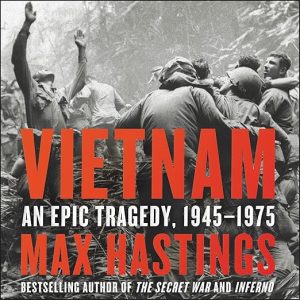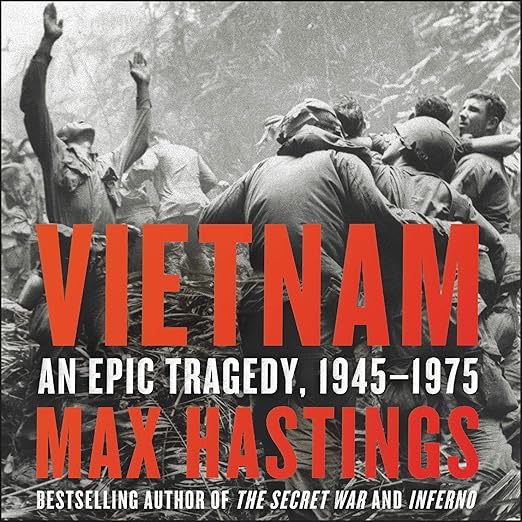
Paul Ham's Vietnam is not the Vietnam War book that American exceptionalism would have written. Ham is an Australian author, and Max Hastings - the British military historian whose research and interviews form the basis of this account - approaches the conflict without the national stake that shapes most American tellings of it. That distance is the book's primary critical advantage and what makes this thirty-one-hour audiobook worth the considerable investment of time it demands. The war as experienced by the Vietnamese people - north and south, military and civilian, victor and victim - receives treatment here that most English-language accounts have been reluctant to provide.
Hastings spent three years interviewing participants on both sides of the conflict, working through American and Vietnamese documents and memoirs to build what the synopsis accurately describes as an epic narrative. The set pieces are all present - Dienbienphu, the 1968 Tet offensive, the air campaign against North Vietnam - but Hastings consistently uses them as entry points into human experience rather than as occasions for strategic analysis. The testimonies he gathers from Vietcong guerrillas, Southern paratroopers, Saigon bargirls, and Hanoi students sit alongside those from infantrymen from South Dakota and Huey pilots from Arkansas, and the juxtaposition is the argument: that the human cost on all sides deserves to be held simultaneously, rather than parceled out according to national perspective.
Forty Vietnamese Deaths for Every American One
Hastings makes a structural claim that shapes everything that follows: this was overwhelmingly a Vietnamese tragedy, not an American one. Forty Vietnamese people died for every American, and any account that centers the American experience distorts the moral geography of the conflict. Ham's rendering of Hastings' research takes that claim seriously, tracking the experiences of Vietnamese civilians and soldiers with the same granular attention given to American servicemen and their families. That rebalancing is not a rhetorical maneuver - it is backed by the testimonies Hastings gathered and by the documentary record he worked through.
The political history of the conflict is traced from the French colonial period through the 1954 defeat at Dienbienphu and into the American escalation without the telescoping that typically compresses the earlier period into brief context. Understanding what the Vietnamese were fighting for before American involvement - the complex relationship between communist ideology and genuine national liberation aspiration, the specific history of colonial subjugation under the French - is essential for understanding why the American military model was so catastrophically ill-suited to the conflict it was entering. Hastings makes this case carefully rather than polemically.
Peter Byrne's narration across thirty-one hours is a serious achievement. He handles the dense political and strategic material with clarity, the biographical passages with appropriate human warmth, and the combat sequences with the kind of restraint that keeps them from becoming spectacle. Differentiating the many voices and perspectives gathered in a work this wide-ranging is a formidable narration challenge, and Byrne meets it without calling attention to the achievement - the mark of a skilled performance.
Thirty-One Hours That Reward Close Listening
The audiobook format for a work this long and this dense is a genuine question worth addressing. Thirty-one hours of military and political history is a serious commitment, and some of the passages - particularly the detailed accounts of specific military operations, the presentation of multiple simultaneous American command disagreements, or the Vietnamese internal political debates of the 1950s and 1960s - reward the kind of close rereading that audio makes difficult. The text is not designed to be passively received.
That said, Byrne's narration creates a sustained listening experience that carries the narrative forward in ways that reading in fragmented sessions would not. The testimonies from participants, which are among the most powerful material in the book, are particularly effective in audio - you hear them as voices rather than text blocks, which gives them their appropriate human weight. Reviewers consistently cite the balance and honesty of Hastings' approach, the willingness to hold American blunders and Vietnamese communist atrocities in the same frame, as the book's most distinctive and valuable feature. That quality translates directly to the audio experience.
One reviewer quoted a Vietnamese veteran - "only those who never fought in a war discuss who lost or won" - as a framing for what the book achieves. Another described Hastings as laying it out in a balanced and thorough way that respected the controversy and emotional complexity of the subject. Both responses describe the same quality: a refusal to simplify the conflict into the terms that each side's political culture prefers.
Comprehensive Scope Comes at a Cost
The scope of the book is both its strength and its primary challenge. Hastings covers five decades of conflict across two major colonial powers and dozens of operational theaters, with testimony from hundreds of participants. Listeners who want a focused, single-perspective account of the war - the specific experience of American combat soldiers, or of Vietcong fighters, or of Vietnamese civilians in the south - will find this comprehensiveness somewhat frustrating. The book deliberately resists the kind of sustained focus that makes individual experience feel fully inhabited.
Hastings does not position himself as a neutral observer - he draws conclusions, makes moral judgments, and advances a thesis that neither side deserved to win and that both committed acts that forfeit the claim to historical vindication. That moral seriousness is precisely what makes the book valuable, but listeners who want a more purely descriptive history should know that the author's perspective is present and active throughout.
At thirty-one hours, this audiobook requires genuine commitment and is best consumed in extended sessions rather than five-minute increments. The narrative threads are complex enough that frequent short sessions will lose the connecting tissue. Listeners who have two-to-three-hour driving or exercise sessions will find the format ideal; those who can only listen in short fragments may need to accept that some continuity will be lost and plan to revisit certain sections.
Ideal for Readers Who Want Vietnamese Voices Centered
This audiobook is ideal for serious history readers who want a comprehensive, morally honest account of the Vietnam War that centers Vietnamese experience alongside American and is willing to hold the complexity of all sides' failures simultaneously. It is a strong pick for listeners with existing familiarity with the war who want deeper and more balanced coverage, and for those who find that most American-authored accounts leave them frustrated by their national framing. Peter Byrne's narration makes the thirty-one-hour commitment feel worthwhile. Those looking for a shorter or more action-focused treatment of the war should look for more specific accounts of individual campaigns or units - this is the overview, and it is one of the best available.
Before You Listen
Is this audiobook appropriate for listeners with no prior knowledge of the Vietnam War?
It is accessible to newcomers but rewards prior knowledge. Hastings traces the conflict from French colonialism through 1954 and into the American escalation with enough historical context that a newcomer can follow the arc, but the density and breadth of the account mean that listeners with some existing familiarity will get more out of the early sections and spend less energy on basic orientation.
Is Peter Byrne's narration up to the challenge of such a long and complex audiobook?
Reviewers who have engaged with the book consistently find the narration clear and well suited to the material. Byrne handles the differentiation of many testimonies and perspectives across thirty-one hours without the performance fatigue that some long-form narration develops. His measured, authoritative delivery is appropriate for the gravity of the subject matter.