Quick Take
- Narration: Virtual Voice AI narrator delivers the text cleanly but without the intellectual urgency the material demands; dense philosophical argument benefits from a human reader who can modulate weight and emphasis.
- Themes: Enlightenment critique, Christian epistemology, philosophical foundations of Western thought
- Mood: Polemical and dense, best absorbed in short focused sessions
- Verdict: Listeners already skeptical of Enlightenment assumptions will find it sharply argued; those seeking a balanced academic survey of epistemology should look elsewhere.
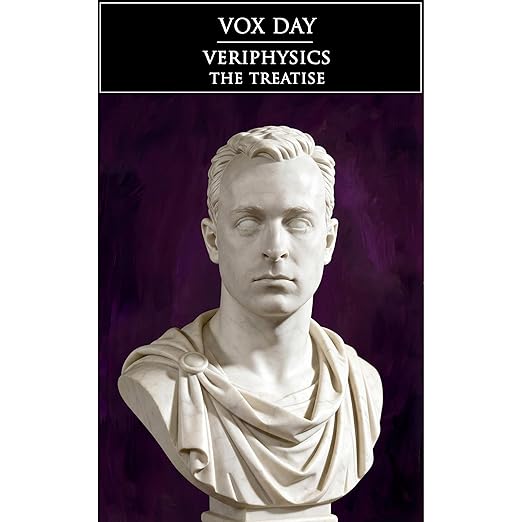
I put on Veriphysics: The Treatise on a Tuesday evening after a long stretch of fiction, partly out of curiosity, partly because the title’s ambition intrigued me. Two and a half hours felt manageable for what Vox Day describes as a philosophical successor to the Western intellectual tradition. By the end, I had a page of notes and a few genuine arguments with myself about what I’d just heard.
The book arrives with a near-perfect rating from a small but vocal audience, and it wears its polemical intent openly. Day is not trying to persuade the undecided so much as arm readers who already sense, as the synopsis puts it, that “something is deeply wrong with the intellectual world they inherited.” If you go in expecting a dispassionate survey of epistemological options, you will be surprised. This is a manifesto, and it reads like one.
Our Take on Veriphysics: The Treatise
The structure is genuinely interesting. Day divides the work into three parts: a diagnosis of the Enlightenment’s five core premises and how each has allegedly been falsified, a historical account of how the classical and Christian philosophical tradition was outmaneuvered by superior rhetoric and institutional capture rather than better arguments, and finally a constructive proposal called Veriphysics, built on what he terms Aletheian Realism. The central tool he introduces, the Triveritas, demands that any claim satisfy three conditions simultaneously: logical validity, mathematical coherence, and empirical anchoring. If a claim cannot meet all three, he argues, assent is not warranted regardless of the credentials behind it.
Applied to the cogito, Darwinian evolution, classical economics, and social contract theory, Day uses the Triveritas as what he himself calls a wrecking ball. Readers sympathetic to that project will find the argument satisfying. One reviewer compared it to blueprints for rebuilding a crashed aircraft; another called it “a Christian epistemology you can use” after years of searching. Those are genuine endorsements from readers who found what they were looking for.
Why Listen to Veriphysics: The Treatise
The strength of this audiobook lies in its organizational clarity. Whatever one thinks of Day’s conclusions, the three-part architecture gives the listener a coherent sequence to follow, and the synthesis of philosophy, theology, and epistemology in the final section is ambitious in a way that is rare in contemporary polemical writing. The Triveritas, whatever its limitations, is at least a concrete framework rather than vague assertions, and listeners from a religious intellectual tradition, particularly those trying to reconcile faith with scientific culture, will find the constructive section more useful than most popular apologetics.
The release from Castalia House in early 2026 also positions it as a timely intervention in ongoing debates about the authority of scientific institutions and the legitimacy of progressive epistemologies. For listeners already engaged in those debates, the book provides vocabulary and structure for arguments they may already be making informally.
What to Watch For in Veriphysics: The Treatise
The narration is a significant caveat. Virtual Voice, Audible’s AI narrator technology, handles prose adequately but lacks the intellectual texture this kind of material deserves. Philosophical argument builds through cadence and emphasis as much as through content. A skilled human narrator signals to the listener when a pivot is happening, when a qualification matters, when a conclusion is being landed. The Virtual Voice delivery is flat in ways that make dense epistemological passages harder to parse on a single listen. I found myself rewinding several times not because the argument was unclear but because the inflection had not prepared me for where the sentence was going.
There is also the matter of scope. At two hours and thirty-six minutes, the book covers an enormous amount of intellectual territory. The deconstruction of five Enlightenment premises, the reconstruction of how a rival tradition was suppressed, and the introduction of a new epistemological framework would each justify a book-length treatment. Compressed into this runtime, some sections feel asserted rather than demonstrated. Readers sympathetic to the project may find that acceptable. Those approaching it critically will want more developed argument in the philosophical history sections.
Who Should Listen to Veriphysics: The Treatise
This audiobook is well-suited to listeners who are already engaged with critiques of secular rationalism, have some background in Western philosophy or theology, and want a structured framework for thinking about epistemological alternatives. It will also resonate with Christians in STEM fields who have found popular apologetics unsatisfying and are looking for something more analytically rigorous. Listeners who want a balanced academic treatment of Enlightenment philosophy, or who are looking for the kind of argument that engages its strongest critics, will likely find the book frustrating. Those uncomfortable with AI narration for substantive philosophical content should note that limitation before purchasing.
Frequently Asked Questions
What exactly is the Triveritas that Day introduces in Veriphysics?
The Triveritas is Day’s proposed epistemological tool requiring that any claim meet three simultaneous conditions: logical validity, mathematical coherence, and empirical anchoring. He argues that claims failing any of these conditions do not merit assent, and he applies this framework critically to major Enlightenment theories including the cogito, Darwinian evolution, classical economics, and social contract theory.
Is the Virtual Voice AI narration a problem for a philosophy audiobook?
It is a real limitation. Dense philosophical argument relies on emphasis and cadence to signal when pivots and conclusions are landing, and AI narration lacks that texture. The text is delivered intelligibly, but listeners engaging critically with the argument may need to rewind more often than they would with a skilled human narrator.
Do you need to have read Vox Day’s other work, including Probability Zero, to follow this one?
No prior familiarity with Day’s earlier writing is required. The treatise is structured as a self-contained argument, opening with the diagnosis of Enlightenment premises before building to the constructive Veriphysics framework. References to Probability Zero appear but do not carry the argumentative weight.
Is this audiobook appropriate for listeners who disagree with its conclusions?
Day states explicitly in the synopsis that the book is not for those who want their assumptions confirmed. That said, the argumentative style is more rhetorical than dialectical, and critical readers will find that counterarguments receive limited engagement. It functions best as a statement of a position rather than an invitation to debate.