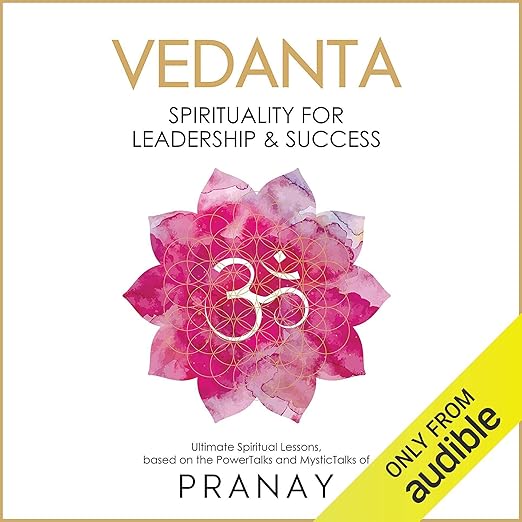
Quick Take
- Narration: Nathan Dcosta delivers Pranay’s text with appropriate gravity, though the pacing occasionally leans too deliberate for listeners accustomed to more conversational spiritual audiobooks.
- Themes: Non-dual philosophy applied to modern leadership, the Vedic conception of consciousness, the intersection of ancient wisdom and contemporary management theory
- Mood: Contemplative and instructive, with applied urgency
- Verdict: A compact and accessible distillation of Vedantic philosophy for listeners with no Sanskrit background, though serious students of the tradition may find the synthesis too abbreviated.
I tend to approach introductory texts on deep philosophical traditions with cautious skepticism, particularly when those texts promise corporate applicability alongside ancient wisdom. The marketing intersection of Vedanta and leadership consultancy has produced a substantial body of work that often sacrifices the tradition’s depth in order to generate actionable takeaways. Pranay’s Vedanta surprised me by being more honest about this trade-off than most books in the space. The author acknowledges upfront that what he is offering is a distillation, not a complete transmission, and that framing earns him more credibility than a bolder claim would.
At three hours and thirty-four minutes, this is a genuinely short audiobook. For a tradition as complex and internally diverse as Vedanta, that brevity requires choices. Pranay focuses on the practical philosophical core: the nature of consciousness, the relationship between the individual self and a broader universal reality, and what the Upanishadic sages identified as the conditions for genuinely successful living. He draws the connection to Japanese Zen Buddhism and modern management theory deliberately, and while that connection can feel more asserted than demonstrated, it gives Western listeners a useful orientation point.
Our Take on Vedanta
Nathan Dcosta’s narration carries the material with a formal respect that is appropriate for the subject. He does not rush the philosophical passages, which is the right instinct: concepts like the relationship between the individual atman and Brahman need space to land, and a faster-paced delivery would flatten them into bullet points. Some listeners accustomed to more conversational nonfiction narration may find his pace slow, but for this content the gravity feels earned rather than affected.
One reviewer with clear familiarity with Swami Vivekananda’s work described the book as an inexhaustible source of wisdom, which is a response shaped by existing devotion to the tradition as much as by the book itself. A reader coming to Vedanta entirely fresh may have a more calibrated reaction. The book is a strong introduction precisely because it does not assume prior knowledge of Sanskrit, the Upanishads, or the various schools of Vedantic interpretation. Pranay writes for accessibility, and he achieves it.
Why Listen to Vedanta
The argument that Vedantic philosophy has genuine resonance with modern neuroscience and psychology is one of the most interesting threads in this book, and it is developed with more intellectual seriousness than the genre typically allows. The claim that the Vedic investigation of human consciousness anticipated certain findings in contemporary brain science is not a fringe position. It has serious philosophical and scientific proponents. Pranay does not overstate it, which makes the discussion more valuable than if he had promised more than the evidence supports.
The COVID-19 framing the book uses for crisis decision-making is dated now, but the underlying argument holds: Vedantic philosophy developed in circumstances of scarcity and uncertainty, and its central teachings are addressed precisely to the conditions of living with outcomes beyond personal control. That framework has obvious utility regardless of which specific crisis a given leader or individual happens to be navigating.
What to Watch For in Vedanta
The leadership and corporate applications Pranay draws out are the book’s most contestable sections. The movement from ancient Indian philosophical inquiry to modern management theory requires several conceptual bridges that the book builds quickly and without extensive support. Readers who approach management advice critically may find these transitions too smooth. The value of the book is greater in its philosophical content than in its practical prescriptions, and listeners who focus there will find more to work with.
The book is part of a series called Greatest Spiritual Wisdom, and it carries the hallmarks of that format: accessible, introductory, oriented toward a broad audience. Readers who want a more rigorous encounter with Vedanta will need to supplement with primary texts, particularly the Upanishads themselves, and secondary works by scholars such as Sarvepalli Radhakrishnan or Swami Vivekananda’s own lectures.
Who Should Listen to Vedanta
Best suited to listeners who have some curiosity about Indian philosophical traditions and no Sanskrit background, professionals interested in how ancient wisdom traditions intersect with contemporary questions of leadership and decision-making, and spiritual seekers looking for an organized introduction to a tradition they have encountered in fragments. Skip it if you are already well-versed in Vedanta, the Upanishads, or Advaita philosophy, as the material will feel too summary. Also skip it if you are skeptical of the corporate-wisdom genre and not inclined to be charitable about its trade-offs.
Frequently Asked Questions
Do I need any background in Hinduism or Sanskrit to follow this book?
No. Pranay writes explicitly for readers without prior knowledge of Sanskrit or Hindu philosophy. Key terms are introduced and explained in English, and the structure is designed for newcomers to the tradition.
How does Pranay connect Vedantic philosophy to modern neuroscience and management theory?
He draws parallels between Vedic concepts of consciousness and contemporary findings in neuroscience, and between the philosophical frameworks of the Upanishads and modern approaches to leadership under uncertainty. The connections are argued rather than proven, and readers should approach them as invitations to explore rather than established conclusions.
Is this book part of a series, and does it require listening to other volumes?
It is part of the Greatest Spiritual Wisdom series, but it is fully self-contained. No other volumes are required. It can be listened to independently as a standalone introduction to Vedanta.
Is three and a half hours enough to meaningfully engage with a tradition as complex as Vedanta?
It is enough to develop genuine familiarity with the tradition’s core concepts and to decide whether you want to go deeper. Pranay is explicit that he is offering a distillation rather than a complete account, and serious students of Vedanta will need to follow this book with primary and secondary texts.