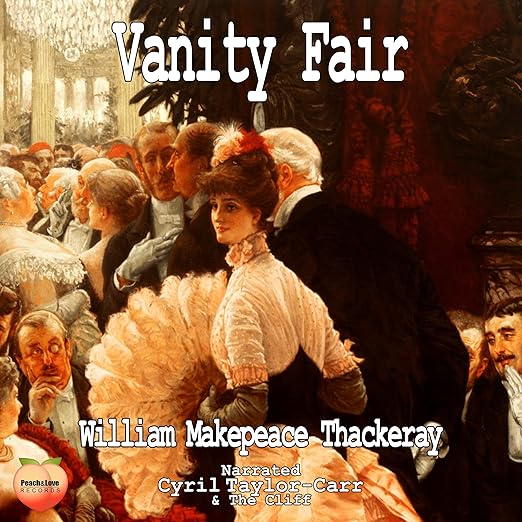
Quick Take
- Narration: Cyril Taylor-Carr brings a steady, period-appropriate voice to the material, clear and capable for such a long text, though the narration prioritizes clarity over dramatic performance.
- Themes: Social ambition and its costs, the hypocrisy of Victorian England’s moral theater, the different rules for men and women navigating the same world
- Mood: Satirically bright on the surface, genuinely bleak underneath, Thackeray never lets his comedy fully resolve into comfort
- Verdict: Essential Victorian literature with a more modern satirical sensibility than its 35-hour runtime might suggest, though the length demands genuine commitment.
I first read Vanity Fair in a literature seminar during my second year of university, and the thing I remember most clearly is arguing with a classmate about whether we were supposed to like Becky Sharp. We were not, my professor said. We were supposed to recognize her. That distinction has stayed with me through two subsequent rereads and now an audio version that I worked through during a particularly hectic week of commuting. Thackeray’s novel is 175 years old and it continues to feel uncomfortably current, which is either a tribute to its artistry or an indictment of the social structures it satirizes, probably both.
The premise is deceptively simple: two young women leave their boarding school and embark upon their lives. Amelia Sedley is good-hearted, well-connected, and entirely passive. Becky Sharp is calculating, talented, socially invisible, and absolutely determined. The novel follows them across the social landscape of Regency England during the Napoleonic Wars, watching what the world does to each of them and what they do to the world in return. Thackeray subtitled it A Novel Without a Hero, and he meant it seriously, there are no heroes in Vanity Fair, only people making the best of a world built to reward specific kinds of dishonesty.
What Becky Sharp Actually Is
The reviews for this particular edition focus on physical qualities, the Tillotson’s critical edition, the Four Corners Familiars printing, which tells you something about what the existing listener base looks like. Those print-focused reviews aren’t useful for evaluating the audiobook experience. What I can tell you is that Becky Sharp is one of the great achievements in English fiction, and one of the reasons she remains compelling in audio format is that Thackeray built her through action and dialogue rather than through internal revelation. We understand Becky from the outside in; she is always performing for someone, and the text never quite gives us unmediated access to whether there is a sincere self underneath the performance.
That question, whether Becky Sharp has an inner life, or whether she is entirely composed of social surface, is what makes her genuinely interesting rather than merely villainous. Thackeray doesn’t answer it. He presents her ambition and her occasional flashes of what might be genuine feeling and lets the reader decide. Amelia, her foil, is more transparent and in some ways more troubling, her passive goodness is as much a social performance as Becky’s active scheming, just a more socially approved one.
Thackeray’s Satire That Doesn’t Date
Thackeray is categorized as a Victorian satirist, but his targets in Vanity Fair are recognizable in ways that Victorian setting can obscure. The novel is about social climbing in a world where social mobility is technically possible but actually expensive and exhausting, requiring you to become someone you’re not while pretending to be someone you are. It’s about financial anxiety dressed as social confidence. It’s about the particular position of women who have enough intelligence to see exactly how the game works and not enough institutional power to win it on honest terms.
The comedy is sharp and consistent, Thackeray has a deadpan relationship with his characters’ self-delusions that produces a kind of sustained irony, but it never curdles into cruelty. Even the novel’s most ridiculous figures, like Jos Sedley with his elaborate vanity, are treated with fond contempt rather than pure mockery. Dobbin, the one genuinely decent male character, receives the treatment that genuine decency typically receives in Thackeray’s world: he is overlooked, undervalued, and made to wait.
Navigating Thirty-Five Hours of Thackeray
The honest assessment of this audiobook is that thirty-five hours is a serious commitment, and the novel’s pace reflects its original serial publication, it sprawls, it doubles back, it introduces characters who matter later after long absences. Cyril Taylor-Carr’s narration is clear and competent; he reads the prose without getting in the way of it, which for densely written Victorian fiction may be the most useful thing a narrator can do. He does not attempt dramatic distinctiveness between Becky’s voice and Amelia’s voice, which means the novel’s comedy of manners lands as literary comedy rather than theatrical comedy. Some listeners will prefer this; others will find it slightly flat across the runtime.
What I’d say is that Vanity Fair on audio rewards listeners who are willing to let the novel breathe, who don’t need the entertainment to be constantly kinetic, and who find pleasure in sustained irony and dense social observation rather than plot acceleration.
Who Should Listen / Who Should Skip
Vanity Fair is for listeners with a genuine appetite for Victorian fiction and the patience for a novel built on accumulation rather than momentum. It is one of the essential English novels, and it is sharper and funnier than its reputation as Serious Literature might suggest. Listeners coming for Thackeray’s satire and moral complexity will not be disappointed. Listeners who need audiobooks to be exciting at every turn should probably look elsewhere, this is a thirty-five-hour novel that earns its length, but it does not spend that length on narrative urgency.
Frequently Asked Questions
Are the existing reviews for this audiobook actually about the audio version, or are they about a print edition?
The visible reviews appear to be responding to specific print editions, one mentions the Tillotson’s critical edition and another mentions the Four Corners Familiars format. They are not evaluating the audiobook narration or listening experience, which limits their usefulness for prospective audio listeners.
At 35 hours, is Vanity Fair a practical audiobook for most listeners?
At 35 hours it’s a significant commitment equivalent to roughly a month of regular commute listening. The novel’s serial structure means it can be paused and resumed without losing too much thread, which makes it more manageable than a 35-hour narrative with tight plot momentum would be.
Is Becky Sharp a protagonist you’re meant to root for, and how does that ambiguity work in audio format?
Thackeray explicitly refuses to make Becky either a heroine or a simple villain. In audio, that ambiguity works because Becky is primarily defined through dialogue and action rather than interiority. You hear what she says and does without being given unmediated access to whether she feels anything about it.
Do you need knowledge of the Napoleonic Wars or Regency England to follow the plot?
Basic familiarity is helpful but not required. Thackeray explains context as needed, and the social dynamics are self-describing, you don’t need a history background to understand what it means to lose one’s fortune or to marry above one’s station.