Quick Take
- Narration: Mela Lee brings disciplined clarity to a dense, argument-driven history, her delivery is measured and confident, giving each woman’s story the weight it deserves.
- Themes: Black women’s political agency, voting rights history, the erasure and recovery of historical memory
- Mood: Authoritative and urgent, with accumulated moral weight
- Verdict: A rigorously researched history that recovers essential stories about American democracy, essential listening for anyone who takes the subject seriously.
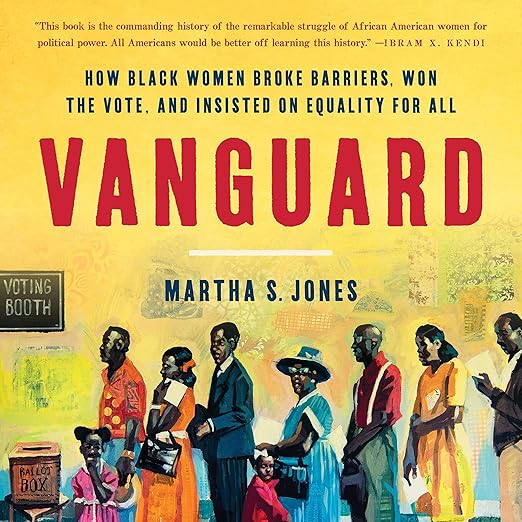
I spent a good part of one October evening finishing this one, and I kept thinking about the reviewer who wrote that history is written by the victor and that we need our own victors finding our history and sharing it with us. That framing captures something real about what Martha S. Jones is doing in Vanguard. This is not a corrective footnote to existing histories of American women’s suffrage. It is an argument that those histories have been fundamentally misdescribed, that Black women were not latecomers to the fight for the ballot but its vanguard, present and pushing from the earliest days of the republic.
Our Take on Vanguard
Jones won the Los Angeles Times Book Prize for History with this book, and the ambition that earned that recognition is evident throughout. She moves from the early nineteenth century through the passage of the 1965 Voting Rights Act and beyond, tracing a continuous tradition of Black women’s political thought and action that mainstream suffrage history has consistently sidelined. The figures she brings forward range from the relatively well-known, Fannie Lou Hamer, Sojourner Truth, Harriet Tubman, to women whose names have been almost entirely erased from popular history. Maria Stewart, Frances Ellen Watkins Harper: Jones restores them to their proper centrality.
What is particularly impressive is the way Jones handles the relationship between the suffrage movement and the Black women who were repeatedly betrayed by it. She documents not just the racism of white suffragists who were willing to sacrifice Black women’s enfranchisement for strategic advantage, but also the persistent determination of Black women who continued fighting for a democracy that kept failing them. The book does not offer this as a story of victimhood. It is a story of political agency exercised under extraordinary constraint.
Why Listen to Vanguard
Mela Lee’s narration is a strong match for the material. Jones writes with what the New York Times called an “elegant and expansive” style, and Lee’s delivery honors that, she brings the same measured authority to a nineteenth-century pamphleteer’s rhetoric as she does to Jones’s own analytical commentary. The academic weight of the argument never collapses into dry recitation; Lee keeps the human stakes in view throughout.
The audiobook format works particularly well here because Jones is synthesizing a lot of sources, letters, speeches, newspapers, legal records, and Lee handles the tonal shifts between quotation and analysis smoothly. At just over ten hours, this is a substantive commitment, but the pacing never drags. Jones moves efficiently between biography, legal history, and political theory without losing the narrative thread.
What to Watch For in Vanguard
This is a scholarly work first, and it moves with the rigor that implies. Listeners expecting biography will find the book treats individual lives as windows into larger political arguments rather than as stories complete in themselves. Each figure gets enough detail to feel real, but Jones is always interested in what the life reveals about the broader struggle rather than the personal drama for its own sake.
The book’s scope, from the early republic through the mid-twentieth century, means some periods and figures get more sustained attention than others. The chapters on Reconstruction and its dismantlement, and on Fannie Lou Hamer’s defiant testimony at the 1964 Democratic National Convention, are particularly strong. Readers who want deep biographical immersion in any single figure may find the breadth slightly frustrating.
Who Should Listen to Vanguard
Anyone with a serious interest in American political history, women’s history, or civil rights history should consider this essential. It substantially revises what you think you know about the suffrage movement and the people who drove it. As one reviewer put it, Vanguard fills in pages that were omitted from our history books, and that is exactly right.
The book is accessible to general readers with no prior academic background in the period, Jones is a skilled popular historian as well as a scholar, but it rewards listeners who are willing to engage with its arguments rather than treating it as background listening. This is a book that asks something of you, and gives a great deal back.
Frequently Asked Questions
Does Vanguard cover the full history of the women’s suffrage movement or focus specifically on Black women?
Jones focuses on African American women’s political lives specifically, but in doing so she substantially reframes the broader suffrage story. She addresses the 19th Amendment’s passage but also the ways it failed Black women, making the 1965 Voting Rights Act the more meaningful milestone for the women she writes about.
Is Mela Lee’s narration suitable for the academic density of Martha S. Jones’s writing?
Yes. Lee handles Jones’s blend of biography, legal history, and political analysis with consistent clarity. The narration doesn’t simplify the material but makes it accessible through measured, confident delivery that tracks the book’s own rhetorical rhythms.
Will this audiobook cover figures I’ve never heard of, or is it mainly about well-known civil rights leaders?
Both. Jones writes about figures like Fannie Lou Hamer and Harriet Tubman with fresh framing, but a significant part of the book is devoted to recovering women who have been largely erased from popular history, Maria Stewart, Frances Ellen Watkins Harper, and many others whose contributions shaped Black political life for generations.
How does Vanguard handle the relationship between Black women and white-led suffrage organizations?
Jones addresses this directly and without softening. She documents the racism within white-led suffrage organizations and the repeated willingness of white suffragists to sacrifice Black women’s voting rights for strategic political gain, while also showing how Black women responded to these betrayals with sustained, independent political organizing.