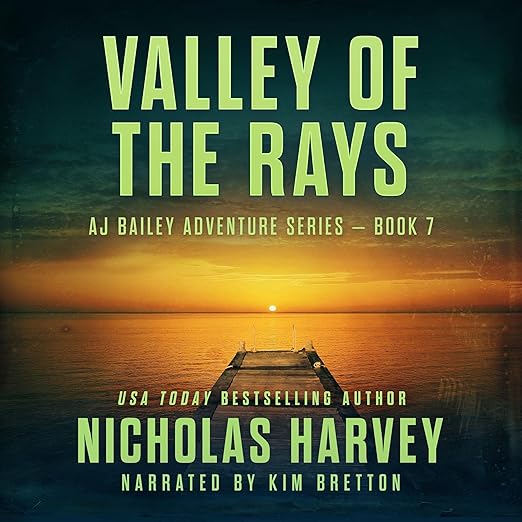
Quick Take
- Narration: The narrator brings an appropriate weight to material that sits at the intersection of spirituality and scientific inquiry, neither overselling the mystical nor flattening the emotional content.
- Themes: near-death experience and consciousness, scientific skepticism and its limits, personal transformation through extraordinary experience
- Mood: Contemplative and quietly awe-struck, with the measured quality of someone reporting faithfully from beyond their conceptual framework
- Verdict: A careful, intellectually honest account of NDE experiences that takes both the science and the phenomenology seriously without forcing a premature resolution.
I came to Valley of the Rays in a specific and somewhat unusual state of mind: I had just finished a dense book on the neuroscience of consciousness and was feeling the particular limits of the materialist framework that sometimes become more visible after extended immersion in its strongest arguments rather than less. The timing was probably as ideal as it could have been for this audiobook, which is organized around near-death experience accounts and their implications for how we understand consciousness, personal identity, and what we actually mean when we use the phrase ‘what happens after death.’ Whether you approach NDE literature as a committed materialist skeptic, a convinced believer in transcendent experience, or somewhere in the genuinely complicated middle, this audiobook is a more careful and intellectually honest treatment of the material than most entries in this crowded and often tendentious genre.
The book’s central preoccupation is with the phenomenological consistency of near-death experiences across different subjects, across different cultures and religious frameworks, and across different medical contexts and circumstances, and with what that documented consistency implies about the nature of consciousness and its relationship to the physical processes we can observe and measure. The author is careful throughout to present the scientific literature on NDE honestly and accurately, including the various explanatory frameworks that mainstream materialist neuroscience offers for the phenomenology of these experiences, without either dismissing the experiences as mere neurological artifacts or uncritically accepting the metaphysical conclusions that many NDE survivors draw from them. That intellectual balance is genuinely difficult to maintain in a field where most voices are committed strongly in one direction or the other, and its consistent presence here is the audiobook’s most valuable quality.
The Science and What It Can and Cannot Explain
The sections dealing with the scientific literature on near-death experience are the audiobook at its most careful, most valuable, and most likely to be genuinely useful to listeners across the full spectrum of prior belief. The author is clearly familiar with the major research programs in this area, including the cardiac arrest studies designed specifically to test whether veridical perceptions occur during clinical death, the cross-cultural consistency research, and the ongoing technical debates about whether current neuroscientific models can adequately account for the specific phenomenological features that NDE reports consistently include. The presentation is scientifically accurate, accessible to non-specialists without significant background in neuroscience or consciousness studies, and genuinely honest about the areas of uncertainty that remain unresolved in the research. The audiobook does not pretend that the science has definitively answered these questions, and that intellectual honesty is the stable foundation on which the more experiential material is built.
The Personal Accounts and What They Contribute
The individual NDE accounts included in the audiobook are selected and presented with evident care for the argument they are meant to support rather than for their dramatic intensity or their emotional impact as standalone stories. They are not chosen because they are the most spectacular or the most emotionally compelling accounts available in the literature. They are chosen for the specific features they illustrate within the broader argument about phenomenological consistency across radically different individuals and circumstances. The subjects’ descriptions of their experiences are reported with enough detail to give listeners a genuine sense of the texture and structure of these accounts without descending into the kind of sensationalism that undermines the material’s credibility with scientifically oriented listeners. The author’s care extends to honest presentation of the post-NDE difficulties that many survivors report, including adjustment challenges and relationship disruptions that uncritical mystical framing tends to omit.
Narration That Serves the Material’s Complexity
The subject matter places specific and unusual demands on the narrator: holding the tension between scientific rigor and genuine openness to the possibility that the experiences being described point toward something that current science cannot adequately explain, without collapsing either side of that tension into premature certainty. The narrator here manages this sustained balance with consistent skill across the full length of the audiobook. The delivery of the scientific content is clear and measured without becoming dry or mechanically academic. The delivery of the personal accounts carries appropriate emotional register without tipping into the reverential breathlessness that NDE content sometimes generates in narrators who are more invested in the transcendent interpretation than in intellectual honesty. The pacing is well-judged throughout, giving the more complex and counterintuitive material room to settle in the listener’s understanding while maintaining enough narrative momentum to prevent the contemplative sections from becoming tedious.
Who This Audiobook Is For and Who Should Look Elsewhere
Valley of the Rays is most valuable for listeners who find themselves genuinely uncertain about what the accumulating NDE research implies and who want a serious, honest engagement with both the scientific and experiential dimensions of the available evidence. It is not the right choice for committed materialists who want the neuroscientific framework validated against all challenges, or for committed believers who want the transcendent interpretation confirmed without the discomfort of serious scrutiny. What it offers both groups, and what makes it worth the investment of several hours of listening time, is intellectual honesty about the genuine and substantive difficulty of these questions and a careful, non-polemical presentation of the evidence that allows thoughtful listeners to form their own informed assessments. That combination of analytical rigor and genuine openness is what serious inquiry into these questions requires, and this audiobook delivers it more reliably than most alternatives in this space.
Frequently Asked Questions
Does the audiobook take a position on whether near-death experiences are evidence for an afterlife?
No, and that restraint is one of its strengths. The author presents the phenomenological evidence and the competing explanatory frameworks without forcing a metaphysical conclusion, which makes the treatment useful to listeners across the belief spectrum.
How accurate and current is the scientific literature cited in the audiobook?
The research references are well-selected and accurately presented. The author is familiar with the major NDE studies and presents the state of the field honestly, including genuine areas of scientific uncertainty.
Is this audiobook appropriate for someone who has had their own NDE or knows someone who has?
Yes. The careful, non-sensationalized treatment of the personal accounts and the honest discussion of post-NDE integration challenges makes it appropriate and potentially useful for those with direct experience.
How does this compare to other NDE audiobooks in terms of scientific rigor?
More rigorous than most. The field has a significant portion of content that is either dismissively skeptical or uncritically credulous. This audiobook occupies the less crowded middle ground of genuine intellectual engagement with the evidence.