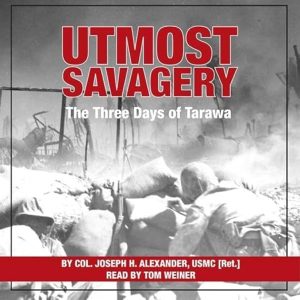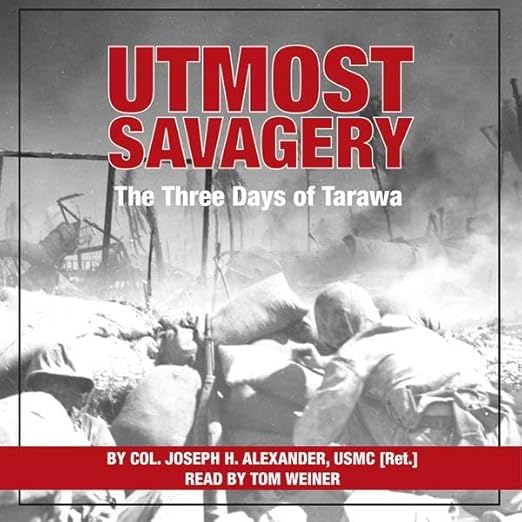
I grew up around military history. My grandfather served in the Pacific and rarely talked about it, and I spent years trying to understand through books what he could not bring himself to describe. Tarawa never came up in his stories, but I have read around it enough to know that it occupies a specific, grim place in the Marine Corps's institutional memory. When I finally sat down with Utmost Savagery, I did so on a long Sunday afternoon with the kind of attention this subject demands. Eight and a half hours later, I understood the battle in a way no previous account had given me.
Colonel Joseph Alexander is not a writer who sensationalizes. He is a retired Marine who served for twenty-eight years, and his approach to Tarawa reflects that background: meticulous, structured, and deeply respectful of the men whose experiences he is reconstructing. The result is a book that functions simultaneously as a tactical analysis and as something approaching testimony.
Alexander's central argument is that Tarawa was not simply a tragedy; it was also a necessary education. The amphibious assault doctrine that American forces were developing in late 1943 had never been tested against this kind of fortified opposition. On November 20, a third of the marines who crossed Tarawa's reef under fire were killed, wounded, or missing before the day was out. Four Medal of Honor recipients emerged from three days of combat. Six thousand combatants died in total. The numbers are almost impossible to absorb.
What sets this account apart is Alexander's use of sources that were unavailable to earlier historians. He draws on Colonel Shoup's personal papers, translations of the Japanese war history (the Senshi Sosho), and recently declassified ULTRA radio intercepts. These materials allow him to reconstruct not only what American commanders decided and why, but also what the Japanese defenders understood about their situation. The result is a genuinely three-dimensional account of a battle that is often told only from one side.
The sections on logistics and preparation are not the kind of material you expect to find gripping, but Alexander makes them so. His analysis of why the tides were misjudged, why certain landing craft got stuck on the reef, and how command communications broke down under fire explains the slaughter without reducing it to pure bad luck or incompetence. What happened at Tarawa was the result of doctrine that had not yet been stress-tested against the reality it would face. The lesson was absorbed, and subsequent amphibious operations were conducted differently because of it.
The Strengths
Tom Weiner's narration is a significant asset here. He brings a composed seriousness to the material that never tips into solemnity for its own sake. Military history is a genre where narrators can easily fall into either stiff recitation or theatrical over-emphasis, and Weiner avoids both. When Alexander quotes survivors directly, Weiner gives those passages the appropriate weight without performing grief. It is confident, controlled work.
The audio format suits this book well for a specific reason: Alexander's prose is dense with operational detail, unit designations, and chronological sequencing. Hearing it read aloud, rather than scanning the page, actually helps the mind follow the narrative thread without getting lost in the scaffolding. At eight hours and forty-two minutes, the runtime is substantial but never feels padded. Every section earns its place.
Weak Spots in Utmost Savagery
The most powerful material in this audiobook comes in the survivor accounts. Alexander incorporates first-person testimonies that describe the experience of crossing the reef under fire in a way that no tactical overview can replicate. One reviewer noted that the book makes you feel almost as though you are there, and that is exactly right, though the qualifier matters: you are glad you are not.
There is also a significant section devoted to what was learned from Tarawa, and this is where Alexander's military background is most evident. He is not interested in assigning blame; he is interested in understanding how doctrine evolves under pressure. For listeners drawn to military history for its lessons rather than its drama, this final analytical portion is the intellectual payoff of the entire book.
Recommended For
This is essential listening for anyone seriously interested in Pacific theater history, amphibious warfare, or the development of American military doctrine in the Second World War. It rewards military history readers who want depth and analysis rather than narrative simplification. Listeners looking for a lighter, more biographical approach to WWII storytelling may find the operational detail demanding. But for those willing to give it the attention it asks for, this is the kind of military history that makes you understand why the subject matters.
Key Details
- Narration: Tom Weiner delivers a serious, authoritative performance that serves the weight of the material without slipping into melodrama.
- Themes: Amphibious warfare doctrine, sacrifice and military command, the Pacific theater's brutal cost
- Mood: Tense and methodical, the kind of military history that treats its subject with real gravity.
- Verdict: Colonel Alexander's account of Tarawa remains the standard against which all other treatments of the battle should be measured, and Tom Weiner's narration makes it fully compelling on audio.
Does the book cover both the American and Japanese perspectives on the battle?
Yes. Alexander draws on Japanese war histories and ULTRA intercept translations to reconstruct the defenders' understanding of the battle, which makes this a more complete account than most treatments of Tarawa, which focus almost exclusively on the American experience.
Is this primarily a tactical study or more of a narrative history?
It is genuinely both. Alexander gives substantial attention to logistics, command decisions, and doctrine development, but he also incorporates survivor testimonies and personal accounts that keep the human cost at the center of the story.
What new sources did Alexander use that earlier accounts lacked?
He incorporated Colonel Shoup's personal papers, translations of the Senshi Sosho (the official Japanese war history), and declassified ULTRA radio intercepts, all of which provide significant additional context not available to historians working on Tarawa in earlier decades.
How does Tom Weiner's narration handle the more graphic combat descriptions?
Weiner maintains a steady, measured tone throughout. He does not soften the brutality of the material, but he also does not dramatize it for effect. The approach is respectful and serves the serious intent of Alexander's writing.