At a Glance
- Voice: Brian Greene narrating his own book is the only right choice here; his voice carries the intellectual urgency and personal wonder that a proxy reader could not replicate.
- Big ideas: entropy and cosmic time, the search for meaning, consciousness as emergent phenomenon
- Atmosphere: Expansive, contemplative, and occasionally overwhelming in the best sense
- Worth it?: A physicist's meditation on deep time and human meaning that earns its ambition through prose rigor and Greene's genuine grappling with questions that exceed physics alone.
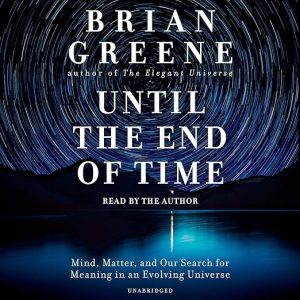
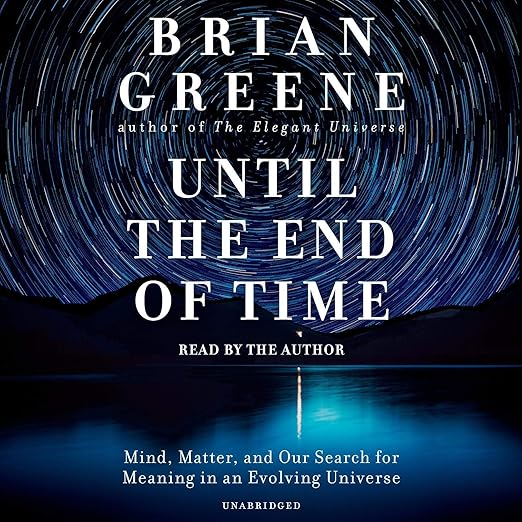
I finished Until the End of Time on a Sunday evening that had already gone quiet, the kind of late-autumn dark that makes you feel the weight of the long view. That may be the ideal listening context for a book that takes you from the big bang to the last possible event the universe will permit and asks, across all of that span, what your life means. Brian Greene narrates his own work, and the decision to do so matters more here than it would for most authors. This is a book about his personal reckoning with mortality and meaning as much as it is about cosmology, and the intimacy of hearing him work through it directly is part of what makes it land.
The framing device Greene uses is entropy: the second law of thermodynamics, the inexorable drift from order toward disorder, from structure toward uniformity. Everything that exists, from galaxies to human civilizations to individual lives, is a temporary eddy against that current. The question Greene pursues across fourteen chapters is why temporary eddies as complex and self-aware as human beings spend so much effort creating narrative, art, religion, science, and love, knowing the current runs only one way.
Is Until the End of Time Worth Your Time?
One reviewer, who identifies themselves as well into their senior years, calls this not a recreational read and describes it as an academic study that rewards patience but demands it. That is accurate. Greene writes with the precision of a physicist and the ambition of a philosopher, and the overlap between those registers produces something that is neither exactly popular science nor philosophy but a genuine hybrid. The New York Times quote praising Greene's mastery of both cosmological science and English prose is not marketing copy. It describes something real about the texture of this book.
Another reviewer describes Greene as brilliant but human, and offers the anecdote of the ten-year-old Greene blowing up his mother's kitchen for the love of a physics experiment. That kind of self-disclosure, woven through the book's more technically demanding passages, is what prevents Until the End of Time from feeling like a lecture. Greene is not performing wonder at the universe; he is actually wondering, and you can hear it in his voice.
The Best Parts of Until the End of Time
Greene narrating himself is the primary argument for the audiobook over the print edition. His phrasing of the entropy argument, his deliberate pacing through the cosmological scale sections where time is measured in units that dwarf human comprehension, and his genuine emotional engagement with the questions he is raising are all audible in his delivery. A professional narrator reading this text would produce a technically adequate audiobook. Greene reading it produces something closer to conversation.
At fourteen hours and thirty-six minutes, this is a serious investment. The book moves through particles, planets, stars, consciousness, creativity, religion, language, and the far future of a universe in which complexity itself eventually runs out of room. None of these sections is superficial. Greene gives each domain the space it needs to develop an argument, and the audiobook format rewards the kind of walking, driving, or lying-in-the-dark listening where you can let the scale of the ideas settle without distraction.
Before You Commit to Until the End of Time
The entropy framework, which Greene returns to throughout the book, is more than a physical concept. It becomes a way of asking why anything bothers. If all structures tend toward dissolution, why does complexity emerge at all? Why does the universe produce creatures capable of asking the question? Greene does not resolve this, nor does he pretend to. What he does is trace the emergence of meaning-making behavior, from religion to art to science, as a response to the human awareness of entropy's direction, and he treats each tradition as a genuine attempt to push back against the current rather than as a failed substitute for physics.
Should You Listen to Until the End of Time?
Readers who found Brian Greene's earlier books, The Elegant Universe or The Fabric of the Cosmos, engaging and want his most personal and philosophically ambitious work will find this the most complete expression of what he is trying to do. Listeners who enjoy science writing that does not bracket out the existential questions the science raises will also find it deeply rewarding. This is not for listeners wanting accessible science at a gentle pace or a clear resolution to the questions being posed. The payoff is not answers. It is the quality of the questions.
Before You Listen
Do I need a physics background to follow Until the End of Time?
No, but some prior exposure to cosmological concepts, entropy, the big bang, thermodynamics, will help the arguments land faster. Greene explains each concept he uses, but he does not do so slowly. Listeners who found popular physics books like A Brief History of Time or The Elegant Universe accessible will be well prepared for this one.
How does Brian Greene's self-narration compare to a professional audiobook narrator for this material?
The consensus among listeners who address this question is that Greene narrating himself is the right choice. The book is partly autobiographical in its intellectual framing, and his voice carries an urgency and personal investment that a proxy narrator could not replicate. He occasionally rushes through technical passages, but the authenticity outweighs that.
Is this primarily a physics book or a philosophy book?
It is genuinely both, and that hybridity is its defining characteristic. Greene uses physics as the foundation but moves into philosophy, religion, art, and cultural history throughout. The final third of the book is more philosophical than scientific. Readers expecting a strict science communication book may be surprised by how far Greene ranges.
Does the book take a position on whether life has meaning given its conclusions about entropy and the eventual end of all structure?
Greene does not offer a resolution in the conventional sense. He explores how human beings have constructed meaning across different traditions and argues that the search itself is a distinctly human response to awareness of mortality and cosmic time. The book ends in a place of engaged uncertainty rather than conclusion.