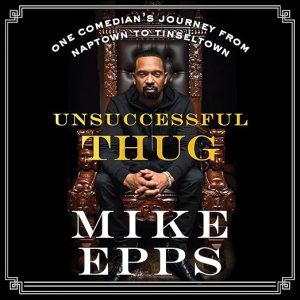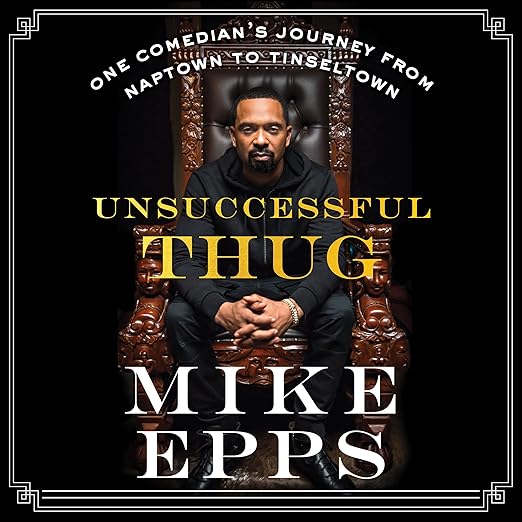
I finished Unsuccessful Thug on a long drive home from a family visit, which felt appropriate. Mike Epps's memoir is fundamentally a book about family: the family you grow up in, the family you almost destroy by making terrible decisions, and the chosen family of fellow comedians who pull you toward something better than what the street was offering. I laughed out loud more than once at seventy miles per hour, which is either an endorsement or a safety warning depending on your perspective on distracted driving.
JD Jackson narrates, and it is worth saying immediately that this casting works very well. Jackson is a veteran of the audiobook world with a catalog that spans genres, and he brings to Epps's stories the quality that matters most in a comedy memoir: the sense that the narrator finds the absurdity genuinely funny rather than performing amusement for the audience's benefit. When he recounts the story of a young Mike Epps having to call the police on himself after a dog trapped him inside a house he was burglarizing, the timing is perfect. The pause before the punchline lands exactly right, every time.
What Mike Epps Delivers
Epps grew up in Indianapolis, which he and its residents call Naptown, and the book is at its most specific and alive when it stays rooted in that geography. The Indianapolis he describes is not the city of the Indy 500 or the Pacers: it is a neighborhood where the pull of the street was not a romanticized abstraction but a literal daily gravity, and where the people who did not escape it mostly did not do so by choice. Epps is honest about the fact that his own escape was partly luck, partly talent, and partly the persistent refusal of people who loved him to let him fully disappear into the life he kept gravitating toward.
His mother figures prominently in the book, as does his brother Chaney, who is described as constitutionally incapable of the behavior his younger sibling found so easy to slide into. One reviewer called the family dynamic a beautiful thing, and that tracks. Epps does not sentimentalize these relationships, but he does not minimize them either. The love is real, and the guilt about what he put those people through is also real and treated with the seriousness it deserves rather than smoothed over in favor of the comedy.
What Mike Epps Gets Right
The memoir's structural argument is simple but earned: comedy was the path out because crime was not working, and crime was not working not only because it was wrong but because Epps was genuinely bad at it. The self-deprecation here is not false modesty. He was caught, arrested, and jailed multiple times. He recounts these episodes with the confidence of someone who has since built a career out of transforming humiliation into material, but the humiliation itself is not minimized or played purely for laughs. He was not a romantic outlaw. He was, as the title says, unsuccessful, and that specific kind of failure turned out to be the beginning of something better.
From Def Comedy Jam and Showtime at the Apollo to sold-out arena tours and the Richard Pryor biopic, the trajectory Epps describes is one of genuine improbability. One reviewer framed it as an underdog born into a situation where the odds were stacked against him. That framing is accurate and also insufficient, because what Epps adds to it is the texture of what those odds actually felt like from the inside: boring, scary, embarrassing, and eventually transformative in ways he could not have predicted while he was living through them.
Where Mike Epps Loses Some Ground
One of the more perceptive reviewers noted that even after achieving significant fame, Epps struggles with accepting it, and that a low self-esteem visible from childhood continues to haunt the narrative long after the career milestones accumulate. This is the kind of observation that separates a genuinely useful memoir from a superficial one: the success story is real, but the person telling it has not simply been healed by the achievement or the money or the recognition. Comedy saved Epps's life in a practical sense, but the internal work of becoming a person at peace with that life is a different and slower story, and he is honest enough to acknowledge that the second story is still in progress at the time of writing.
At nearly six hours, the runtime gives Jackson room to find the rhythm of Epps's voice and stay comfortably in it across the full arc of the story. The conversational style that one reviewer singled out as a strength is well served by the audio format; this is a book that benefits from being heard rather than read silently. The digressive, anecdote-driven structure, which reflects the native form of stand-up comedy, works better when spoken than when encountered on a page where the wandering is more visible and less charming.
Who Should Pick Up Unsuccessful Thug
Listen if: You enjoy comedy memoirs that do not clean up the protagonist's history for palatability, you are a fan of Epps's stand-up or films and want to understand where that sensibility came from, or you want a memoir that addresses race and ambition in America without adopting the earnest tone of a think piece.
Skip if: You prefer memoirs with tight chronological structure and minimal digression. The mature content is not incidental; this is an honest account, not a sanitized one, and younger listeners should be aware of that before starting.
Before You Press Play
- Narration: JD Jackson brings professional warmth and comedic timing; he captures the voice of someone looking back at their own mess with affectionate disbelief.
- Themes: Race and upward mobility, comedy as survival mechanism, the gap between the street and the stage
- Mood: Hilarious and unexpectedly tender, occasionally genuinely sobering
- Verdict: A memoir that earns its laughs by being honest about the real cost of getting to the punchline.
Does JD Jackson's narration capture Mike Epps's comedic voice, or does it feel like a translation?
Jackson finds the rhythms of Epps's humor without attempting to impersonate him. The result feels like a skilled interpreter rather than a copy, and the comedy lands consistently throughout the nearly six-hour runtime.
How honest is this memoir about Epps's drug use and legal trouble?
Very honest. Epps does not smooth over the arrests, jail time, or the ways his addiction affected his career and relationships. One reviewer specifically noted his candor about struggling with self-esteem even after achieving considerable fame.
Is Unsuccessful Thug appropriate for younger listeners who are fans of Mike Epps?
No. The memoir contains explicit language, adult situations, and candid descriptions of drug use and its consequences. It is written for and suited to an adult audience.
Is Unsuccessful Thug available as a free audiobook on Audible?
It is listed at $0.00 for eligible Audible members and through Audible Plus. Check the current listing to confirm availability under your membership tier, or start a free audiobook trial if you have not yet used one.