Quick Take
- Narration: Ehrlich reads her own work, and her voice carries the weight and texture of the landscapes she describes, unhurried, observational, occasionally raw in the passages about climate grief.
- Themes: Climate crisis and ecological grief, solitude and belonging, the body as a record of place
- Mood: Meditative and expansive, with a quiet current of urgency beneath the lyric surface
- Verdict: A sustained meditation on what is being lost, essential listening for readers drawn to literary nature writing and the kind of memoir that thinks as it remembers.
I started Unsolaced on a long train journey through mountain country, which felt like the right frame for it. Gretel Ehrlich writes about landscapes the way very few people can, not as backdrop but as active presence, as something that acts on the body and reshapes the mind. By the time I was an hour into this recording, I had already missed my stop, which is either a review in itself or a confession, depending on how you read it.
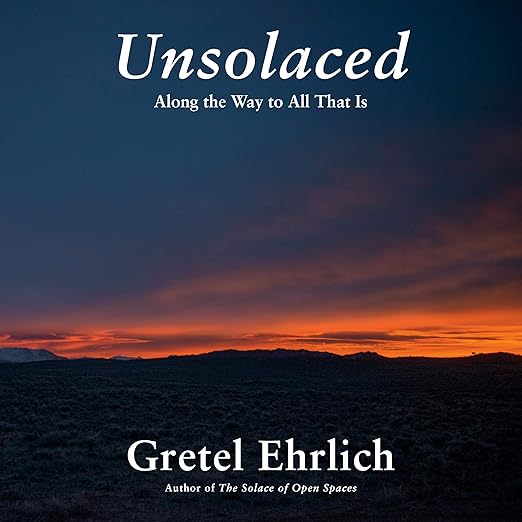
Unsolaced was published in 2021, a sequel of sorts in spirit to Ehrlich’s beloved 1985 debut The Solace of Open Spaces, which documented her years working as a ranch hand in Wyoming after the death of a close friend. That book made her reputation. This one, written nearly four decades later, is both a return and a reckoning. Ehrlich is older now, the Wyoming landscape has changed, and the world beyond it has changed more drastically than most of her generation expected to see in a lifetime. The organizing pressure of this collection of memories and narratives is climate: what is happening to the ice, to the species, to the systems that made the places she loves legible to her.
Our Take on Unsolaced
What distinguishes Ehrlich from other writers working the territory of nature and climate is that she never lectures and she never simplifies. A reviewer compared her to a blend of Thoreau, Emerson, and Hemingway, which is extravagant but not entirely wrong, she has Thoreau’s attention, Emerson’s philosophical reach, and something of Hemingway’s compression when she describes physical experience. The passages about Greenland, where she has returned multiple times over decades to document the retreating ice, are among the best pieces of climate writing I have encountered in any form. They work because she is not arguing; she is witnessing.
The episodic structure, moving between Wyoming, Greenland, Africa, Kosovo, Japan, and an uninhabited Alaskan island, could feel scattered. In practice it doesn’t, because Ehrlich’s sensibility is the connective tissue. Every location is filtered through the same quality of attention, the way water moves, the way animals respond to human presence, the way particular kinds of light alter the experience of being in a body in a specific place. One reviewer described it as an episodic biography, which captures the form well without quite capturing the ambition.
Why Listen to Unsolaced
Ehrlich reading her own work is one of the better authorial performances I’ve encountered in a while. There is a specific risk with author-narrated books, especially literary ones: the author knows exactly what they meant by every sentence, and that knowledge can make the narration feel private in the wrong way, as if the listener is overhearing something rather than being addressed. Ehrlich avoids this. Her pacing is measured without being slow, and she has the quality that the best nature writers share on the page, an ability to be precise about sensory experience without being clinical. The eight-and-a-half-hour runtime gives the material room to breathe.
One reviewer recommended reading The Solace of Open Spaces first, which is fair as context, but Unsolaced functions on its own. The references to earlier Wyoming years are handled clearly enough that the earlier book is not required reading.
What to Watch For in Unsolaced
This is not a book with a conventional narrative drive. The movement between locations and time periods is associative rather than chronological, and listeners looking for the through-line of a memoir that builds toward revelation will find the experience more diffuse than they expect. The climate material, while never didactic, is also genuinely distressing in places, Ehrlich does not soften what she has seen in Greenland, and the weight of that accumulates across the listening experience. A reader who noted it was not her best but still very good was likely responding to exactly this looseness of structure. I think they are not wrong about the structure; I also think what it costs in momentum it gains in texture.
Who Should Listen to Unsolaced
Essential for readers already devoted to Ehrlich, and an excellent introduction for those who come to her through The Solace of Open Spaces or through curiosity about literary climate writing more broadly. Also recommended for listeners who connect with writers like Barry Lopez, Terry Tempest Williams, or Robert Macfarlane, the same quality of sustained attention to the nonhuman world is present here. Skip it if you need narrative momentum or a single sustained story arc; the pleasure here is in the prose itself, and it rewards patience rather than urgency.
Frequently Asked Questions
Does Unsolaced require reading The Solace of Open Spaces first?
Not strictly, though reading Ehrlich’s 1985 debut provides useful context for her Wyoming years and the emotional baseline from which Unsolaced departs. Several reviewers recommend reading it first. Unsolaced works independently, but the resonance is richer if you know the earlier book.
How does Ehrlich’s climate material sit alongside the memoir sections, is it advocacy writing or something more literary?
It is literary rather than advocacy. Ehrlich is a witness rather than an arguer, and the climate material works through description and accumulation rather than through argument or calls to action. It is affecting precisely because it does not try to persuade, it simply shows what she has seen.
Is Gretel Ehrlich’s self-narration consistent throughout the eight-plus hours, or does it feel uneven?
Her narration is remarkably consistent, unhurried and precise throughout. Author-narrated books sometimes flag in the technical sections, but Ehrlich’s voice suits both the reflective passages and the more physically descriptive ones equally well.
Is this collection organized chronologically, or is the structure more thematic?
The structure is associative rather than strictly chronological. Ehrlich moves between time periods and locations according to emotional and thematic logic rather than a straight timeline, which suits the meditative tone but may feel loose to listeners expecting conventional memoir structure.