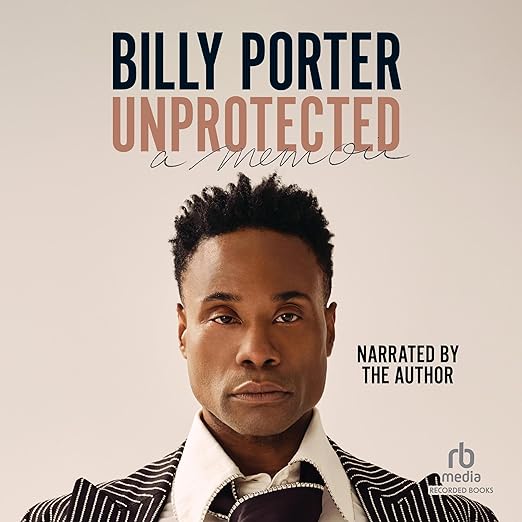
Key Details
- Narration: Billy Porter's self-narration gives raw, personal material an intimacy no hired performer could fully replicate.
- Themes: race and sexuality, childhood trauma and resilience, creative ambition
- Mood: Unflinching and ultimately hopeful
- Verdict: A genuinely brave, unguarded memoir best approached when listeners are ready for its hardest chapters.
Billy Porter, Standing Right in Front of You
How does a five-year-old sent to therapy for effeminacy grow into an Emmy, Grammy, and Tony winner without editing the hardest chapters out of the story he eventually tells? Billy Porter answers that question himself in Unprotected, an autobiography he narrates in his own voice, and the audiobook's opening line sets the tone for everything that follows: this is not a coming-out story, and it is not a down-low story either, because Porter states plainly he never could have passed for straight even if he had wanted to. What follows is an account of growing up Black and gay in Pittsburgh decades before Pose or Kinky Boots made him a household name.
Before the awards, Porter describes a childhood shaped by attempts to correct who he was: sent to therapy at five years old to address his effeminacy, bullied relentlessly at school, criticized at his own church, and, in the book's most difficult material, sexually abused by his stepfather. This is genuinely hard content, delivered without the protective distance a ghostwriter or third-party narrator might have provided, and that directness is precisely what reviewers respond to most strongly across all three available reviews.
Self-narration is not a neutral choice for a memoir this personal, and here it functions as the book's central argument. Porter has spent a career commanding stages and red carpets with deliberate, controlled presence, and that same trained vocal command turns out to serve raw, unguarded material just as effectively as it serves performance. One reviewer describes the experience as feeling like Billy is standing right in front of you telling his own story, an intimacy a hired narrator, however skilled, could not fully replicate for material this specifically personal.
The title itself functions as a thesis statement worth sitting with: Unprotected describes both the literal childhood vulnerability Porter survived, therapy, bullying, abuse, unshielded by the adults meant to guard him, and his adult choice to remain emotionally unprotected in telling the story, refusing the armor of a more curated celebrity memoir. That double meaning threads through the entire audiobook, and Porter's narration keeps both senses of the word audible without ever spelling out the connection too explicitly for listeners to make themselves.
Sad, Entertaining, Uplifting, and Ire-Invoking at Once
Reviewers consistently describe an emotional range across the audiobook that spans sadness, anger, entertainment, and genuine uplift, sometimes within a single chapter, and credit the stream-of-consciousness quality of Porter's delivery for making that range feel earned rather than manipulative. One listener specifically calls the book sad, entertaining, uplifting, and ire-invoking all at once, a combination that is difficult to achieve in print alone and depends heavily here on Porter's own vocal control over tone and pacing across twelve-plus hours of continuous first-person narration.
Beyond the personal narrative, listeners get a genuine account of how talent and determination opened doors that stayed only partly open, Porter's own framing, before his eventual, hard-won success in Kinky Boots and Pose. That structure, real struggle followed by real but incomplete acceptance followed by eventual triumph, avoids the tidiness of a simple redemption arc, and reviewers specifically credit the book's intelligence and honesty over any impulse toward a cleaner, more marketable version of his own story.
Originating the Role of Lola in Kinky Boots
Porter's writing sits within a longer American literary tradition of Black queer memoir and essay, work that insists race and sexuality cannot be understood as separate experiences stacked on top of each other, a lineage stretching back through writers like James Baldwin. Unprotected does not position itself as academic or explicitly literary in that tradition, but the underlying insistence, that his Blackness and his queerness were never separable in how the world treated him, connects the book to that broader conversation even as it tells a specifically contemporary, specifically theatrical-world story.
Listeners drawn to theater and Broadway history specifically will also find real value in the granular detail Porter gives about originating the role of Lola in Kinky Boots, the kind of specific, hard-won craft detail a more compressed, career-highlights-only memoir would likely have skipped entirely.
A 4.8 Rating Built From Just Two Reviews
This book contains sustained, serious content around childhood sexual abuse, conversion-therapy-adjacent treatment, and religious rejection, and listeners should go in prepared for material that is genuinely difficult rather than softened for a broad audience. Porter does not sensationalize these chapters, by all reviewer accounts he treats them with the same directness as the rest of the book, but the content itself demands real emotional readiness before starting, particularly for listeners with related personal history of their own.
At just over twelve hours, the runtime is a reasonable length for a single, complete memoir rather than a sprawling multi-decade account, though the emotional density means it may not suit background or distracted listening. The rating, a strong 4.8, comes from only two reviews at time of writing, a small sample, though both are highly specific and consistent with the book's broader critical and public reception since its release.
Structurally, the book resists the tidy trauma-to-triumph arc that many celebrity misery memoirs default to, where hardship functions mainly as a springboard to an inevitable success story. Reviewers specifically credit Porter for not rushing past the difficult material to reach the more marketable Broadway and television chapters, which means listeners hoping for a faster pace toward the recognizable career highlights should recalibrate: this is a book more interested in dwelling honestly in difficulty than racing toward a satisfying resolution.
He Refuses to Protect His Own Listeners
LGBTQ+ listeners, particularly Black queer listeners looking for a memoir that treats race and sexuality as genuinely intertwined rather than addressing them separately, are the clearest core audience, though Porter's honesty about trauma, resilience, and creative ambition gives the book real reach beyond that specific readership. Fans of Pose or Kinky Boots curious about the person behind those performances will find substantial context here for both, delivered in Porter's own words rather than secondhand profile pieces or press coverage.
Listeners specifically seeking a lighter celebrity memoir focused mainly on career highlights and industry anecdotes should know Unprotected spends real, sustained time in genuinely painful territory before reaching its more triumphant chapters. For anyone prepared for that honesty, though, this stands as one of the more unflinching self-narrated memoirs in the genre, precisely because Porter refuses to protect either himself or his listeners from the harder parts of his own story.
Does Billy Porter narrate the Unprotected audiobook himself?
Yes, Porter self-narrates his own memoir, and that firsthand delivery is central to why reviewers describe the experience as feeling like he is speaking directly to them.
Is the Unprotected audiobook mostly about Billy Porter's career in Pose and Kinky Boots?
No, the majority of the book covers his life before that success, with his eventual breakthroughs arriving only after extensive coverage of his formative years.