In Brief
- Performance: Mark Bramhall handles Annie Hartnett's polyphonic narrative - human, animal, and ghost voices included - with tonal flexibility that makes tragicomedy land rather than tip into parody.
- What it covers: Opioid crisis in small-town America, family expectation and personal failure, the persistence of community across death
- Feel: Darkly comic and surprisingly tender, operating somewhere between magical realism and literary fiction with a firm emotional anchor
- Our call: Unlikely Animals is the kind of novel where the strangest elements - the cemetery narrators, the hallucinating father, the fox - end up being the most emotionally truthful, and Bramhall's performance holds all of it together.
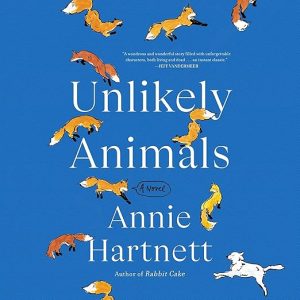
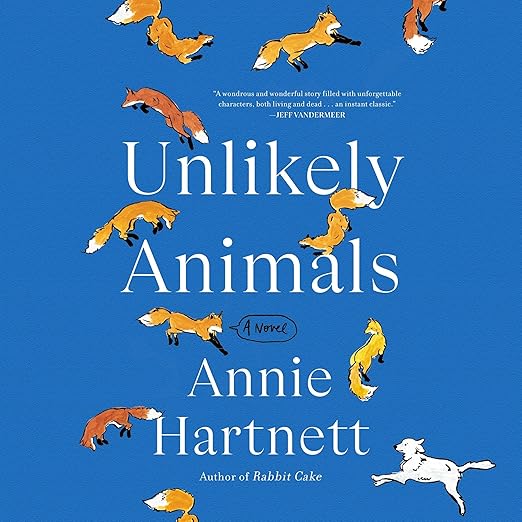
Unlikely Animals arrives in audio with a setup that sounds eccentric and proves to be something else entirely: Annie Hartnett's tragicomic novel about opioids, lost vocations, small-town grief, and a cemetery full of dead locals who watch over Everton, New Hampshire, with sardonic warmth. Mark Bramhall narrates this audiobook, and the casting is right. He has the range to move between Emma Starling's medical-school-dropout pragmatism, her father Clive's hallucination-inflected wisdom, and the cemetery chorus's collective deadpan, all without losing Hartnett's carefully balanced tragicomic tone across ten hours and forty-two minutes.
The Review
Emma Starling has failed at the thing she was supposed to be good at and returned home to the place she was supposed to have left behind. Her father Clive is dying from a mysterious brain disease that causes him to hallucinate small animals and hold conversations with the ghost of Ernest Harold Baynes - a late-nineteenth-century naturalist who was known, in real life, for letting wild animals live in his house. Her younger brother has recently completed a stint in rehab. Her mother's judgment is a constant ambient pressure. And her former best friend from high school is missing, with no one, including the police, bothering to look seriously for a young woman who has a history of drug use.
Hartnett's structural decision to narrate sections from the cemetery's perspective is either bold or unusual depending on your tolerance for novels that make their own narrative apparatus visible. The Good Housekeeping description of Unlikely Animals as heartfelt, touching, and delightfully quirky undersells what Hartnett is actually doing: using the cemetery chorus to give the opioid crisis material a context that extends beyond any single tragedy. The dead have seen this before. They have watched individual lives collapse and families absorb the loss. The perspective is not callous; it is patient in a way that living characters cannot afford to be.
What Makes Unlikely Animals Worth Hearing
Bramhall's narration manages a tonal challenge that would defeat less skilled performers. Unlikely Animals is genuinely funny and genuinely sad, sometimes in the same paragraph, and the comedy is not relief from the tragedy but a different angle on the same material. One reviewer describes the novel as handling tough topics like death and addiction in sensitive and affecting ways, noting that it takes a little time to assemble all the moving parts into a coherent whole - worth flagging, because Hartnett's novel builds its emotional picture gradually. Bramhall's pacing reflects this. He is not rushing toward the payoff but trusting the accumulation, which is the right call.
The comparison point is Hartnett's earlier novel Rabbit Cake, which established her reputation for fiction that holds the surreal and the achingly real in productive tension. Listeners who found Rabbit Cake rewarding will know exactly what Unlikely Animals is aiming for. Those new to Hartnett should know that the novel's quirks - the ghost naturalist, the small-animal hallucinations, the cemetery chorus - are not decoration but structural: they carry thematic weight that would otherwise require more explicit statement than Hartnett wants to make. At ten hours and forty-two minutes, the book has room to build its relationships and let its secondary characters, human and animal alike, become genuinely memorable.
The Caveats
The missing friend thread - Hartnett's version of the opioid crisis made personal - is handled with more care than the premise might suggest. Emma's friend has disappeared in a community that does not look hard for missing drug addicts; that institutional failure is part of the novel's argument, and it is made through character and event rather than polemic. Clive's conviction that the young woman might still be alive, and Emma's decision to believe him despite everything, generates the plot's momentum and also its moral claim: that the marginalized deserve the same attention as anyone else, regardless of official disinterest.
The fox that reviewers mention is a real character in the novel, and so is the dog. Hartnett's grounding in the figure of Ernest Harold Baynes - a genuine historical person - connects the more fantastical elements to specific historical reality. That grounding is what keeps Unlikely Animals from tipping into whimsy: the ghost, the hallucinations, the animal presences are all connected to real things Hartnett cares about, and the novel is considerably better for that discipline.
A brief practical note: ten hours and forty-two minutes is a substantial commitment, and the novel's emotional picture assembles slowly. Listeners who try to speed through Unlikely Animals to reach the payoff will miss the way the book actually works, which is through accumulation rather than revelation. The cemetery narrators, the animal characters, Emma's developing purpose - all of these are built through repetition and variation rather than dramatic turning points. The pacing rewards patience and discourages rushing, and Bramhall's performance is calibrated accordingly.
The Right Listener for Unlikely Animals
Readers who enjoy literary fiction that incorporates magical or surreal elements without abandoning emotional realism - fans of George Saunders's Lincoln in the Bardo, or Aimee Bender, or Maria Semple's Where'd You Go, Bernadette - will find Unlikely Animals operating in a compatible register. Those interested in fiction that addresses the opioid crisis without making it the story's entire moral universe will appreciate Hartnett's approach, which situates the crisis within a broader account of community, family, and what it takes to care about people who have been written off. Listeners who need narratives to resolve cleanly should know that Unlikely Animals embraces productive mess. Those willing to stay with it will find the novel earns the warmth reviewers describe in its final pages.
The Good Housekeeping Book Club selection designation is also worth noting for readers uncertain whether Unlikely Animals is for them. The Good Housekeeping audience tends toward emotionally satisfying fiction with literary ambition rather than genre convention, and the novel fits that taste precisely. The Washington Post and Book Riot both named it one of the best books of the year it was published, and the Joyce Carol Oates Prize longlisting reflects the literary fiction community's recognition of Hartnett's formal ambition alongside her emotional accessibility. Bramhall's performance meets the literary quality of the text, which is the minimum standard for an audiobook adaptation of this kind of novel.
A Few Questions About Unlikely Animals
Is this audiobook primarily a comedy or does it deal seriously with the opioid crisis?
Both, simultaneously and without irony. Hartnett uses dark comedy as a way of sustaining engagement with genuinely difficult material, including addiction, dying, and institutional indifference to missing persons. The humor is never at the expense of the serious content; it is the form in which the novel holds its grief. Listeners who find dark comedy and serious subject matter incompatible should be aware of the combination before starting.
Does the audiobook require familiarity with Annie Hartnett's previous novel Rabbit Cake?
No. Unlikely Animals is a standalone novel with different characters and a different setting. Readers who know Rabbit Cake will recognize Hartnett's tonal approach - the tragicomic register, the surreal elements grounded in specific reality - but the books are independent of each other and neither requires the other as background.
How does Mark Bramhall handle the multiple narrative perspectives in this audiobook, including the cemetery ghost chorus?
Bramhall differentiates the cemetery chorus's collective voice from the individual character voices through a subtle shift in register and pace - slightly more detached, slightly more ironic, without becoming comic-book deadpan. The transitions between perspectives are smooth enough that the structural experiment supports rather than disrupts immersion.