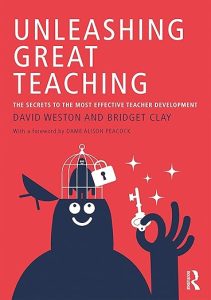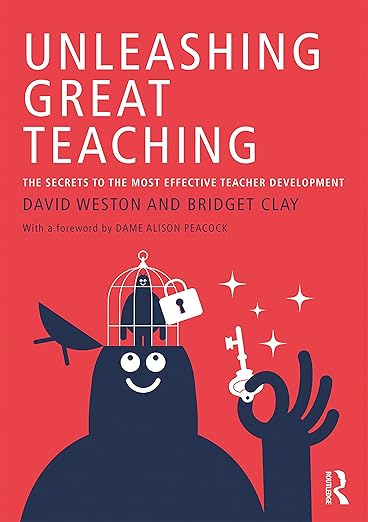
David Weston starts Unleashing Great Teaching from a frustrating observation: most professional development in schools doesn't work. The CPD that fills training days and twilight sessions, the guest speakers, the whole-staff presentations, the one-off workshops, leaves almost no lasting trace in classroom practice. Weston, founder of the Teacher Development Trust in the UK, has spent years documenting what does work instead, and this audiobook, narrated by Tom Lawrence, is his attempt to put that evidence into a form that school leaders can act on. At just under nine hours, the book covers the theoretical underpinnings of effective professional learning, the structural conditions schools need to create it, and the specific practices that reliably change teaching behavior.
Structural Conditions Schools Can Actually Change
The Teacher Development Trust distinction is worth taking seriously. Weston and his co-author are not academics synthesizing other people's research from a distance; the book draws on the TDT's direct work with schools across the UK, including the evaluation of hundreds of professional learning programs. That practitioner grounding gives the recommendations a specificity that much education leadership writing lacks. The book's central argument, that effective CPD requires sustained, collaborative, classroom-embedded practice rather than episodic training events, is not new, but Weston's account of what the conditions for that look like in actual school cultures is more granular than most treatments manage. Reviewer Kathryn Morgan captures the book's aspirational framing well: 'What if every school in this country operated in a climate where every teacher flourished,' which is exactly the opening question the book uses to orient its argument.
The structural analysis is the book's strongest section. Weston identifies the specific organizational features that determine whether professional learning takes root: how leadership allocates time, whether improvement is evaluated honestly, and whether collaboration is built into scheduling or left to individual goodwill. These are conditions that school leaders can actually change, and naming them concretely is more useful than vague calls for culture change. Reviewer B Gibbons notes that the book 'draws on a strong evidence base to skilfully weave theory, personal experience, case studies and checklists.' The last of those is perhaps most valuable for leaders who want to assess where their own school currently sits against a framework.
Lawrence's Calibrated Narration Suits Modular Re-Listening
Tom Lawrence's narration is appropriately calibrated for this material. Education leadership texts require a narrator who can make frameworks and checklists engaging without performing more enthusiasm than the prose warrants, and Lawrence manages that balance. The book's pacing at nearly nine hours is patient but not slow; Weston builds his argument across the runtime rather than repeating a single point in varied language, which means the investment is rewarded with genuine accumulation.
The audio format suits the book's chapter structure. The sections move logically from diagnosis of why most CPD fails, through a framework of what conditions are needed, to application of specific practices for leaders to implement. Those sections work as listening units that can be returned to in relevant professional contexts. A school leader redesigning their appraisal process might revisit the evaluation section; someone building a coaching program might return to the chapters on observation and feedback. That kind of modular re-engagement is easier in audio for practitioners who don't have extended reading time available.
Bad Evaluation Is Worse Than No Evaluation
The book's treatment of evaluation is particularly worth sustained attention. One of the consistent failures Weston identifies in school professional development is the absence of honest assessment of impact: schools deliver training and assume it worked, rather than asking whether teaching actually changed. His chapter on building evaluation practices into the professional learning cycle is both specific and counterintuitive in places; he argues that impact evaluation done poorly is worse than no evaluation at all, because it creates a false sense of evidence where none exists.
The chapter on external expertise is another section that rewards close listening. Weston makes a careful distinction between external input that enriches a school's own thinking and external providers who replace that thinking rather than supplementing it. The difference, in how programs are commissioned, how they're embedded, and whether teachers are active participants or passive recipients, is consequential, and the book gives school leaders tools to evaluate any proposed program against that distinction before committing resources.
Headteachers and CPD Leads Get the Most
School leaders responsible for professional development, including headteachers, deputy heads, CPD leads, and subject leaders with development responsibilities, are the book's primary audience. The specific guidance on structural conditions, evaluation, and the commissioning of external support is written for people with institutional authority to make the changes described. Reviewer Sunny, in the five-star review, calls it 'a brilliant book which unpicks the nuances in creating a positive impact of CPD in schools' and recommends it for anyone in SLT or leading CPD.
Teachers with no direct leadership responsibility for professional learning will still benefit from the book's diagnostic framework: it offers vocabulary for understanding why certain CPD feels pointless and what to advocate for. Listeners from outside the UK education system will find most of the book applicable, as the TDT's research draws on international evidence and the organizational conditions Weston describes are not UK-specific. Some structural examples reference UK inspection and accountability frameworks, but the underlying principles translate to most school systems. Educators working in higher education or corporate learning-and-development contexts will also find relevant material: the conditions Weston identifies as necessary for sustained professional learning, including protected time, honest evaluation, and collaborative practice, are not unique to K-12 schools, even if the book's framing is directed specifically at that setting.
Common Questions
Does the Unleashing Great Teaching audiobook apply to school systems outside the UK?
Largely yes. Weston draws on international research throughout, and the organizational conditions he identifies as necessary for effective professional learning are not UK-specific. Some case studies and accountability references are UK-framed, but the core diagnostic framework and practical guidance translate to most school systems.
How does Tom Lawrence's narration handle the book's use of checklists and frameworks in the audiobook format?
Competently, though print access will serve listeners who want to use those checklists as working documents. Lawrence reads framework sections clearly and with appropriate pacing, but the evaluative tools in the book are designed to be revisited and applied rather than listened to once. The audiobook is best treated as the theoretical and contextual layer, with physical access to checklists for application.
Does the audiobook explain why most school CPD fails, or does it mainly focus on what to do instead?
Both, with roughly equal weight. Weston opens with a diagnostic argument about why episodic, one-off professional development doesn't change classroom practice, then spends the majority of the book on specific structural conditions and practices that do work. The diagnostic section is important because it grounds the practical recommendations; understanding the failure modes makes the solutions more legible.