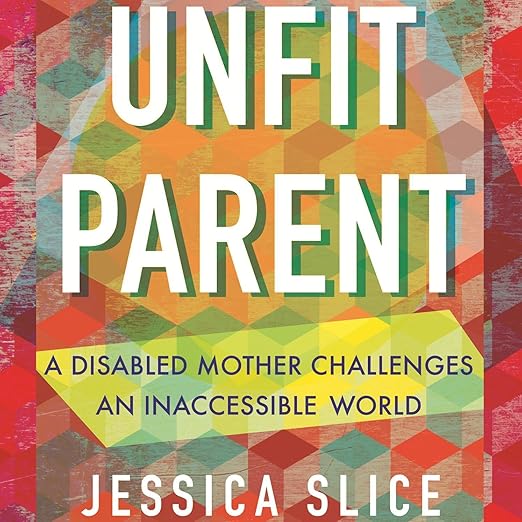
Jessica Slice opens Unfit Parent in the territory where disability, parenthood, and societal judgment intersect, and what the audiobook does from that opening is harder than it sounds: it builds an argument without becoming didactic, and it tells a story without becoming memoir at the expense of analysis. Finlay Stevenson's narration carries this dual structure over eight hours and twenty-five minutes with a steadiness that the material genuinely needs.
Petersen Calls It Beautiful and Razor-Sharp
Slice's central claim is that the assumption embedded in her title, that disabled people are "unfit" to parent, is both empirically wrong and culturally harmful, and that disability culture itself offers corrective wisdom for how all parents might approach the overwhelming uncertainty of raising children. This is an argument that requires evidence, nuance, and personal testimony working in combination, and Slice manages all three. She draws on interviews with disabled parents, research-backed evidence, and her own experience navigating a medical system that assumes disabled people are not reproductive candidates.
What Slice has produced, beyond the endorsements, is a genuinely paradigm-shifting examination of whose body and mind our society deems adequate for the work of parenthood. The specific barriers she documents, inaccessible baby equipment, reproductive care that assumes disabled bodies cannot reproduce, the threat of child protective services for parents whose disability is visible in public, are concrete and real. The book does not generalize from personal grievance; it maps a landscape with specificity and care. Ann Helen Petersen's blurb description of the book as "beautiful and razor-sharp" is not overstated.
Stevenson Delivers Challenges in Someone Else's Voice
Finlay Stevenson's narration is well-calibrated for this material. The book moves between personal testimony, interview passages, and analytical argument, and Stevenson handles the transitions without losing the thread. For a work that explicitly aims to invite readers to imagine what our world might look like if we met every family where they are, the narration maintains that invitation without closing into prescription. The emotional weight is present, several passages are genuinely affecting, but Stevenson does not push for emotional effect where the content has already earned it.
One reviewer described the experience of engaging with this book as having "deeply ingrained ideas I didn't know were buried being challenged," and that observation captures what Slice is doing structurally. The book is not primarily for disabled readers, though it will matter most immediately to them; it is also for nondisabled parents and people considering parenthood who have never been forced to examine what they assume about bodily adequacy and caregiving. In audio, those challenges arrive in someone else's voice, which creates a slightly different relationship to the discomfort than reading silently does. Stevenson delivers the challenges clearly.
Who Might Call Child Protective Services
The book covers a wide range of disability experiences, physical disabilities, chronic illness, cognitive differences, rather than focusing narrowly on one type. This breadth is a strength in terms of argument scope but occasionally means some areas receive less depth than listeners might want. Slice's own experience runs as one thread rather than the singular anchor, which reflects the book's research ambitions but may leave readers who came for memoir wanting more continuous personal narrative alongside the interviews and analysis.
The structural optimism of the book's final argument, that disability culture holds the key to transforming parenting for everyone, is genuinely argued rather than asserted, but it requires accepting the premise that what disabled parents have developed out of necessity represents wisdom rather than simply adaptation. Most readers will find this premise compelling by the time Slice arrives at it; a few will want more sustained engagement with the limits of that argument. The book is aware of those limits but moves through them with more confidence than it interrogates them.
Listeners coming from parenting nonfiction rather than disability studies may find the early chapters cover some territory they are not prepared for in terms of systemic analysis. The book does not assume prior familiarity with disability studies, but it does assume a willingness to encounter structural critique rather than only individual inspiration. That orientation is the book's strength and its defining characteristic.
Slice's use of specific questions throughout the text, such as how two disabled parents creatively keep their children safe, or what it means to be in public knowing someone might call child protective services simply because your disability is visible, gives the argument concrete stakes that abstract disability advocacy writing often lacks. These questions are not rhetorical; Slice answers them, with examples drawn from interviews and her own experience, in ways that are practical and grounded. The audiobook format delivers those specifics with an immediacy that the page format cannot quite match.
A Reason to Choose the Audiobook Over Print
This audiobook will matter most immediately to disabled people who are parents or considering parenthood, and for those listeners, Slice's combination of documentation, testimony, and analysis may feel like finding a book that should have existed for years. For nondisabled readers, the book functions as a substantive corrective to assumptions about parenthood and bodily adequacy that most people carry without examining. Parents interested in how their own parenting might benefit from disability culture's adaptive wisdom will find the final chapters particularly worthwhile. Finlay Stevenson's narration is a solid reason to choose the audiobook over the print edition for this particular work, the material benefits from being heard as well as read, and the performance honors both the argument and the testimony it rests on.
Questions Listeners Ask
Is Unfit Parent audiobook primarily a memoir or more of a research-backed nonfiction argument?
It is both, deliberately combined. Slice uses her personal experience as one thread alongside interviews with other disabled parents and research-backed evidence from disability studies. The balance is closer to reported nonfiction with a personal dimension than to straight memoir, she is building an argument, not just telling her story.
Is this audiobook primarily for disabled listeners, or does it have value for nondisabled readers too?
Both audiences are addressed, and several reviewers who are nondisabled described the book as profoundly affecting and genuinely challenging to their assumptions. Slice explicitly frames the book's argument as relevant to everyone who thinks about parenthood and bodily adequacy, not only to disabled readers. The specificity of the disabled parenting experience is the entry point, but the implications extend further.