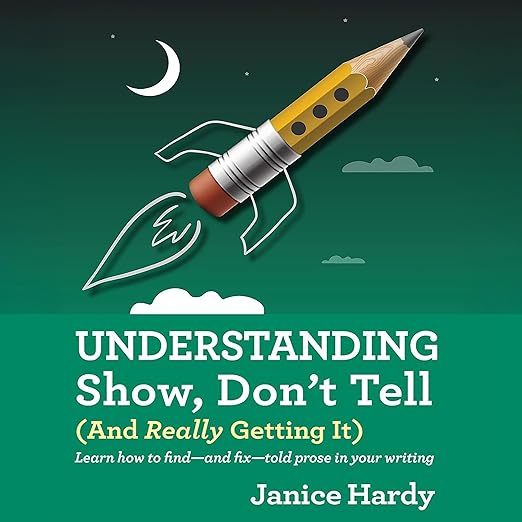
Told prose is the defect most writers can feel and almost none can name, which is why the advice attached to it fails so reliably. Janice Hardy built this audiobook around that failure rather than around the rule itself, and the change of approach is obvious within the first hour: instead of another list of forbidden verbs, the book asks what actually makes prose read as told, when telling is the correct choice, and why the standard fix so often makes a sentence worse.
Told, Feels Told, or Just Dense
Hardy founded the writing site Fiction University, and the teaching instinct behind this is visible throughout. The book separates three things most craft advice runs together: prose that is genuinely told, prose that merely feels told, and prose that is neither but sits next to infodumps, backstory or description dense enough to read the same way. Naming those categories separately is most of the value, because a writer who cannot tell them apart cannot fix any of them. Hardy is also unusually clear that some of what reads as told prose is a pacing problem wearing a disguise, which redirects the fix away from the sentence and toward the scene around it.
Every Telling Rule Breaks on Real Manuscripts
The structural argument underneath is that no single rule survives contact with an actual manuscript. Hardy spends real time on when telling is the right call, on how much telling a given book can carry, and on why the answer differs by genre and by point of view. That refusal to legislate is what earns the book its credibility with working writers rather than with beginners looking for a checklist. It also makes the book slower going than a rulebook, since every principle arrives attached to the conditions under which it stops applying.
Cat N's four-star notice puts a finger on exactly that. What earns Hardy the credit, in that account, is the insistence on a best judgment call driven by point of view and genre rather than by absolutes, and the notice adds that the flexibility buys credibility because writing is subjective. The same account is honest that an experienced writer will already know some of this, which is a fair warning about where the floor sits, and a useful corrective to publisher copy promising revelation.
Handysides Reads, and an Engineer Gets Credited
The production credit is unusually specific for a listing this small, and it comes from the description itself: Kim Handysides reads, Sam Platt handles audio engineering, and Echo Point Books and Media, an independent bookseller in Brattleboro, Vermont, produced and published it. Naming an engineer at all is a signal about how the publisher thinks about the recording, and it is more information than most craft titles put on the page.
Red-Flag Words You Can Recite at 2 AM
Compression suits the subject, and at three hours and fifty-one minutes the book fits inside a single working day without ever feeling hurried. A craft book that runs long tends to lose the thread of its own examples, and Hardy's method depends on holding a before-and-after pair in mind long enough to hear what changed between them. Tighter is genuinely better here, and the decision not to pad the argument with case studies is one of the reasons the material stays usable at drafting speed.
Tim Wilbur's five-star notice describes the practical payoff: Hardy "gives concrete, actionable information" and "a plethora of red flags to look for", useful whether you already feel confident about showing or you are still lost. That is the correct frame for the audio edition too, because red-flag words are the part of this book you can genuinely carry in your head afterward and apply while drafting. A list you can recite is worth more at two in the morning than an appendix you would have to go and find.
Holding Two Text Versions in Memory Alone
Numbers on this page fail a basic test. A 4.7 average is credited to one rating, and a single vote can only land on a whole star, so that figure cannot have come from the votes it claims. Underneath it sit five written reviews, which is more accounts than the counter admits exist, so the breakage runs in both directions at once. Neither number carries information, and the five written accounts are the only evidence on this listing worth your attention.
Three of those five predate the audio edition entirely. The recording was released in April 2025, and one notice from August 2020 plus two more from January 2024 all describe the text rather than the reading. Brandon Stephen, posting at five stars in 2020, is explicit about the mode, describing highlighting and note-taking while working through it, which is a description of a printed copy under a pen.
That points at the format's real cost. Chad S. White's five-star notice mentions the appendix listing all the common red-flag words that indicate telling, and adds that the book explains things well enough that you will not need to lean on it. Appendices and before-and-after text comparisons are visual by construction, and the description promises exactly that: examples showing clear before and after text. Listening means holding both versions in memory rather than seeing them stacked.
Writers Midway Through a Manuscript Benefit Most
Writers midway through a manuscript are the natural audience, and B. Kolbeck, at five stars, describes the effect precisely: reading it produced a list of places in a work in progress that mirrored the examples, and enough confidence to start cutting into them. A craft book that makes editing feel possible rather than punitive has done the only job that matters at that stage. Most books on this subject leave a writer newly aware of a problem and no better equipped to solve it, which is the opposite of useful.
Anyone handed the show-don't-tell note by an editor and unable to act on it is the other obvious buyer. The book's premise is that the note is usually correct and the standard remedies are usually wrong, which is a far more useful starting position than any rulebook offers, and it is aimed squarely at revision rather than at first drafts. Writers who freeze at the sentence level during a rewrite will find the diagnostic vocabulary here does more for them than another round of encouragement would.
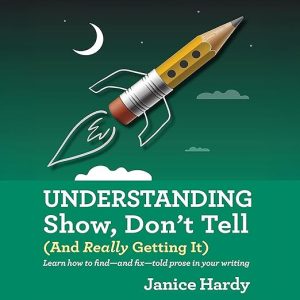
One kind of listener gets very little here: the writer who wants a rule to apply mechanically and stop thinking about. Hardy's whole argument is that the rule does not exist in that form. Anyone who works from marked-up text should also consider the print edition instead, because the appendix and the paired examples are built for the eye, and this listing does not even display the full title, which carries the parenthetical promise that you will really get it.
In Brief
- Performance: Kim Handysides reads, with Sam Platt credited for audio engineering, a level of production detail the description volunteers unprompted
- What it covers: Told prose diagnosis, when telling is correct, infodumps and backstory, revision over rules
- Feel: Practical, patient, workshop-adjacent
- Our call: The most useful book on this particular note that I know of, though its before-and-after examples pay a real tax in audio.
Does the Understanding Show, Don't Tell audiobook work without the printed examples?
Mostly, with one caveat. The method rests on paired before-and-after passages, and hearing both versions means holding the first in memory while the second plays. The red-flag word list survives the transfer intact, and it is the part you can carry into a drafting session without the book in front of you.
Is this audiobook aimed at beginners or experienced writers?
Both, at different depths. The floor sits higher than the marketing implies, so a writer who has already absorbed the basic advice will meet familiar ground early. The distinctive work is on when telling is correct and why standard fixes fail, which is a revision-stage concern rather than a first-draft one.
How long is it, and can you get through it quickly?
Under four hours, short enough for a single working day. The compression is deliberate and it helps: the argument depends on holding examples in mind across a few minutes rather than a few chapters, so a tighter book actually improves comprehension rather than costing you detail.
Why does the listing show a 4.7 rating from one rating?
It is a broken figure. A single vote can only be a whole number of stars, so 4.7 cannot have come from one rating, and the counter shows fewer votes than the five written accounts underneath it. The reviews themselves are trustworthy; the aggregate score on this page is not.