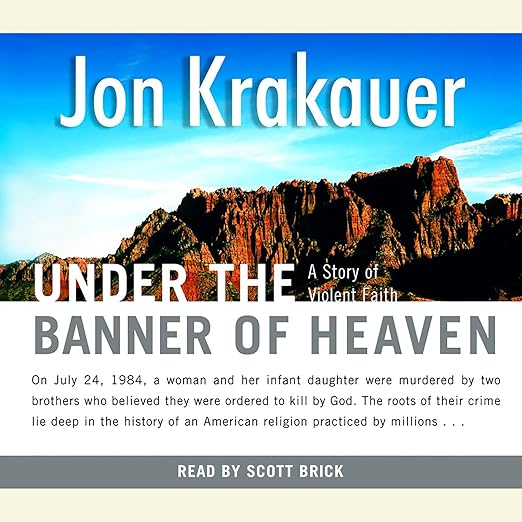
Under the Banner of Heaven earns its comparisons to In Cold Blood for reasons that have nothing to do with marketing copy. This audiobook asks its narrator to sustain rigorous historical research and a genuinely disturbing double murder across twelve hours and twenty-nine minutes without either side undercutting the other, and Jon Krakauer, the author of Into the Wild and Into Thin Air, built the book specifically to hold that tension.
The case at the center of the book involves brothers Ron and Dan Lafferty, who insisted they received a commandment from God to kill a woman and her baby daughter, both described in the synopsis as blameless. Krakauer starts there and works outward, building what the San Francisco Chronicle called a book "right up there with In Cold Blood and The Executioner's Song," tracing the murder back through a shadowy Mormon Fundamentalist offshoot and the broader history of polygamist communities still operating in defiance of both civil authorities and the mainstream Mormon establishment in Salt Lake City. The synopsis puts the number still practicing polygamy in these communities at roughly forty thousand people, a scale that turns what could have been a true crime curiosity into something closer to a study of an entire hidden social structure.
The book has also found a second life as an FX limited series streaming on Hulu, which likely explains why a title originally released in 2003 is drawing new listeners now. That renewed attention gives the source material a chance to make its own case again, separate from whatever creative choices the adaptation made. Random House Audio published this recording in December 2003, close to the print release, and the book has stayed in circulation as a National Bestseller long enough to outlast several waves of renewed interest in the case it documents.
How Much Religious Freedom Is Too Much?
Bryan Carey's review frames the book around a genuinely uncomfortable question: how much religious freedom is too much? Carey traces a line from the Lafferty murders back through history, noting that acts of religious violence, while less common today, have never fully disappeared, and treats Krakauer's case study as one entry point into that larger pattern rather than an isolated horror story. Bart's review goes further into the specific communities Krakauer documents, describing the Fundamentalist offshoots as a group that uses claimed "Revelations" to justify sexual assaults on minors and abuse of women, and credits Krakauer's writing style with making genuinely difficult material easy to follow rather than exhausting to read. Bart's review also flags a detail worth knowing going in: the book covers how difficult law enforcement found these communities to prosecute, and mentions one prosecutor who finally pushed back, though the excerpt available here stops short of explaining what came of it.
S. Thorkildsen's review adds useful context about how the book is built, noting that Krakauer goes back to the actual founding of the religion, through John Smith and Brigham Young, before working forward to the Lafferty case, which gives listeners the full history rather than dropping them into the crime cold. Thorkildsen had already read two memoirs on the same subject, Escape and Stolen Innocence, before coming to this book, and found that grounding useful for understanding how the religion adapted, or in some communities did not adapt, over time. That pattern, arriving at Krakauer's book after one of the first-person FLDS memoirs, shows up more than once among these five reviewers, suggesting the book functions almost as a companion piece to that wider shelf of survivor accounts rather than a fully standalone read.
Reviews Stay Silent on the Narration Itself
Ana Mardoll's review, titled "Fascinating book, but not without flaws," makes for an interesting case study in itself. Mardoll read this book the same weekend as Escape and Stolen Innocence and draws a clear contrast: where those two memoirs offer a woman's first-person view of how difficult escape from FLDS plural marriages actually is, Krakauer's book takes a more scholarly, wide-lens approach, "with brief zooms into individual lives." The visible excerpt of that review breaks off mid-thought, right after calling the result "a fascinating book but, on reflection," without finishing what the reflection actually concludes, so the specific flaws promised by the review's own title remain unstated here.
None of the five attached reviews comment directly on how the narration itself handles the shift between dense historical research and the violent specifics of the Lafferty case, which is worth noting for a book that asks one voice to carry both registers for over twelve hours. The star math on this listing is at least consistent: a displayed 4.4 out of five across ten rated reviews works out to a total of forty-four points out of a possible fifty, six points short of a perfect sweep, which lines up cleanly with what the visible written reviews suggest.
Into the Wild Readers Already Know This Approach
Readers of Krakauer's other investigative work, including Into the Wild and Into Thin Air, already know what to expect from that approach to dangerous, insular worlds, and this book applies the same method to a subject much closer to home than a mountain expedition. Anyone drawn to the FX and Hulu adaptation who wants the fuller research behind it will find fair value here, as will readers of true crime who want the crime grounded in decades of religious history rather than treated as an isolated tragedy.
This is not a book for anyone who wants true crime kept at arm's length from the specifics. The murder at the center of the story involves a woman and her infant daughter, and Krakauer does not soften that material to make it more comfortable listening.
Key Details
- Narration: Scott Brick reads across twelve and a half hours, and while none of the five attached reviews comment on the narration itself, the material demands sustaining both scholarly research and violent crime in one register.
- Themes: religious extremism and polygamy, investigative journalism, the history of Mormon Fundamentalist offshoots
- Mood: Sober and unflinching, built for sustained attention rather than casual listening
- Verdict: A rigorously researched true crime and religious history hybrid that earns its In Cold Blood comparisons, best suited to listeners ready for genuinely disturbing material.