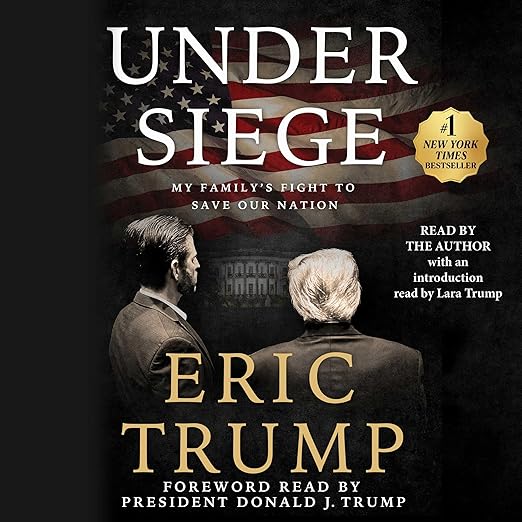
- Narrator: Eric Trump reads his own memoir, so the account and the voice defending it arrive on the same track for eight hours and nineteen minutes.
- Subjects: Family business, political grievance, legal warfare, inherited legacy
- Tone: Combative and unguarded
- Bottom line: Convincing if you already agree, and candid enough about that to be worth the hours either way.
Every written response to this memoir describes an object you can hold. One entry recommends it because "it is in larger print." Another calls the experience "a captivating, quick read." A third closes with a promise: "I will be reading it to my two small children soon." The audiobook runs eight hours and nineteen minutes in Eric Trump's own voice, and none of the five people who wrote in mentions hearing any of it.
A Badge of 4.8 Against a Counter of Two
Simon & Schuster Audio put this out on October 14, 2025, with the author at the microphone, and that choice carries more weight here than it would on most memoirs. Under Siege is a book about being talked about, and its central claim is that the talking was coordinated, sustained, and false. Letting the person making that claim deliver it himself strips out the last layer of mediation. Nobody stands between the grievance and the ear. Whether that reads as candor or as a closed loop depends on how much you already agree, but as a production decision it is at least consistent with the argument the book is making.
Jacket copy sets the scale before it says anything about content, opening on "INSTANT #1 NEW YORK TIMES BESTSELLER" and following it with a second bestseller line. What comes after is a career summary, not a plot. Earliest memories inside the family, pivotal roles in the 2016 and 2024 presidential elections, strategies built to combat lawfare, and the running of the Trump Organization, which the copy says he took over at thirty-three years old. The named set pieces are the raid on Mar-a-Lago, described as his childhood home, Russiagate, the court rooms, and the boardroom of The Celebrity Apprentice.
Dr. Jeffrey Horelick dates an entry to October 14, 2025, the release day itself, and lets slip that the book answered a public request: "On September 3, 2025, I posted on X, encouraging Eric to pen his memoirs." That review breaks off in mid-sentence, and it is not the only one here that does, so the conclusion it was building toward never arrives. What does arrive is a column of five responses, every one of them a five, sitting under a badge that reads 4.8 and a counter that reads two. The tally and the text disagree about how many people are in the room.
Self-Narration Is Closer to the Point Here
Eight hours and nineteen minutes is a workable length for a book of this kind, and the material suits the format. The description promises anecdote more than argument: real estate, the boardroom, the campaign trail, "the highs and lows of life in the Trump world." Stories told aloud by the person they happened to have an advantage over stories reconstructed by a hired reader, because delivery can carry emphasis that prose has to spell out. Self-narration is often a compromise struck to save money. On a memoir whose entire subject is how the author was portrayed by other people, it is closer to the point of the exercise.
Winston, EMANations, and Donna Partow are, without exception, the audience this was written for, and each describes an effect while leaving technique alone. The first writes about "true grit, determination, resilience, and warrior spirit." The second calls the experience "truly pleasurable and uplifting." Donna Partow frames the book as new information: "I had absolutely no idea the level of abuse heaped upon the Trump family in the aftermath of 2020." That is the sales pitch, made by a reader instead of a publicist, and it is the clearest available signal of what the eight hours actually deliver.
A second thing the recording offers is a settling of scores conducted at conversational volume rather than campaign volume. The publisher copy escalates hard, closing on the claim that "America itself was under siege," but the spine underneath that sentence is smaller and more concrete: an apprenticeship, a company, two elections, a family. Listeners who find the rhetoric wearing may still get value from the business passages, and from the account of navigating what the copy calls the dual worlds of politics and business since 2015.
Large Print Is a Property of Paper
Large print is a property of paper. B. B. Sizemore recommends the book on exactly that basis, writing, "It's an easy read because it is in larger print AND it is very interesting." Nothing in that sentence survives the move to a recording. The same goes for "quick read," and for the plan to read the book to two small children at bedtime. What sits under this listing is a print reception bolted onto an audio product: the column tells you a great deal about who liked this book and nothing whatsoever about how the eight hours sound.
Ratings here should be treated as decoration. A displayed 4.8 cannot be assembled from two whole-star votes under any rounding convention, and the five grades you can read are all fives, each of them sitting above the badge they are supposed to feed. Five written responses against a counter of two is not a rounding quibble, it is a broken tally, and the sensible move is to disregard the number and read the entries, short as two of them are.
Advocacy is the declared posture here, not a hidden one. The media, the Democrats, and the legal system are named as antagonists in the description before a single anecdote arrives, and the framing runs from "raids on his childhood home" all the way to "near assassination attempts." Anyone hoping for a memoir that examines the family instead of defending it has the wrong title, and no listening strategy will alter that. The book's clarity about its own purpose is the counterweight: it never once pretends to be an inquiry.
The Recording Over the Hardcover, Delivered by Him
Supporters of the family will get precisely what the description promises, delivered by the person it is about, which is the strongest argument for choosing the recording over the hardcover. Anyone curious about the Trump Organization as a business should also find something, since the material about running a multibillion-dollar company from the executive vice president's chair is more concrete than the political passages around it, and eight hours leaves room for both halves.
Skeptics should know what they are buying before they press play. The five people who wrote in are unanimous, the counter beneath them does not work, and the description was built to sell a position as much as a story. Anyone who wants to hear how this family answers the charges against it will find that answer here, in the voice of the man making it.
Frequently Asked Questions
Does Eric Trump narrate the Under Siege audiobook himself?
Yes. The narrator credit and the author credit carry the same name, so the eight hours and nineteen minutes arrive in the voice of the person the book is about. On a memoir built around how the author was portrayed by other people, that removes a layer of interpretation instead of adding one.
Why do the reviews for this audiobook talk about print size and bedtime reading?
Because the written responses attached to this listing were made about the physical book. One recommends it for its larger print, another calls it a quick read, and a third plans to read it to two small children. Not one of the five describes the recording, so the column cannot tell you how the narration lands.
Is the 4.8 badge on this audiobook trustworthy?
Not as arithmetic. The counter logs two votes while five written responses sit below it, and 4.8 cannot be produced by two whole-star votes under any rounding rule. Every grade you can actually read is a five, which puts all of them above the badge. Read the entries and ignore the figure.