Quick Take
- Narration: Jeff Gurner gives the intelligence and operational sections a controlled urgency that suits the material, his measured delivery preventing what could become breathless incident-reporting from losing credibility.
- Themes: Benghazi attack, intelligence failure and political accountability, the real cost of American presence in post-Gaddafi Libya
- Mood: Tense and investigative, written from inside the intelligence community’s perspective on events that became intensely politicized
- Verdict: A close-sourced account of the September 11, 2012 Benghazi attack that prioritizes operational truth over political point-scoring, with Gurner’s narration keeping the intelligence framework coherent through a complicated night.
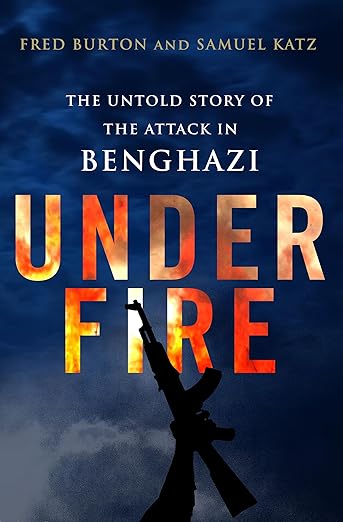
I remember September 11, 2012 primarily through the political noise that followed it in the United States, the congressional hearings, the competing narratives, the weaponization of specific talking points. What Fred Burton’s Under Fire attempts, drawing on confidential intelligence and diplomatic sources, is to clear some of that noise away and reconstruct what actually happened in Benghazi that night, hour by hour, inside the compound where four Americans died.
Burton comes to this material with substantial credentials. A former State Department counterterrorism official and deputy chief of the counterterrorism division, he has spent his career inside the institutional world he is writing about. Under Fire draws on confidential eyewitness sources within the intelligence, diplomatic, and military communities, which gives the account a level of operational specificity that purely journalistic reconstructions typically lack. The book is not neutral, because no first-person account from inside the American national security establishment can be neutral, but it is specific in ways that matter.
The Night of September 11, 2012, Hour by Hour
Burton reconstructs the attack on the US diplomatic and intelligence presence in Benghazi with methodical attention to timeline and decision-making that the political accounts of the event largely abandoned in favor of assigning blame. The key facts are established early: Ambassador Christopher Stevens, Information Officer Sean Smith, and CIA contractors Tyrone Woods and Glen Doherty died during a prolonged assault by heavily armed militants. The assault was not a spontaneous response to a video, as the initial official narrative claimed, and Burton’s sourcing makes clear that people inside the intelligence community understood this quickly.
The most valuable sections cover the operational response during the attack itself. Burton traces the decision chains that determined who requested help, who received or failed to receive those requests, and what resources were available and potentially deployable. The constraints he describes are specific and operational rather than politically convenient, which gives this account a different character than the versions that circulated in congressional testimony.
What the Intelligence Community Knew and When
Burton’s position as a former counterterrorism official is both a strength and a limitation. The strength is access: he can speak with sources who would not talk to a mainstream journalist, and those sources provide the operational texture that distinguishes Under Fire from most accounts of the same events. The limitation is that his analytical framework is shaped by institutional loyalties that are not neutral. His treatment of the intelligence community’s performance is more sympathetic than his treatment of the political apparatus above it, and readers should approach the account with that orientation in mind. This is an insider’s reconstruction, which is precisely what makes it valuable and precisely what makes it partial.
Jeff Gurner’s Narration
Gurner is a reliable narrator for nonfiction with an investigative edge. He gives the operational passages a measured urgency that conveys stakes without turning the account into a thriller. The intelligence community material, which requires the listener to track overlapping institutional responsibilities and command relationships, is navigated with clarity. At under ten hours, the runtime is compressed enough that the pacing rarely feels slow, and Gurner’s consistent delivery keeps the reader oriented through a complicated night without reducing it to simple chronology. His register throughout is that of a professional who understands that the material’s credibility depends on not overselling it.
Who Should Listen and Who Should Skip
Under Fire is best suited to listeners who want an intelligence-community-sourced reconstruction of the Benghazi attack that prioritizes operational specificity. Those who have already formed settled political views about what Benghazi represents in the broader American foreign policy debate will likely read confirmation or refutation depending on their priors, rather than engaging with the operational account on its own terms. Readers wanting full context for the Libyan situation following Gaddafi’s fall will benefit from supplementary reading; Burton focuses tightly on the attack itself. For those willing to engage with the material as intelligence history rather than as political evidence, this is a careful and credibly sourced account of a night that has been misused by almost everyone who has written about it since.
Frequently Asked Questions
Does Under Fire take a political position on the Benghazi controversy?
Burton’s background is in the intelligence community, and his framing is more sympathetic to that community’s performance than to the political actors above it. The book prioritizes operational specificity over explicit political argument, but listeners with strong political priors will find material to engage with.
How does this account differ from congressional investigations and journalistic accounts of Benghazi?
Burton’s sourcing from confidential eyewitnesses within the intelligence and diplomatic communities provides operational detail that public testimony and journalistic reconstruction typically lack. The timeline and decision-chain reconstruction is more granular than most available accounts.
Does the book address what happened to the survivors of the attack?
The book focuses primarily on the attack itself and the deaths of the four Americans. The broader political aftermath and subsequent investigations are present but not Burton’s central focus, which remains the operational reconstruction of the night itself.
Is the 9.5-hour runtime sufficient to cover the full context of the Benghazi attack?
Burton focuses tightly on the attack rather than the full strategic context of post-Gaddafi Libya. Listeners wanting the broader geopolitical picture will need to supplement with other sources. What the runtime covers, it covers in operational depth.