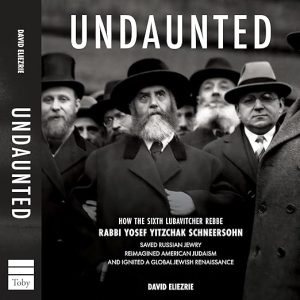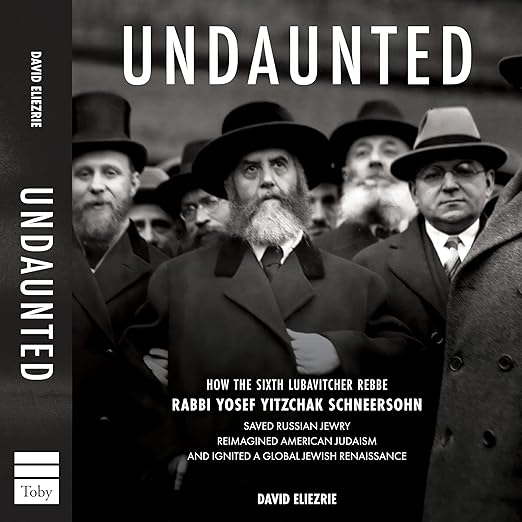
Somewhere past the halfway mark of this audiobook, Rabbi Yosef Yitzchak Schneersohn steps onto American soil and tells the community waiting for him that America is not different, pushing directly against the idea that Judaism has to soften itself to fit American life. David Eliezrie builds Undaunted around moments like this one, where a single declaration carries the weight of a much longer argument about what it costs to hold a line under pressure.
An Escape Made Possible by an Odd Wartime Deal
Eliezrie's account follows the Sixth Lubavitcher Rebbe through czarist Russia, the Soviet crackdown on synagogues and schools, arrest, torture, and a death sentence, and it does not rush past the danger to get to the inspirational parts. The book stays with the specific mechanics of survival: the international advocacy campaign that secured his release, the escape from Poland made possible by an unusual wartime arrangement between the US government and Nazi Germany, and the slow work of rebuilding Jewish institutional life once he reached American shores.
What keeps this from reading as a straightforward hagiography is how much space Eliezrie gives to the Sixth Rebbe's actual decisions: staying in Russia while other religious leaders fled, introducing Chabad teachings in Western Europe, opening yeshivas, and expanding the role women played inside the movement. The book also traces the relationship between the Sixth Rebbe and his successor, Rabbi Menachem Mendel Schneerson, which grounds the biography in a continuity that Chabad readers will recognize and newcomers can follow without prior context.
Founding the First Nationwide Network of Day Schools
The synopsis frames the Sixth Rebbe as one of the most consequential leaders of modern Jewry, emerging from what it calls an era of unparalleled turmoil and challenge, and the chapter-by-chapter structure, moving between czarist Russia, Poland, Western Europe, and the United States, is built to support that claim rather than simply assert it.
The later chapters follow the Sixth Rebbe's postwar work in the United States: founding the first nationwide network of Jewish day schools and laying groundwork that, in Eliezrie's telling, seeded a global Jewish renaissance carried forward by generations of Chabad leaders. That arc, from one man defying an empire to an institutional network still operating today, is the throughline the synopsis promises, and the book appears built to deliver on it.
Zacks Narrates Solo Through Hebrew and Yiddish Terms
Substantive review length is rare on an audiobook page, and this listing clears that bar easily: several of the five reviews here run long enough to get cut off before they finish their thought. Michael Rubin's review specifically calls out the footnotes, noting that they are worth reading closely rather than skimming past, a useful signal for a biography built on archival research rather than secondhand summary. Another review, from May, credits Eliezrie with conveying the mindset and emotional texture of the period rather than just listing events in order.
Nancy M.'s review adds a specific, human-scale detail: the Seventh Rebbe's own reluctance to take on the role, reportedly overcome only when his wife told him that refusing would undo the work of her father, the Sixth Rebbe. Small, sourced moments like that one are what separate a review section worth reading from a wall of five-star ratings with nothing behind them. Not every review runs that long: Cheli Joffe's simply reads, "Everyone needs to read this book. Beautiful. Amazing. Inspiring." The distance between that kind of enthusiasm and Rubin's footnote-by-footnote engagement gives a sense of how wide this book's actual readership already is.
Shlomo Zacks narrates the full fifteen and a half hours solo, which matters here because the text is dense with Hebrew and Yiddish terminology, honorifics, and place names that shift across Russia, Poland, Western Europe, and the United States as the story moves. A narrator unfamiliar with that vocabulary can turn a book like this into a minefield of mispronunciations; whether Zacks clears that bar is not something the reviews confirm one way or the other, since none of the five comment on the reading itself.
Fifteen Five-Star Votes Add Up to Seventy-Five
Two of the five reviews are dated in December 2025, several weeks before this edition's official January 29, 2026 release. That gap is worth knowing going in: it usually means a review was written against an earlier print or ebook edition, or from an advance listening copy, rather than a sign that anything is wrong with the audiobook itself. The other three reviews land after the release date and read as standard post-release reactions.
The rating sits at a perfect 5.0 across fifteen ratings, and the math only works one way: fifteen five-star votes add up to exactly seventy-five, the maximum possible total for that many ratings, so nothing short of a full sweep gets you there. That uniformity is worth going in aware of, since a listener hoping for a more mixed, warts-and-all discussion of Chabad's internal politics will not find much pushback in the visible reviews to calibrate against.
The Toby Press, which released this edition, publishes specifically within Jewish-interest history and literature, which matters if you are coming to Undaunted expecting a general-audience popular history rather than a book aimed first at readers already inside or adjacent to the tradition it describes. The synopsis, the reviews, and the publisher's own focus all point in the same direction on that question.
Closer to a Multi-Week Listen Than a Weekend
This audiobook rewards listeners already curious about twentieth-century Jewish history, Chabad specifically, or the mechanics of how a religious movement rebuilds itself after near-destruction. Carl Ynes Buxeda's review frames the book as essential for understanding the approach behind what the review calls the most powerful Jewish movement in America, and that framing fits the book's own ambition: this is not a light devotional read, it is a researched account of institutional survival with real political stakes attached.
At just over fifteen and a half hours, this is a substantial commitment even by biography standards, closer in scale to a multi-week listen than a weekend one. Anyone hoping for a condensed overview of Chabad history should look elsewhere; the runtime reflects a decision to work from primary documents rather than compress the Sixth Rebbe's life into a shorter narrative arc.
Listeners hoping for a critical or scholarly-distance biography, one that weighs the Sixth Rebbe's choices against competing historical accounts, should adjust expectations: every visible review here comes from within a sympathetic frame, and Eliezrie's own closeness to the material, drawing on Chabad archives and documents, reads as more testimonial than adversarial. For anyone approaching from inside that tradition, or simply wanting a clear, well-sourced account of a dramatic slice of Jewish history, Undaunted delivers on what it promises.
Before You Listen
Is this Undaunted audiobook based on Eliezrie's own archival research?
Yes. The synopsis states Eliezrie draws on historical documents and rare archives to reconstruct the Sixth Rebbe's life, and reviewer Michael Rubin specifically praises the footnotes as worth reading closely rather than skimming, since they carry real additional detail beyond simple citations.
Does this audiobook cover the relationship between the Sixth and Seventh Lubavitcher Rebbes?
Yes, directly. The synopsis notes that Undaunted explores the deep relationship between the Sixth Rebbe and his successor, Rabbi Menachem Mendel Schneerson, tracing how the Sixth Rebbe's course for Chabad was continued and expanded by the more widely known Seventh Rebbe.
How long is the Undaunted audiobook and does it require prior knowledge of Chabad history?
It runs fifteen hours and thirty-seven minutes. No prior background is required. Eliezrie introduces the Sixth Rebbe's world from the ground up, and the book's own structure, moving from czarist Russia through the Soviet years to postwar America, builds the historical context as it goes rather than assuming it.