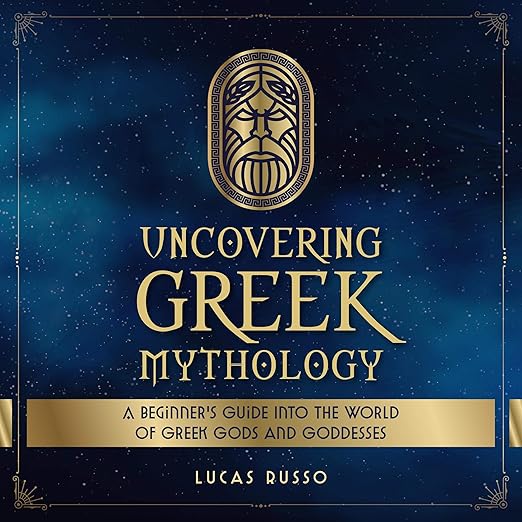
Quick Take
- Narration: Jared Zak delivers the survey material cleanly, suited to the beginner-guide format and the mythology overview register.
- Themes: The Greek pantheon and their relationships, mythology as cultural and moral instruction, ancient Greece’s intellectual legacy
- Mood: Accessible and enthusing, designed to kindle interest rather than exhaust it
- Verdict: A reliable three-hour introduction to Greek mythology for genuine beginners, particularly those who want an organized overview before pursuing the primary texts.
There is a particular kind of audiobook that exists to open a door rather than walk through it, and Uncovering Greek Mythology: A Beginner’s Guide occupies that space with appropriate self-awareness. This is not a companion to Ovid or a close reading of the Iliad. It is an organized introduction to the Greek pantheon, their stories, and their cultural significance, written for listeners who have registered mild curiosity about this material and want a structured entry point. The 846-listener rating at 4.6 tells you something useful: this is a book that successfully delivers what it promises to a large number of people.
I listened to it on a Sunday afternoon, three hours and eighteen minutes from creation myth to cultural legacy, and it performed exactly its stated function. By the end I had a cleaner mental map of the relationships between the Olympians than most people retain from school mythology units.
From Chaos to Olympus: The Organizational Logic
Lucas Russo’s structure follows the mythological chronology from the creation of the world through the Titans, the Olympian succession, and the various cycles of demigods and monsters. This is the right organizational choice for a beginner guide. Starting with the Titans establishes the genealogical relationships that make the Olympian dynamics legible; without knowing that Zeus dethroned Cronus, the psychology of Olympus makes less sense. The creation myth also establishes the cosmological framework that determines where characters live, what domains they control, and why certain confrontations are inevitable.
Russo covers Zeus, Hera, Poseidon, Demeter, Athena, Apollo, Artemis, Hephaestus, Ares, Aphrodite, Hermes, Dionysus, and Hades with enough specificity to distinguish their individual characters, domains, and significant myths. He includes Hades as a key figure despite the occasional tendency to exclude him from the Olympian count on grounds that he rules the underworld rather than Olympus. This is the correct decision for a comprehensive overview.
Storytelling Over Scholarship
The book is explicitly not a scholarly treatment. It does not engage with source debates, the differences between Homeric and Hesiodic versions of myths, or the regional variations in Greek religious practice. Russo presents the myths in their most widely recognized forms, which is appropriate for his stated audience and would be inappropriate for a different one.
One reviewer quotes from their reading experience with evident enthusiasm: the description of every god and goddess as comprehensible and intriguing, the details vivid enough to create immersion. This is genuine praise for the book’s primary achievement, which is making mythology accessible without making it dull. Russo writes with enough momentum that the material moves rather than catalogues.
What the Book Adds Beyond the Stories
The synopsis promises not just the myths themselves but the moral lessons and cultural values the Greeks embedded in their mythology, the mythological explanations for natural phenomena, and a brief history of Greek civilization and how they worshipped. These contextual sections are the book’s secondary value. Understanding why the Greeks told these particular stories, what function they served socially and religiously, gives the myths a dimension that pure narrative retelling lacks.
The section connecting Greek mythology to contemporary culture and asking why these stories still matter is brief but coherent. The argument that Greek mythology gave Western civilization not just stories but a framework for thinking about power, desire, fate, and mortality is not original, but it is well-made.
Jared Zak and Three Hours of Mythology
Zak reads with appropriate pace for the material, neither so fast that names and relationships blur nor so slow that the book feels padded. The mythology survey register requires a narrator who can shift between story mode and explanatory mode without making the transitions feel abrupt, and Zak handles this competently. Greek proper names are read consistently throughout.
At 846 ratings, this has significantly more listener validation than most comparable mythology primers, and the 4.6 average represents a genuine consensus that the execution matches the promise. For what it is, this is one of the more reliably satisfying short mythology introductions available in the format.
Who This Introduction Is and Is Not For
This audiobook is exactly right for listeners who are approaching Greek mythology with genuine curiosity and minimal prior knowledge. It is also useful for those who absorbed the stories in childhood and want an organized adult refresher before reading Homer, Hesiod, or Ovid.
Listeners who already have serious engagement with Greek mythology, whether through classical education, Stephen Fry’s Mythos, or the primary texts, will find this too elementary. It is not designed for them, and it should not be evaluated as if it were.
Frequently Asked Questions
Does this beginner’s guide include the major hero myths like Hercules, Perseus, and Odysseus, or does it focus only on the gods themselves?
The synopsis indicates coverage of Titans, Olympians, and demigods, suggesting the major heroes are included. The structural approach moves from creation through the divine cycles to demigod stories and monsters, so figures like Heracles would appear in the demigod section.
Is this a good audiobook for children or teenagers wanting to learn about Greek mythology, or is it specifically aimed at adults?
The content is appropriate for older children and teenagers interested in mythology, but the book is written for adult general readers rather than specifically for young audiences. Listeners familiar with Rick Riordan’s Percy Jackson series may find this a useful bridge to the actual mythology behind those stories.
Does the book address the Roman equivalents of the Greek gods, since many people encounter them first through Roman names like Jupiter and Venus?
The synopsis does not specifically mention the Roman equivalents, and based on the book’s framing as a guide to Greek mythology specifically, the Roman pantheon is likely treated as peripheral. Listeners who primarily know the Roman names will need to build the Greek-to-Roman mapping themselves.
At 846 ratings and 4.6 stars, this seems unusually popular for the genre. Is this explained by the content or by the way the book is marketed?
The high rating count reflects the book’s position as a popular entry-level introduction to a perennially interesting subject. Greek mythology primer audiobooks attract a large audience of listeners who are curious but not deeply committed. The 4.6 average with that volume of ratings represents genuine listener satisfaction with the book’s accessibility and clarity.