Quick Take
- Narration: Eric Michael Summerer delivers Gallicchio’s dense policy history with measured authority, keeping the prose from becoming lecture-hall dry without sacrificing the subject’s gravity.
- Themes: Unconditional surrender doctrine, memory and myth-making, postwar political reversal
- Mood: Scholarly and methodical, with flashes of genuine political drama
- Verdict: An indispensable corrective for anyone who thinks the end of the Pacific War was straightforward, though readers wanting narrative sweep over policy analysis should know what they are signing up for.
I came to this one already convinced I knew the broad outlines of how World War II ended in the Pacific. The bomb dropped, the emperor spoke, the surrender documents were signed on the USS Missouri, and that was that. What Marc Gallicchio does in this book is take that comfortable sense of settled history and quietly dismantle it, chapter by chapter. I finished the final hour somewhere between a long commute and a parking lot, reluctant to turn it off because the argument Gallicchio builds keeps getting sharper the further it goes.
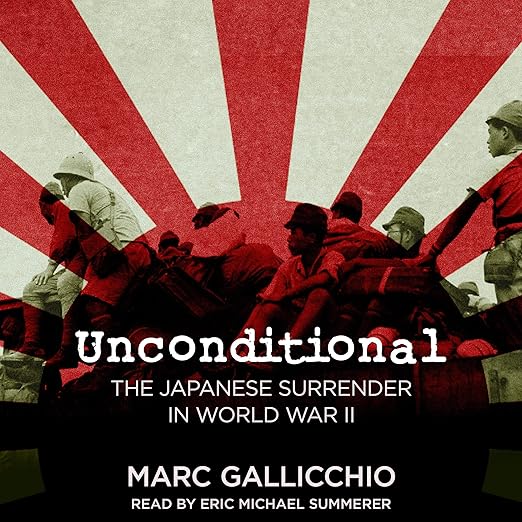
The title comes from Franklin Roosevelt’s announcement at Casablanca in 1943 that the Allies would accept nothing less than unconditional surrender from the Axis powers. What Gallicchio reconstructs is how that phrase, which seemed so self-evidently correct at the time, became one of the most contested political commitments in American history before the ink on the Missouri’s surrender documents was even dry. The book is part of the Pivotal Moments in American History series, and Gallicchio uses that framework to do something genuinely useful: he traces a single policy decision not just through its immediate context but through the decades of argument it generated.
The Conservatives Who Blinked First
One of the genuinely surprising revelations here is the political reversal Gallicchio documents around unconditional surrender. A reviewer noted they had assumed skepticism of the surrender policy began with liberal revisionist historians in the 1960s. That assumption turns out to be entirely wrong. It was Republicans in Congress who first wavered, alarmed by the casualties at Iwo Jima and Okinawa in 1945, who worried that forcing unconditional surrender would require an invasion of the Japanese home islands costing hundreds of thousands of American lives. Gallicchio traces this with careful sourcing, and the result is one of those genuinely disorienting historical correctives where you realize the political landscape of the 1940s does not map cleanly onto contemporary categories.
The argument gets more interesting still when Gallicchio extends his timeline well past 1945. The unconditional surrender of September 2nd is the centerpiece, but the book’s longer ambition is to show how that policy shaped American war-making and war-remembering through Korea, Vietnam, the Gulf War, and Iraq. The phrase peace with honor that haunted the Nixon administration is not, in Gallicchio’s telling, a rhetorical invention of the 1970s. It is the direct ideological offspring of the debates surrounding unconditional surrender, and the liberal and conservative positions on it had by then exchanged places entirely. That is the kind of structural argument that makes a short book feel much larger than its page count.
What the 50th Anniversary Dredged Up
Gallicchio is at his sharpest in the chapters dealing with the 1995 Smithsonian controversy surrounding the planned Enola Gay exhibition. The anniversary debates reignited every argument that had been fermenting since 1945 about whether unconditional surrender necessitated the bombs, whether Japan was about to surrender anyway, and who bears moral responsibility for Hiroshima and Nagasaki. One reviewer wrote about revisionist notions blurring the history of the war’s end, and you can feel that cultural friction throughout this section. Gallicchio does not adjudicate every claim, but he maps the historiographical battlefield with precision, which is arguably more useful than any single verdict would be. The ability to orient a listener within a long-running argument is a rare skill in historical writing.
The historiography is worth noting on its own terms. This is a book that wears its research openly. Gallicchio draws on figures including Fleet Admiral Leahy, who believed the atomic bombs were militarily unnecessary, and reconstructs the debates inside the Truman administration and Congress with close attention to primary sources. Where other histories of this period rush toward the dramatic moments, Gallicchio lingers on the political machinery, which is where his real expertise lies. At roughly ten hours, the runtime rewards the focused listener who wants the argument rather than the atmosphere.
What Summerer’s Reading Adds
Eric Michael Summerer is a reliable presence in American history narration and he earns his keep here. The text is dense with proper names, institutional titles, and embedded policy arguments, and Summerer handles it all without flattening the material into a monotone. He reads at a pace that respects the listener’s intelligence, which is important for a book that occasionally asks you to hold competing policy positions in mind simultaneously. This is not an audiobook where your attention can drift for five minutes and you will catch back up. Summerer’s clarity of diction is the main tool that prevents that from becoming a problem.
The Right Listener for This Argument
If you have already read the standard accounts of the Pacific War’s end and want something that challenges assumptions about what unconditional actually meant as policy, this is the right next listen. One reviewer invokes Richard Frank’s Downfall as a favorable comparison, and that pairing makes sense: Downfall provides the military-operational narrative, Gallicchio provides the political-ideological analysis that ran alongside it. Those who engage seriously with this book will come away with a substantially revised understanding of how a single phrase shaped American foreign policy debates for the next half century. Those who want narrative sweep and battlefield drama should look elsewhere first.
Frequently Asked Questions
Does Gallicchio take a position on whether the atomic bombs were necessary?
He maps the debate carefully without issuing a verdict. The book is more interested in how the unconditional surrender policy shaped the decisions leading up to the bombs and the historical arguments that followed than in adjudicating the moral question itself.
How much does the book cover the actual surrender ceremony versus the policy debates?
The ceremony on the USS Missouri is the symbolic centerpiece, but the majority of the book is policy history: the Casablanca origins of the doctrine, the wartime debates, and its long afterlife through Korea, Vietnam, and the Gulf Wars.
Is this suitable for listeners who have not read much about World War II?
Gallicchio writes clearly but assumes familiarity with the basic outline of the Pacific War. Listeners new to the period would benefit from reading something like Richard Frank’s Downfall first, which reviewers cite as a useful companion.
Why does Gallicchio spend time on the 1995 Smithsonian Enola Gay controversy?
Because that controversy was when the unconditional surrender debates resurfaced most publicly and most acrimoniously. Gallicchio uses it to show how the unresolved arguments of 1945 persisted in American historical memory for fifty years.