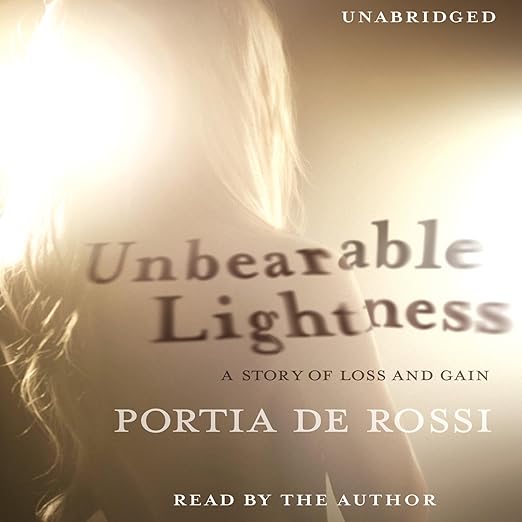
MzShawn was watching a talk show on the day Portia de Rossi came on to discuss Unbearable Lightness, and by the end of the show had decided to buy it. That review gives the reason plainly: she sounded sincere and sad. It is a very particular route into a memoir, and it points straight at what this audiobook has that no paperback can offer, since the voice that convinced a stranger through a television set is the voice reading all 9 hours and 18 minutes of the book.
The Verdict, Briefly
Where the story starts is earlier than most people expect. Portia de Rossi was twelve years old and working as a model in Australia. By the time she was a cast member on Ally McBeal she was starving and bingeing while terrified that the tabloids would expose her sexuality. The memoir sets those two pressures beside each other and declines to rank them, which is the structural decision that makes the book work: the closet and the illness feed each other, and neither is offered as the tidy cause of the other. The summary reaches back further still, to the pivotal moments of a childhood that set her on the road to the illness, so the twelve-year-old model is a symptom rather than an origin.
Both the back-cover text and the reviews insist on a distinction worth preserving. Marissa points out that the book does not present itself as self-help but as a brutally honest narrative of a journey to hell and back, and that is exactly right. It explains nothing and prescribes nothing. What it supplies instead is detail: the elaborate rituals around food that came to dominate hours of every day, and the running arithmetic of calories consumed and calories spent.
What Makes Unbearable Lightness Worth Hearing
One decision separates this recording from every print edition, and it belongs to the author. She reads it herself. In a memoir about controlling a body in public, hearing the same person speak the numbers out loud alters their weight entirely: a calorie count is a statistic on paper and a confession in the ear. Ceebs describes the book as opening her deepest wounds for all to see, which is the print version of that sentence. The audio version is that she says every word of it in her own voice. The book she is reading describes concealing the seriousness of the illness from everyone around her and from herself, and that gives the calm of the delivery an edge no hired reader could manufacture.
Whether nine hours of this is bearable is a fair question, and the column answers it from an unexpected direction. Ceebs reports that the book prompted a call to a counselor. Amazon Customer, writing from Australia, credits it with making the mechanics of an eating disorder comprehensible for the first time. Marissa expects it to resonate with anyone who has starved to meet society's ideals and the entertainment industry's expectations of the ideal female form. Nobody here calls it easy and everybody recommends it.
Points to Consider
Most pages make the star average safe to ignore. This one repays a minute. The badge reads 4.5 and the counter reads two votes, which fixes their combined total at nine points out of ten, so one of the pair is a four. Not one of the five written responses on display is anything other than five stars. Whoever cast that four left no sentence behind, and the only reservation this memoir has drawn on this page is a single unexplained point.
If you are in the middle of an eating disorder yourself, take the warning seriously, because the book is specific about method. Rituals, numbers, the daily accounting of intake against expenditure, all of it set down by someone who lived inside that system and remembers precisely how it operated. The same specificity that makes it valuable to a family trying to understand makes it hazardous to a listener looking for instruction, and here it arrives in the steady voice of the woman who no longer needs any of it.
For a book about Hollywood, the responses come from nearly everywhere else: Australia, India, France and the United States, spread over more than a decade. The French review recommends it to anyone obsessed with their own weight, with or without a diagnosed problem, and then to every fan of Ally Mc Beal, spelled that way, describing a viewer who had always found Portia simply sublime and never suspected what the years of that series were costing her.
Who Should Listen to Unbearable Lightness
Listeners who want a celebrity memoir will get one, and that is the least interesting thing on offer. The famous names are present, the show is present, the marriage is present, but the spine of the book is a woman explaining how a mind talks itself into starvation and how the industry around her supplied the vocabulary. If that sounds clinical, it is, and the clinical register is the reason it lands instead of sentimentalizing itself. Marissa identifies the third element that holds those two together, a misguided view of what it means to be a professional, which is how the industry's expectations became instructions.
Anyone who teaches, raises or works with young women is the audience this book keeps finding, judging by who has written here. Two responses out of five describe it as an education, including one from a reader who had never grasped the illness from the outside. The newspaper verdict the back-cover text leads with, an unusually fresh and engrossing memoir of both Hollywood and modern womanhood, sounds like marketing until you notice how many of these readers arrived out of curiosity and left with something they could use.
The ending is where memoirs of this kind usually go soft, and this one does not. The climb back is summarized as health, honesty, a marriage to Ellen DeGeneres and a public role advocating for gay rights and women's health, and the reviews confirm that the book earns that ending instead of announcing it. Ceebs sets the caution beside the hope: even with the best resources available to anyone, recovery is still a huge uphill struggle. If that sounds like the version you can use, take it in the voice of the person it happened to.