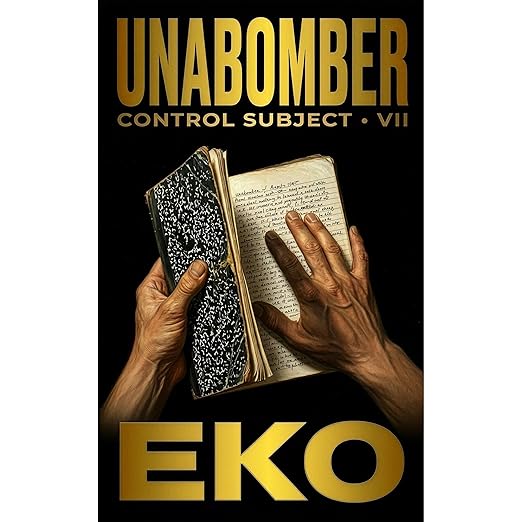
In the fall of 1959, on Divinity Avenue in Cambridge, a seventeen-year-old was asked to write down his deepest beliefs and then watched through a one-way mirror as a trained adversary dismantled them. That experiment, part of a psychological study run by Henry Murray for Harvard, ran for three years. The youngest subject was assigned a code name: LAWFUL. His name was Theodore John Kaczynski. EKO's audiobook on the Unabomber opens with this material, and if you know Kaczynski's story, you understand immediately why this particular entry point matters. This is not a story about bombs. It is a story about what the apparatus of the modern world does to a certain kind of mind when that mind is young enough to be permanently shaped by it.
EKO is the author of the Unsealed Archives series, a collection of high-velocity nonfiction narratives about historical figures whose full stories have been buried inside institutional files or misrepresented by the official record. The Unabomber is entry seven. The format is distinctive: EKO structures the account in chapters organized around specific phases rather than a continuous biography. The room. The prodigy. The cabin. The bombs. The brother. The trial. The cell. Each section works as a unit, and the whole functions as a kind of dossier, exactly the framing EKO uses explicitly in the text.
Human Failure Modes Under Sustained Pressure
The audiobook uses a Virtual Voice narrator, which means the listening experience has the characteristic smoothness of AI-generated audio: clean pronunciation, reliable pacing, absence of interpretive risk. For a short-form text like this one, running at one hour and twenty minutes, that approach is serviceable. The prose itself is doing the atmospheric work, and EKO's writing is sharp enough to carry the listener without requiring a dramatically performed narration. Reviewers consistently praise EKO's 'illustrative voice' in his writing, and that quality comes through clearly even in AI audio: the sentences are precise and weighted rather than journalistically flat.
The Harvard experiment material is where this audiobook is most arresting. Murray's protocol, designed to induce psychological stress through sustained interpersonal attack, was documented extensively on film. The experiment's goals have never been fully disclosed, and EKO's framing, that this represents a documented attempt to evaluate 'human failure modes under sustained psychological pressure,' is historically accurate. Whether it caused Kaczynski's radicalization or merely accelerated tendencies already present is a question EKO handles carefully: the dossier format implies evidence without claiming certainty.
The Brother Who Knew the Manifesto's Style
True crime audiobooks tend to organize themselves around the crime. EKO's approach here is different: the bombs and the FBI manhunt are covered but are not the narrative center of gravity. The center of gravity is the making of a worldview. EKO is interested in what the Kaczynski case reveals about the relationship between institutional power and individual psychology, and that framing distinguishes this from the mass of true crime content that treats the criminal as pure spectacle. Listeners who come to this audiobook will get context that most Unabomber coverage does not provide.
The brother chapter is one of the most important in the book. David Kaczynski's decision to contact the FBI after recognizing his brother's writing style in the Unabomber Manifesto is one of the most morally complex acts in any contemporary true crime case. EKO does not simplify it. The trial and cell chapters bring the account forward to Kaczynski's death in a federal medical facility in 2023, closing a loop that most earlier accounts could not. The complete arc from the Harvard chair to the federal cell is available here in eighty minutes, and EKO uses that compression to make the shape of the story visible rather than merely its incidents.
Unable to Slow Down for Divinity Avenue
The Virtual Voice narration limits the emotional range available to the material. EKO's prose has been described by readers as having genuine atmospheric power, and that power is present but somewhat muted in the AI audio format. Listeners who are sensitive to synthetic narration will notice it, particularly in passages where the material calls for weight. The clean delivery does not have the capacity to slow down for the Divinity Avenue scenes the way a skilled human narrator would. That is a real loss, though not a disqualifying one for an eighty-minute listen.
The Unsealed Archives series format also rewards sequential reading. EKO's readers report wanting to consume the full series, and this entry references the broader project in ways that function as teasers. New listeners can engage with the Unabomber account on its own terms, but the most invested response to this audiobook may be the desire to find the other entries in the series, which cover figures ranging from Cold War operatives to commanders who faced irreversible decisions. EKO is building something cumulative, and entry seven lands best if you understand the architecture it belongs to.
The Interpretive Frame Behind Eighty Minutes
Listeners who have followed true crime coverage of the Unabomber case and want a more analytically framed account will find EKO's approach satisfying. The audiobook does not recap what you already know so much as it reframes it: the Harvard experiment, the brother's decision, the manifesto as intellectual document rather than as propaganda. Anyone interested in the intersection of institutional psychology, radicalization, and American counterculture will find this an efficient and intelligent listen.
Skip it if you want a comprehensive biography. At eighty minutes, this is a compressed dossier, not a full account. Readers who want the complete Kaczynski story, including detailed coverage of the bombings themselves and the FBI investigation, will need a longer source. What EKO offers is a particular interpretive frame: the story of what Harvard and Murray did in that room on Divinity Avenue, and how it fits into everything that followed. That frame is original enough to justify the eighty minutes even for listeners who know the case well.
Before You Press Play
- Performance: Virtual Voice delivers the prose cleanly, but EKO's atmospheric writing carries more weight than the AI audio can fully realize; short runtime makes it manageable.
- What it covers: Institutional psychology and radicalization, the Harvard experiment's shadow, American anti-modernity.
- Feel: Cold and precise, structured like a declassified document with a thesis.
- Our call: EKO's dossier format reframes the Unabomber case in ways most coverage ignores; the Harvard experiment material alone makes this audiobook worth the eighty-minute investment.
Does this audiobook cover the Harvard psychology experiment in detail, or is it a general Unabomber biography?
The Harvard experiment is central to EKO's framing, not peripheral. The 'room' chapter opens the account and establishes the interpretive lens for everything that follows. If you want to understand why EKO finds that experiment significant to Kaczynski's later trajectory, the audiobook makes the argument clearly.
Is this audiobook part of a series, and do I need prior entries to understand it?
It is the seventh entry in EKO's Unsealed Archives series. It stands alone completely in terms of content, but readers who engage with this audiobook frequently seek out other entries in the series afterward. EKO's approach across the series is consistent, and knowing the format helps set expectations.
Is the audiobook's account of the Harvard experiment historically accurate?
EKO draws on documented sources, including Murray's protocols and the filmed records of the experiment. The connection between the Murray study and Kaczynski's radicalization is a matter of ongoing scholarly debate, and EKO frames it as significant without overstating causality. The historical foundation is sound.