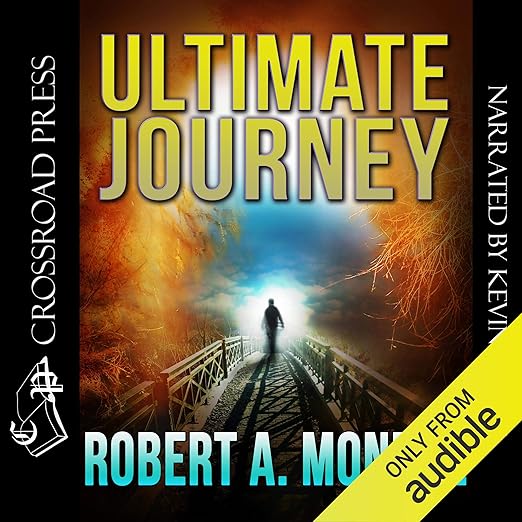
The Short Version
- Narrator: Kevin Pierce delivers Monroe's final, most ambitious work with the measured gravity it requires, treating the material with respect without either endorsing or distancing himself from its extraordinary claims.
- Subjects: Consciousness beyond the physical body, the cartography of what lies after death, the nature of purpose and identity stripped of bodily experience
- Tone: Expansive and quietly vertiginous, like standing at the edge of something without a clear bottom
- Bottom line: Monroe's final book is the most complete statement of his life's work, and Pierce's narration honors both its strangeness and its sincerity.
There is a particular quality to books that describe experiences the author cannot prove happened and does not expect you to simply believe. Ultimate Journey has that quality. Robert Monroe is not writing to convince you that out-of-body travel is real. He is writing to describe what he found when he practiced it over decades, with the precision of a man who spent his professional life in broadcasting and his interior life mapping territory that had no agreed-upon cartography. The combination is unusual and, for the right reader, genuinely arresting.
I came to this book through a recommendation from someone who had their own out-of-body experiences before encountering Monroe's trilogy, which is the ideal pathway according to most devotees of his work. Monroe himself acknowledges that Ultimate Journey is written with some assumption that the reader is familiar with the material in his first two books, Journeys Out of the Body and Far Journeys. As a standalone, certain passages assume context you may not have. One reviewer who came to this book second rather than third noted feeling they had missed significant intervening material. That observation is worth heeding if you are approaching the trilogy for the first time.
What We Made of It
Ultimate Journey is Monroe's attempt to synthesize everything he learned across decades of out-of-body exploration into a coherent framework for understanding what lies beyond physical existence. He calls the post-physical territory the interstate, and the metaphor is characteristically practical: a system of routes with entry and exit ramps, signposts, and hazards. Monroe was a businessman by training, and even his most expansive metaphysical claims are organized with the logic of someone accustomed to making things work at scale. He does not traffic in vague spiritual impressions. He builds a model and explains it with the clarity he would bring to any operational challenge.
What makes this framework interesting even for skeptical readers is that Monroe is not primarily arguing a theological position. He is describing what he encountered, how it felt, and what provisional conclusions he drew from it. The difference between here is what is true and here is what I found and what I made of it is a crucial one, and Monroe maintains it with more consistency than many writers in this territory manage. Kevin Pierce's narration supports this framing throughout. He reads with the gravity of someone conveying something important, but without the evangelical certainty of someone who has decided for you what to believe.
Why Listen to Ultimate Journey
One reviewer who had their own out-of-body experiences before reading Monroe described a passage about out-of-body simulations that nearly made them lose composure because it described something they had experienced and never found described anywhere else with such precision. This is the specific gift of Monroe's work for readers who come to it with relevant personal experiences. He does not write in the generalities of spiritual self-help. He describes specific phenomenology, the texture of specific kinds of experience, with a precision that either resonates with familiarity or lands as extraordinary detail from an extraordinary interior life.
For readers without such experiences, the material is still engaging as a document of a particular kind of interior life, one that Monroe lived publicly and recorded with unusual care across three books. Another reviewer described it as bringing them back to understanding a deep knowing that had been present since childhood but resisted articulation. Monroe gives language to things that resist language, which is its own kind of achievement regardless of one's metaphysical starting position.
What Might Not Land
The strongly recommended reading sequence is Journeys Out of the Body first, Far Journeys second, and Ultimate Journey third. Multiple readers across all three books note that the trilogy builds in ways that make each volume more meaningful in context. Ultimate Journey functions as synthesis and culmination: it refers back to earlier findings, develops the framework earlier books established, and reaches conclusions that assume the journey preceding them. Starting here is technically possible but significantly limits the experience, particularly for the passages that synthesize decades of earlier exploration into Monroe's final statement on what it all means.
At under eight hours, the runtime is shorter than the scope of the material might suggest. Monroe was not a maximalist, and Pierce's pacing does not inflate artificially. The book is dense in the specific sense of carrying more weight per passage than its length implies. Listeners should allow more reflection time between sessions than a shorter, lighter book would require.
Monroe's position as a credentialed professional rather than a countercultural figure gives the book an unusual texture. He was not a spiritual seeker who stumbled into out-of-body experience. He was a broadcasting executive who discovered, to his considerable personal inconvenience, that he could leave his body during sleep and that the territory he found was neither dream nor hallucination in any form he could account for. The way he approaches that discovery, with systematic documentation and a stubborn refusal to force it into pre-existing frameworks, gives the book a credibility that more explicitly mystical accounts often lack. Readers who enjoy William James or Frederic Myers will find Monroe's empirical instincts recognizable, if the subject matter more extreme than either.
Who Should Pick Up Ultimate Journey
Ultimate Journey is essential for anyone who has worked through Monroe's earlier books and wants the completed framework. It is also a meaningful listen for readers curious about consciousness, the phenomenology of non-ordinary states, or the history of modern out-of-body research. Listeners who need metaphysical claims to be scientifically validated before engaging with them will find this book frustrating from the very first chapter. Those who can hold unusual claims with open curiosity rather than immediate judgment will find one of the more genuinely strange and interesting documents of a singular interior life that managed to find a large and devoted audience despite its extraordinary subject matter.
Frequently Asked Questions
How does Kevin Pierce handle material this unusual? Does the narration maintain neutrality or does it take a position?
Pierce reads with gravity and respect for the material without adopting a promotional tone. He conveys Monroe's sincerity without asking the listener to share his beliefs, which is the appropriate approach for this kind of experiential memoir.
Monroe describes very specific phenomenology. Is this the kind of book that resonates differently for listeners who have had their own unusual experiences?
Yes, significantly. Readers with out-of-body or non-ordinary experiences of their own describe recognition effects that Monroe's precision generates and that more generalized spiritual literature cannot replicate.