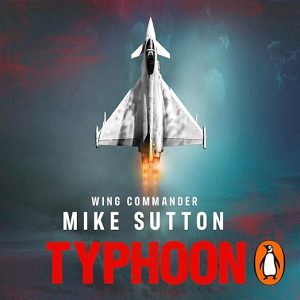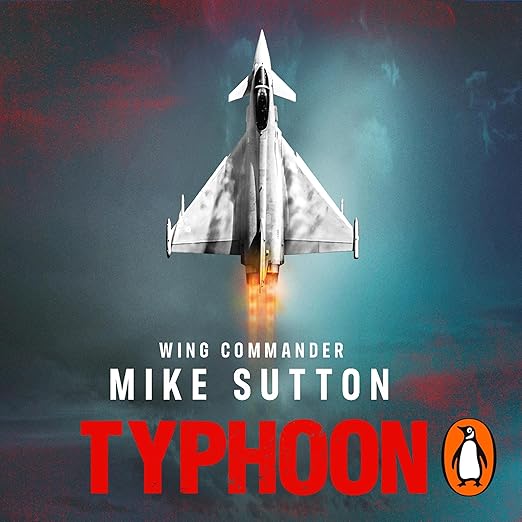
Mike Sutton's Typhoon, narrated by Simon Bubb and running just under ten hours, is the first inside account from the RAF Wing Commander who led 1 Squadron's Eurofighter Typhoon FGR4s in combat against ISIS over Syria and Iraq. That distinction matters in deciding how to place this audiobook. This is not a general history of the air campaign or a journalist's reconstruction from declassified documents; it is the account of the man who commanded the squadron, who made targeting decisions with lethal consequences, and who had to hold his pilots together across a deployment where a single error could produce a civilian casualty the mission's opponents were counting on. The weight of that responsibility is audible throughout the audiobook in a way that distinguishes it from the broader genre of fighter pilot memoir.
Bubb's narration carries the biographical sections, covering Sutton's path from early RAF training through his years on the aging Jaguar to taking command of 1 Squadron, with enough personal texture to establish Sutton as a specific individual rather than a composite military archetype. The Jaguar years and the transition to the Typhoon platform are essential context for understanding what the aircraft represents in British military aviation: the step change from legacy airframes to a fourth-generation multi-role jet capable of delivering precision munitions that a whole squadron of Lancasters could not have guaranteed. One reviewer noted particular enjoyment of the moment Sutton's fiancee asked about the desert camouflage on the aging Jaguar, a small detail that grounds the technical narrative in a recognizable human life.
The Legal Framework Behind Every Approved Strike
The audiobook's most distinctive quality is Sutton's treatment of targeting ethics. Operating against ISIS required a level of precision, and a level of legal and procedural authorization before any strike was approved, that earlier air campaigns could not have approached. Sutton explains the frameworks governing strikes with enough transparency that a civilian reader can understand the constraints under which the squadron operated, without those explanations becoming dry bureaucratic recitation. The strike authorization process, the intelligence confirmation requirements, the prohibition on collateral damage that was not militarily proportionate: these are not abstract legal principles in Sutton's telling but the actual conditions under which 1 Squadron flew into combat. Bubb reads these sections with appropriate gravity.
1 Squadron's history is one Sutton invokes carefully: the Western Front, the Battle of Britain, the Falklands. The ISIS deployment represents one more chapter in a century of frontline operations, and the audiobook earns the weight of that lineage without leaning on it for drama the immediate story has not earned independently. The flying sequences are technically specific, altitude, speed, weapons loads, threat envelopes from ground fire and surface-to-air missiles, in ways that will satisfy aviation enthusiasts while remaining followable for listeners without specialized knowledge of fast-jet operations.
Bubb's Controlled Adrenaline During Cockpit Sequences
The case for the audiobook over print comes down to Bubb's delivery of the cockpit sequences. He reads with a controlled adrenaline that accelerates appropriately during the mission narratives and settles during the reflective passages. The rhythm he establishes communicates something a printed page cannot quite replicate: the specific relationship between professional composure and physical intensity that defines combat aviation at the highest level. At nine hours and forty-eight minutes, the runtime gives Sutton the space to contextualize the operational history thoroughly without rushing through the human material, and the balance is well-maintained throughout the audiobook.
Sutton is unusually candid about the psychological demands of command. The fear he describes is not the fear of personal death but the fear of responsibility for other lives and other outcomes, for the pilot who gets shot down behind enemy lines, for the civilian who is in the wrong place at the wrong moment. Bubb voices this candor with restraint rather than performance, and the combination of frank first-person admission and understated narration gives the audiobook an emotional authenticity that is harder to sustain in print without the human voice carrying it.
Nichol's Endorsement Carries a Decorated Navigator's Weight
The sections dealing with the rules of engagement and the political oversight of the air campaign are more substantial than most combat memoirs provide. Sutton operated under a framework where every strike required legal authorization and where the consequences of error were not limited to military outcomes but had direct diplomatic and reputational implications for the UK's continued participation in the coalition. These passages give the audiobook a dimension that distinguishes it sharply from mission-focused aviation writing centered on the purely technical and tactical.
John Nichol's endorsement, cited in the synopsis, describes the audiobook as a rare insight into the high-pressure world of an RAF fighter squadron at war. Nichol is himself a decorated RAF navigator and author of multiple combat aviation books, so his assessment carries genuine weight as a genre judgment rather than promotional copy. Listeners familiar with Nichol's own writing about the Gulf War or the Falklands will recognize in Typhoon the qualities he is pointing to: the specificity, the honesty about fear and doubt, the refusal to present military professionalism as the absence of human frailty.
The Added Authority of a Commanding Officer
This audiobook suits readers interested in modern air warfare, RAF history, or the experience of military leadership under operational pressure, as well as general memoir listeners who want a military account grounded in specific operational detail rather than generalized heroism. Listeners who have read John Nichol or Dan Hampton's aviation memoirs will find Sutton's book occupies similar territory with the added authority of a commanding-officer perspective rather than a mission-pilot one. Those hoping for extensive political analysis of the ISIS campaign should look elsewhere; this is an operational memoir, not a policy book. The narration by Bubb is particularly well-suited to long-haul listening where the sustained pace of combat narrative can be absorbed without interruption.
A Few Questions About Typhoon
Is the Typhoon audiobook the first account from someone who actually commanded RAF Typhoons against ISIS?
Yes, according to the publisher and Sutton's own framing. Typhoon is the first inside account of the RAF's long war against ISIS from the Wing Commander who led 1 Squadron's Typhoon FGR4s in combat. Previous accounts of the air campaign have been journalistic or historical rather than first-person operational memoirs from command level.
Does this audiobook require military aviation knowledge to follow the technical content?
No. Sutton explains the aircraft's capabilities, the weapons systems, and the tactical frameworks in terms accessible to a general reader, though he does not simplify the technical content unnecessarily. Aviation enthusiasts will find the specificity rewarding; general memoir readers can follow the narrative without prior knowledge of fast-jet operations.
How does Simon Bubb's narration handle the shift between combat sequences and personal reflection in this audiobook?
Bubb manages the tonal range well, accelerating during the cockpit sequences and settling into a more reflective pace for the personal and biographical sections. The transitions feel calibrated rather than abrupt, which is important in a memoir that moves between combat operations and the human cost of prolonged deployment.