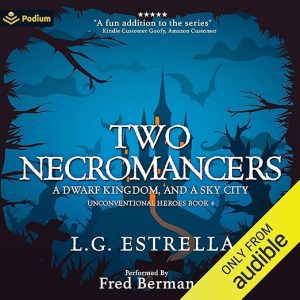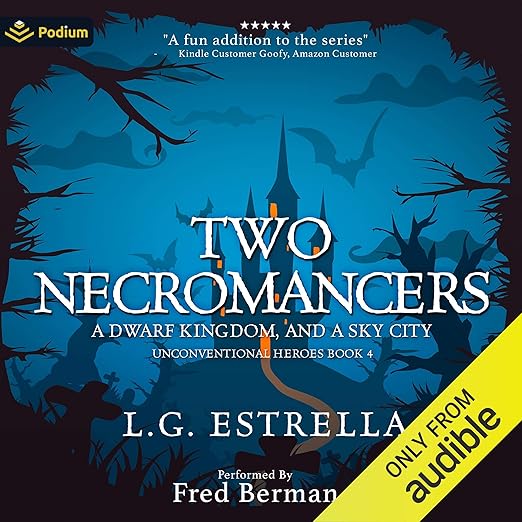
Timmy the necromancer returns in Two Necromancers, a Dwarf Kingdom, and a Sky City, the fourth installment of L.G. Estrella's Unconventional Heroes Series, narrated by Fred Berman in a runtime of 21 hours and 38 minutes. The title functions as both a synopsis and a warning: Timmy and his increasingly ungovernable crew have a princess to rescue, a goblin horde to repel, a crime lord to outwit, and a war to prevent, and none of these objectives will proceed in any sensible order. Estrella's particular genius has always been the collision between Timmy's relentless competence and the complete impossibility of the situations his companions generate around him, and book four leans into that dynamic with more confidence than any of its predecessors. This audiobook is where the series' commitment to chaotic ensemble comedy starts to feel like genuine literary ambition.
First, the Big Picture
The ensemble is the book's central asset and its most discussed liability. Returning listeners will be familiar with the cast: a young dragon who believes every problem can be resolved by eating it, an elf with a dedicated interest in property destruction, an ancient vampire whose approach to missions involves being impaled at regular intervals, a semi-retired legendary swordsman, a bureaucrat who has discovered that screaming and a frying pan constitute a viable combat strategy, and an apprentice necromancer doing her earnest best to be menacing despite a personal color palette that runs heavily toward pink. The book now adds a second necromancer to this arrangement, which doubles the potential for sensible planning and somehow produces the opposite effect.
One critic noted that the cast is beginning to feel crowded, and that observation is fair - at this point in the series, Estrella is managing more narrative threads than a tighter book would carry. But the criticism misses what makes the ensemble work: Estrella does not try to give equal weight to every character in every chapter. The narrative perspective rotates deliberately, spending time in the heads of different ensemble members and shifting the comedic register accordingly. One reviewer singled out the scene in which Spot and Chomp play tug-of-war with a goblin corpse as representative of this: it is simultaneously funny, slightly horrifying, and entirely characteristic of the specific dynamic between those two creatures. That kind of precision in comic set-pieces requires knowing your characters well, and four books in, Estrella clearly does. The goblin horde sequences - Timmy deploying zombie armies with the careful tactical reasoning of a man who has done this before and would prefer not to have to do it again - are among the book's most satisfying set-pieces precisely because Estrella has earned the payoff through three books of established rules.
Fred Berman has been part of what makes this series work in audio. His Timmy is not played as a hero with hidden depths but as exactly what the text describes: a genuinely sensible person who has repeatedly made the tactical error of accumulating friends. The deadpan delivery he brings to Timmy's internal monologue - the passages where Timmy assesses a situation, identifies the rational response, and watches his companions do something entirely different - is responsible for a substantial portion of the series' comedy. Berman also handles the tonal shifts between action sequences, which Estrella writes with actual kinetic energy, and the quieter character moments without forcing either register. At 21 hours and 38 minutes, a narrator who cannot sustain that range becomes a problem; Berman does not become a problem. The audiobook format rewards Estrella's style particularly because her comedy is partly rhythmic - dependent on timing between setup and consequence that benefits from being heard rather than read.
Things to Know Before Starting Two Necromancers, a Dwarf Kingdom, and a Sky City
New listeners should not start here. The emotional context for Timmy's relationships with the ensemble members - particularly the more quietly developed bonds beneath the comedy - has been building across three previous books, and book four assumes familiarity with that history. The war-on-the-horizon stakes also carry significantly more weight if you have experienced the world-building of the earlier installments. For existing series listeners, the book introduces a sky city plotline that expands the world's geography in ways that suggest Estrella has a longer arc in view. Whether that arc will sustain the ensemble without additional crowding is the main open question heading into the next installment. The crime lord rescue subplot is resolved cleanly; the sky city raises more questions than it answers, which is either a structural strength or a setup depending on your tolerance for deliberate incompletion.
Best Suited For
This audiobook is for readers already invested in the Unconventional Heroes Series who want more of the same ensemble dynamics, escalated stakes, and a second necromancer adding to the rational-planning deficit. It works for fans of comic fantasy in the tradition of Terry Pratchett's ensemble work - not because Estrella writes like Pratchett, but because the underlying commitment to taking the comedy seriously is similar. New listeners to the series should begin with book one. Anyone fatigued by large ensemble fantasy should approach with caution, though Berman's narration makes the cast more manageable in audio than it might appear on the page. For those who have been with the series from the beginning, the fourth book offers the specific satisfaction of watching an author who has fully mastered her world - the comedy is sharper, the stakes are higher, and the ensemble's internal dynamics have developed to the point where even minor characters carry weight accumulated across prior installments.