Quick Take
- Narration: Fred Berman plays Timmy’s exasperation absolutely straight, which is exactly the right call for a comedy that depends on a deadpan center, his timing gives the absurdist setpieces room to breathe.
- Themes: Reluctant redemption, found-family chaos, competence comedy in an incompetent world
- Mood: Over-the-top and cheerfully irreverent, Pratchett-adjacent without pretending to be Pratchett
- Verdict: A two-book publisher’s pack that delivers consistent laughs and an ensemble of disasters you will actually root for, unpretentious fun that earns its comparison to the lighter end of fantasy comedy.
There is a particular kind of fantasy comedy that announces its intentions immediately in the title, and Two Necromancers, a Bureaucrat, and an Army of Golems does not waste your time on ambiguity. I loaded this on a slow Sunday afternoon when I wanted something that would not ask much of me emotionally, and found myself listening well into the evening because the ensemble kept generating new reasons to keep going. This is not high literature, one of the book’s own reviewers cheerfully notes as much, but it executes its specific ambition with real competence.
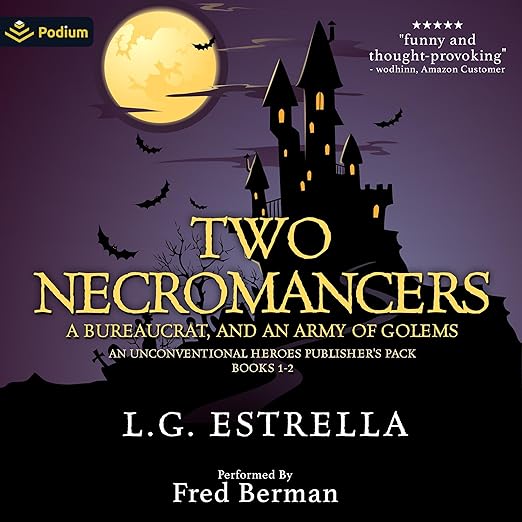
L. G. Estrella’s Unconventional Heroes series follows Timmy, a necromancer of considerable power and minimal people skills who is trying to exit a life of villainy and repeatedly failing. This publisher’s pack contains the first two books, Two Necromancers, a Bureaucrat, and an Elf, and Two Necromancers, an Army of Golems, and a Demon Lord, covering roughly thirteen hours of material. The conceit is that Timmy is objectively dangerous and powerful but surrounds himself with a catastrophically dysfunctional support team: a pink-glasses-wearing ten-year-old apprentice named Katie, a bureaucrat whose primary survival strategy is fainting, and an elf with the world’s worst case of pyromania. The comedy engine is simple: Timmy must accomplish serious things with people who are constitutionally unsuited to helping.
The Deadpan Center That Holds the Ensemble Together
The book’s single cleverest structural decision is positioning its most powerful character as the straight man. Timmy is essentially a very tired professional surrounded by chaos he cannot control, and the humor emerges not from him being funny but from his sustained, exhausted reaction to everyone else’s incompetence. His zombie hydra-dragon-bear getting the better of him in the opening pages sets the tone: this is a book about a man who is very good at something that keeps going wrong anyway.
Fred Berman’s narration serves this structure well. He keeps Timmy’s exasperation pitched at a consistent deadpan that never tips into mugging, which gives the more absurdist moments their full comic value. Reviewer dcarlson identified the book accurately as being in the same neighborhood as Terry Pratchett without being Pratchett, and Berman’s performance occupies that same honest territory: it is good enough to work, without overselling what the material is. His ensemble differentiation keeps group scenes legible throughout, Katie’s cheerful menace, the bureaucrat’s perpetual anxiety, the elf’s oblivious enthusiasm each get their own register.
Two Books, One Escalating Disaster
Book one establishes the group dynamic and uses it to generate individual setpieces. Book two, which covers Timmy’s attempts to earn a pardon from the Council of Mages by completing increasingly dangerous missions, allows the relationships within the group to deepen slightly. Katie’s designs on Timmy’s castle, the bureaucrat’s evolution from pure comic relief into something slightly more capable, the elf’s ongoing pyromania, these do not transform into complex character arcs, but they do give the second book a sense of earned progression. The Demon Lord plot in book two is more ambitious than the Everton Council setup in book one, and the ensemble’s need to function collectively under genuine threat lands with more weight than the first book’s largely episodic structure.
One reviewer described it as over-the-top comedy with a necromancer protagonist, that framing is accurate. The horror elements are defanged entirely; undead creatures are essentially furniture in Timmy’s world, and the lightness extends to the threat structure. Stakes are present but lightly held. If you need genuine darkness or moral weight in your fantasy, this will not supply it.
Thirteen Hours and What They Deliver
At thirteen hours for two complete books, this publisher’s pack represents solid value for listeners who connect with the premise. Estrella writes with a light touch and a clear affection for her ensemble, the Katie and Timmy dynamic in particular generates the book’s warmest moments without ever abandoning the comic register. The worldbuilding is functional rather than elaborate: the Everton Council, the various monsters, the city geography exist as scaffolding for the comedy rather than as ends in themselves. That is a choice rather than a failing, and the book is consistently honest about what it is.
Reviewer G. Messersmith described it as a delightful read and noted that Katie and her ninja rats are among the book’s most distinctive touches. That specificity is real, Estrella’s world has texture in the particulars even when the larger structure is keeping things light. Berman carries the thirteen hours without notable inconsistency.
Who Should Listen and Who Should Skip
Listen if you want fantasy comedy that leans into incompetence and found-family chaos without taking itself too seriously. The Pratchett comparison that keeps appearing in reviews is honest, this is Pratchett-adjacent rather than Pratchett-equivalent, which sets appropriate expectations. At thirteen hours for two books, the commitment is low and the delivery is consistent.
Skip if you want detailed worldbuilding, genuine stakes, or character arcs with real emotional weight. This is comedy first and world second. Also skip if the premise’s reliance on a single joke structure, capable man beset by disasters, sounds like it would wear thin over a full-length listen. For some listeners it will; for others the execution will keep it fresh.
Frequently Asked Questions
Does this publisher’s pack work as a standalone, or do I need to know the series backstory?
It works as a complete standalone, the pack contains Books 1 and 2, and Book 1 starts at the beginning of Timmy’s story with no assumed prior knowledge. You can pick this up without any familiarity with the Unconventional Heroes series.
How dark does the necromancy content get? Is this appropriate for younger teen listeners?
The necromancy is played almost entirely for comedy, undead creatures are treated as furniture, not horror elements. The overall tone is light fantasy comedy with no graphic violence or genuinely dark content. A teen listener comfortable with absurdist fantasy would find nothing troubling here.
Are the two books in this pack roughly equal in quality, or does one outperform the other?
Most readers find Book 2 slightly stronger because the ensemble has settled into its dynamic and the group is required to function collectively under more serious external pressure. Book 1 is more episodic and serves primarily as setup for the characters and world. Both are consistent in tone.
Does Fred Berman differentiate the ensemble members clearly? With five or more recurring characters, is the audio easy to follow?
Berman maintains clear vocal distinctions between the main ensemble, Timmy’s weary deadpan, Katie’s chipper menace, the bureaucrat’s perpetual anxiety, and the elf’s bluff enthusiasm are consistently differentiated. Group scenes remain easy to follow throughout both books.