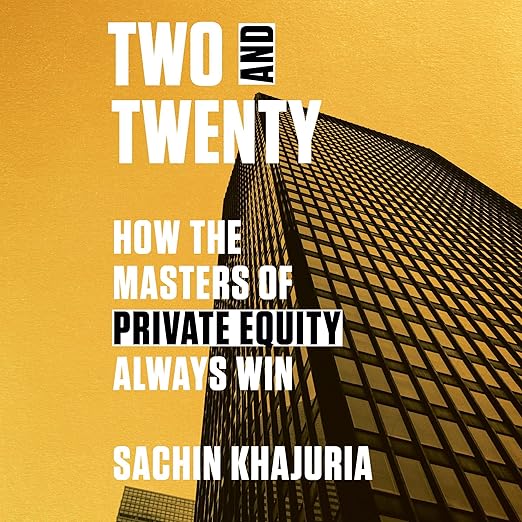
Quick Take
- Narration: Will Damron brings clean, authoritative delivery to Khajuria’s financial prose, moving comfortably between deal sketches and industry analysis without losing momentum.
- Themes: Private equity mechanics, dealmaker culture, the ethics of financial power
- Mood: Insider and confident, occasionally defensive but always lucid
- Verdict: The clearest audio explanation of how private equity actually works, though listeners hoping for scandal or critique will need to look elsewhere.
I spent a Saturday morning with this one, coffee going cold on my desk, genuinely absorbed in what I expected to be dry financial instruction. Sachin Khajuria writes with the assurance of someone who has sat in investment committee rooms and knows every move at the table. That confidence either draws you in or pushes you away depending on your tolerance for unapologetic insider advocacy, and I found myself more charmed by it than I anticipated.
The title refers to the fee structure that defines private equity: a two percent annual management fee on committed capital plus twenty percent of investment profits. If you have heard those numbers but never understood what the people collecting them actually do all day, this audiobook is a more efficient education than anything else I have encountered on the subject.
Our Take on Two and Twenty
Khajuria structures the book around vivid deal sketches, composite scenarios drawn from his career as a partner at Apollo and as a limited partner in other major firms. These sketches are the book’s strongest feature. He walks through how investment committees evaluate deals, what kills a transaction at the last minute, how value is actually created or extracted at portfolio companies, and what eventual exit looks like. The financial press has covered private equity from the outside for decades; this is someone explaining how the machine runs from inside the engine room.
Forbes called it brilliant and an essential read, and it is certainly efficient. At under eight hours, it covers significant ground without becoming a textbook. One reviewer with genuine PE experience called it the most basic and simplified version she had ever encountered, which is fair if you already work in the industry, but for outsiders that accessibility is the point. The FT’s description, that it demystifies private equity, is accurate.
Why Listen to Two and Twenty
Will Damron’s narration suits the material precisely. His voice carries weight without being pompous, and he navigates the vocabulary of private markets, terms like GP, LP, EBITDA, dry powder, and carry, without stumbling or slowing to over-enunciate. For financial audio content, fluency with the jargon matters enormously, and Damron delivers it naturally. The audiobook’s seven-and-a-half-hour runtime is well matched to a long flight or a weekend project.
The deal sketches work particularly well in audio. They read like compressed case studies, short enough that you never lose the thread, detailed enough to feel real. Hearing them sequentially builds a cumulative picture of how PE firms think, how they evaluate risk, and what distinguishes the firms that consistently outperform from those that stumble. Khajuria’s prose is punchy and confident, and Damron’s delivery matches that register without tipping into the performative urgency that can make financial audio feel like a motivational seminar.
The book’s seven-and-a-half hours also compare favorably to the doorstop PE histories that preceded it. Khajuria is not trying to write a comprehensive institutional history of KKR or Blackstone. He is trying to explain a mentality, the principal mindset he returns to throughout, and that focused scope keeps the runtime honest.
What to Watch For in Khajuria’s Framing
Readers expecting a balanced account of private equity’s social and economic effects will find the book one-sided, and that is worth knowing before you start. Khajuria is explicitly a defender of the industry. He addresses criticisms of private equity but does so as an advocate, not an arbiter. The book does not examine job losses at portfolio companies, the effects on pension funds that don’t achieve projected returns, or the broader debates about financialization of the economy. If you want those arguments, you will need other sources alongside this one.
The book also leans heavily on the principle that PE firms think like principals rather than advisors, a framing Khajuria finds clarifying and repeats in several contexts. It is genuinely useful as an organizing idea, but listeners should notice how often it functions as justification for aggressive behavior that might otherwise raise questions.
Who Should Listen to Two and Twenty
This is ideal for anyone who keeps encountering private equity in financial news and wants to understand the mechanics rather than just the headlines. Business school students, journalists covering finance, or anyone whose employer is PE-backed will find it illuminating. If you already work in PE, the book will feel thin. If you are a committed critic of the industry, you will find the framing frustrating. Everyone else gets a rare, clearly written look at one of the more opaque corners of global finance.
Frequently Asked Questions
Is Two and Twenty appropriate for listeners with no finance background?
Yes, though it helps to have basic familiarity with investment concepts. Khajuria explains PE-specific terms as he introduces them, and Will Damron’s narration keeps the pacing accessible. You do not need an MBA to follow it, but some comfort with financial vocabulary will make it more enjoyable.
Does the audiobook cover the criticism that private equity harms workers at portfolio companies?
Not in depth. Khajuria is a defender of the industry, and while he acknowledges that PE attracts critics, he does not engage substantively with arguments about labor practices, debt loading, or social costs. Listeners wanting a balanced debate will need to supplement this with other sources.
How do the deal sketches in the audiobook work, are they real transactions?
Khajuria describes them as composite scenarios drawn from his experience, not blow-by-blow accounts of specific deals. They are detailed enough to feel grounded in real situations but constructed to illustrate principles rather than expose confidential transactions.
Will Damron has narrated many business audiobooks, does his style work for this material?
Well. Damron’s delivery is confident and fluent with financial terminology, which is essential for this kind of content. He keeps the pacing steady without rushing through analytical sections, and his tone matches the book’s insider assurance without tipping into arrogance.