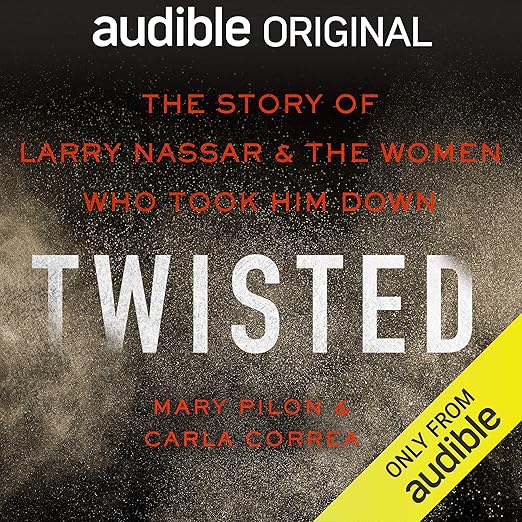
I started Twisted on a long drive, which turned out to be the wrong context. Not because the audio is bad, it is not, but because the subject matter requires a different kind of attention than highway listening allows. Mary Pilon and Carla Correa have produced something between an investigative audiobook and a documentary, and the testimonies embedded in it, survivors speaking in their own voices about what Larry Nassar did to them, deserve more than background listening.
The Nassar case needs no introduction. More than 150 women confronted him at his sentencing in early 2018 after he pleaded guilty to federal child pornography charges and multiple counts of sexual assault. Twisted was produced as an Audible Original in 2019, one year after that sentencing, when the immediate shock of the testimony was still reverberating. What Pilon and Correa set out to examine was not just what Nassar did but how he did it for as long as he did, and who knew, and when, and why they did nothing.
First, the Big Picture
The most important thing this audio production offers is direct survivor testimony, voices that print journalism can quote but cannot replicate. When a survivor speaks in her own voice about what she experienced, what it cost her to come forward, and what she needed from institutions that failed her, the register is categorically different from a reporter's paraphrase. Pilon understands this, and the structure of the piece foregrounds those voices while providing the investigative framework that contextualizes them within the broader institutional failure story.
The production quality is the honest caveat. Several testimonies were recorded in environments with audible background noise, and at least one reviewer found the incidental music too loud against the vocal track. These are not catastrophic problems, but they are real ones, and they matter for a subject that deserves production rigor proportional to its seriousness. At five hours and seventeen minutes, this is also significantly shorter than comprehensive book-length accounts of the same scandal, which means it functions more as a companion piece than a definitive account.
Why Twisted Works as an Audiobook
The institutional story is the one this production handles best. Pilon and Correa trace Nassar's ability to operate through the United States Olympic Committee, USA Gymnastics, and Michigan State University with the clarity of reporters who have done their homework. The argument that individual predation is always also institutional failure, that the systems designed to protect children failed spectacularly and deliberately, is made without sentimentality and without simplification.
The audio format's access to survivor voices is the irreplaceable element. Readers who have already consumed print coverage of this story will find those voices justify the listen even if the investigative narrative covers familiar ground. There is simply no substitute for hearing someone tell their own story in their own voice, and Twisted provides that access in a way print journalism cannot.
A Few Reservations
The overall rating of 2.8 reflects a very small sample and skews heavily on production complaints rather than content objections. The one detailed negative review is specifically about audio mixing, not about the reporting or the survivor testimonies. That context matters when interpreting the aggregate score, which is not representative of the work's actual quality.
This is not a complete account of the Nassar scandal. It functions more as an extended audio essay and documentary than as comprehensive investigative journalism. Listeners who want depth should treat it as a companion piece to longer reporting rather than a standalone account of everything that happened.
Who Should Listen to Twisted
Anyone who wants to hear survivor testimony in the survivors' own voices will find that access worth the production limitations. Listeners tracking the institutional failure story of elite sports culture will find Pilon's reporting efficiently structured and factually grounded.
Those who need high-quality audio production, or who have already absorbed multiple long-form accounts of this case, will find five hours and seventeen minutes less revelatory than they might hope. The subject is important. This particular treatment is a meaningful starting point, not a comprehensive reckoning.