Before You Press Play
- Narration: Bronson Pinchot balances theatrical range with restraint, differentiating a large Gilded Age cast without losing noir atmosphere.
- Themes: Hidden queer history, inherited fortune, family secrecy
- Mood: Noir-tinged and investigative
- Verdict: A meticulously researched true story that rewards listeners willing to sit with archival density alongside the romance.
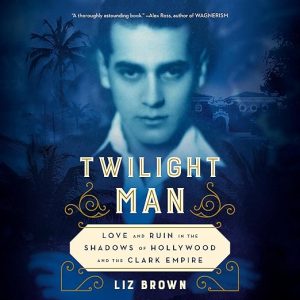
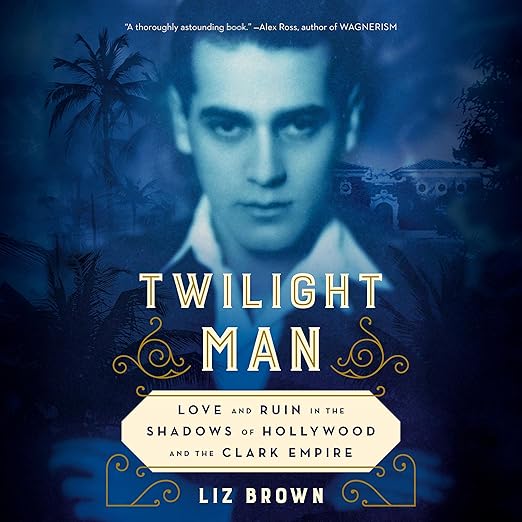
Harrison Post spent decades erased from the Gilded Age history his own life had shaped, so what finally pulled him back into view was a photograph his own family had forgotten existed? Liz Brown, William Andrews Clark Jr.'s great-grandniece, stumbled on that portrait and followed it into a story her own relatives had buried, and this audiobook spends thirteen hours tracing exactly how deep that burial went.
Biography, Romance, and the Bite of Fiction
The facts alone would carry a lesser book: Clark, heir to a Montana copper fortune and founder of the Los Angeles Philharmonic, kept a lover named Harrison Post through the boom years of 1920s Hollywood, and when Clark died suddenly, Post inherited a fortune along with a family's determined effort to take it back. What follows moves from Prohibition-era Hollywood glamour to Nazi prison camps to Mexico City nightclubs, a genuinely wide arc for a story this personal, and Brown never lets the scope overwhelm the human specifics of Post's own unraveling.
The Los Angeles Review of Books called it 'biography, romance, and nonfiction mystery, carrying with it the bite of fiction', and that triple description is accurate rather than promotional. Brown writes with a researcher's rigor about court documents and estate battles while never losing the emotional throughline of two men whose money and sexuality made them targets from every direction, including, eventually, from Post's own family.
Bill Dedman's cover blurb connects this book directly to his own Empty Mansions, his bestseller about Huguette Clark, William Andrews Clark Jr.'s half-sister, and that link is worth knowing going in. The Clark family's buried secrets clearly ran in more than one direction, and Brown's book effectively functions as a companion piece uncovering a parallel hidden story from the same Gilded Age copper fortune that produced Huguette's own reclusive, headline-making later life.
The Triple Threat Behind the Twilight Title
The title itself rewards a second look once the story is finished. 'Twilight Man' captures Post's entire existence: a life lived in the in-between hours, visible enough to enjoy Hollywood's high life but never fully out in daylight, threatened simultaneously by the district attorney, his own employer's family, and eventually his own relatives. That triple threat, coming from every direction a person might expect protection instead, is the book's real engine.
Post's own trajectory before Clark enters the picture matters too: a 'former salesclerk' who found himself, almost by accident, at the center of Hollywood's wealthiest social circles. That inverted Cinderella arc, the sudden elevation followed by an even more sudden reversal after Clark's death, gives the book a shape closer to classical tragedy than a simple rise-and-fall celebrity story.
The Clark family's public philanthropic legacy, the Los Angeles Philharmonic and the Hollywood Bowl among the era's most visible cultural gifts, sits in stark contrast to how privately vicious the same family could be when a fortune and a reputation were on the line. Brown lets that irony speak for itself rather than hammering it, letting listeners draw their own conclusions about a family capable of building beloved civic institutions while working just as hard to erase Harrison Post from their own history.
Pinchot's Range Keeps a Sprawling Cast Distinct
Bronson Pinchot narrates with real theatrical range without ever tipping into overplaying the material, which matters enormously for a book built around a large cast of socialites, lawyers, and Hollywood-adjacent figures who each need to stay distinct across thirteen hours. His own background as a working actor registers here in a way that feels genuinely apt, since identity and performance sit at the thematic center of Post's entire story, a man who spent his public life playing a role his private life could never fully match.
The noir atmosphere Brown builds on the page survives intact in Pinchot's reading, helped by pacing that never rushes the investigative sections just to get back to the more overtly dramatic ones. Dense archival material, court filings, family correspondence, newspaper clippings, comes through legible rather than dry, which is no small feat for material this document-heavy.
A Genealogical Link to the Andrews Family
This is closer to an investigative biography than a straightforward romance, and listeners drawn in purely by the 'romance' half of that Los Angeles Review of Books description should know the legal and archival material gets real weight here, particularly in the sections tracing the inheritance battle after Clark's death.
One listener reviewing the book turned out to have a genuine genealogical link to the Andrews family at its center, discovered only after reading, which speaks to how thoroughly Brown researched the surrounding social world rather than isolating her subjects. That level of documentary density is a strength, but it does mean pacing occasionally slows for readers expecting a purely propulsive narrative.
Why Dedman's Noir Fairytale Label Actually Fits
Sheila J's review describes being 'swept into the world' Brown reconstructs, crediting the writing for balancing lyrical description with investigative rigor, and that balance is worth flagging as a genuine achievement rather than a given. Biographies built on court documents and estate filings often read dry by necessity; Brown's manage to stay propulsive without sacrificing the paper trail that makes the story verifiable rather than speculative.
The book's supporting cast gets real texture too; Post's Hollywood circle, Clark's household staff, and the family's own attorneys all register as distinct people rather than functional background figures, a byproduct of how deeply Brown mined court records and estate correspondence rather than relying on secondhand celebrity-biography shorthand.
Dedman's cover description, a 'noir fairytale,' is a genuinely precise genre label rather than jacket-copy flattery, since the book combines fairytale-style sudden fortune with the moral shadows and inevitable comeuppance structure of classic noir. Listeners drawn specifically to that hybrid tone, rather than to straightforward biography or straightforward romance, will find the label earns its place on the cover.
How Families Shape Their Own Legacies
Readers of Gilded Age and Hollywood history, LGBTQ+ biography fans, and anyone drawn to noir-structured true stories about buried family secrets will find this exactly as absorbing as its reviewers suggest, especially anyone who wants a true story with the shape and payoff of a well-built novel.
The book's closing thesis, an exploration of 'how families shape their own legacies, and the lengths they will go in order to do so', extends well past this one family's specific scandal into a broader question about who controls a legacy's official version, which is part of what gives the ending its weight beyond simple resolution of the inheritance dispute.
Readers expecting a fast-moving plot with minimal legal or archival detail should adjust expectations before starting, since the inheritance battle and its supporting documentation form a real backbone of the back half rather than a brief detour.
How does Bronson Pinchot's narration handle this audiobook's large cast of Gilded Age figures?
With real theatrical range kept carefully in check, differentiating socialites, lawyers, and family members clearly across thirteen hours without ever tipping into overplaying any single voice.
Do I need prior knowledge of the Clark family fortune to follow this audiobook?
No. The book builds the family's Montana copper-mining background and Los Angeles Philharmonic connections into the narrative itself, so no outside research is necessary going in.