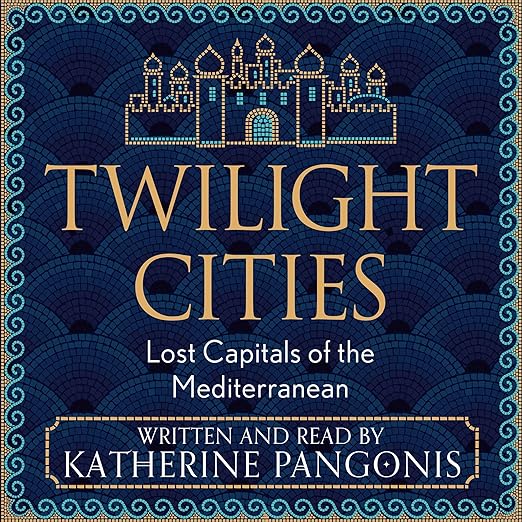
Quick Take
- Narration: Katherine Pangonis reads her own work with real authority, blending the scholarly and the personal in a way that suits the book’s dual structure.
- Themes: Decline of once-great Mediterranean cities, the fragility of empire, history as lived geography
- Mood: Elegiac and richly atmospheric
- Verdict: A Somerset Maugham Award winner that earns its prize, combining rigorous history with first-person travel in five cities that most listeners will know only by name.
There is a particular kind of historical writing that makes you want to book a flight. I was halfway through the Carthage chapter of Twilight Cities when I opened a tab to look at airfares to Tunisia. Katherine Pangonis has the rare ability to make you feel the residue of vanished civilizations in the present geography of a place, and that quality drives this book from its opening pages.
The premise is deceptively simple: five Mediterranean cities, Tyre, Carthage, Syracuse, Ravenna, and Antioch, that were once among the most significant in the ancient world and have now faded into relative obscurity. Pangonis, a historian, sets out on a voyage to each of them, combining primary research with on-the-ground travel to build a portrait of what it means for a great city to decline. The result won the 2024 Somerset Maugham Award, which is one of British publishing’s most respected prizes for travel writing.
Our Take on Twilight Cities
The range of historical material Pangonis covers across five cities is genuinely impressive: Alexander the Great’s siege of Tyre, Nebuchadnezzar’s campaigns, the Punic Wars and the fall of Carthage, Archimedes at Syracuse, the Byzantine period at Ravenna, the Arab and Norman conquests at Antioch. The connecting thread is not just Mediterranean geography but the question of what glory leaves behind and what it means to be a city that history has largely forgotten while Rome, Istanbul, and Jerusalem have not.
Pangonis’s own travels give the book its emotional core. Her account of reaching Antioch just as the 2023 earthquake devastates the region is the book’s most powerful section, turning abstract historical decline into something immediate and visceral. One reviewer described wanting to travel to these places themselves after listening, which is the highest compliment you can pay this kind of historical travel writing.
Why Listen to Twilight Cities
The self-narration is one of the book’s assets. Pangonis reads with the rhythmic confidence of someone who has given many lectures and knows how to hold a room, but she also brings a personal quality to the travel sections that a hired narrator could not replicate. The balance between the scholarly and the experiential feels natural throughout.
At nearly twelve hours, the audiobook has room to develop each city properly rather than rushing through. Listeners who come in knowing nothing about Ravenna or Tyre will leave with a genuine sense of their histories and why they matter. This is history writing that functions as orientation as much as argument.
What to Watch For in Twilight Cities
One critical review on record is pointed: a reviewer with specialist knowledge of ancient history found factual errors in the Syracuse section, including what they describe as a fabricated Cicero quotation and other mistakes. This is the review that costs the book a star in the aggregate and deserves to be taken seriously. Listeners without specialist background are unlikely to notice, but those with academic training in classical history may find the errors disruptive.
The book’s structure, moving city by city rather than chronologically, means the time period jumps considerably between chapters. Listeners accustomed to linear historical narrative may need a moment to reorient each time Pangonis shifts location and era.
Who Should Listen to Twilight Cities
This is for history enthusiasts who want to understand the Mediterranean world beyond the standard Rome-Athens-Jerusalem triad, and for travel readers who enjoy first-person narrative as a frame for serious historical content. Listeners who enjoyed Mary Beard’s SPQR or Tom Holland’s Rubicon will find Pangonis working in a comparable space, though with a more personal travel-memoir register. Those with deep specialist knowledge of classical antiquity should be aware of the critical factual concerns raised by at least one reviewer.
The Somerset Maugham Award is worth taking seriously as a signal. It is awarded annually for a significant work of travel or biography by a writer under thirty-five, and the 2024 selection speaks well for both Pangonis’s writing and for the ambition of the project. Twilight Cities is not a debut in the tentative sense. It reads like a book written by someone who knew exactly what they wanted to do and executed it.
Frequently Asked Questions
Do I need prior knowledge of ancient Mediterranean history to follow Twilight Cities?
No. Pangonis writes accessibly and provides enough context for each city that listeners without specialist background can follow comfortably. The book is designed to introduce these cities to a general audience.
How much of the audiobook is travel memoir versus academic history?
The two are genuinely interwoven. Each city gets both historical coverage drawn from primary sources and research, and a travel-present section in which Pangonis visits the contemporary location. The balance varies by city.
Is Katherine Pangonis’s narration of her own work a strength or a weakness for audio?
Reviewers who enjoyed the book found her narration authoritative and personal. She is a confident reader. Listeners who prefer polished professional narration may notice the difference from a dedicated audiobook narrator.
Does the book address the 2023 earthquake at Antioch, and if so, how?
Yes. Pangonis was traveling to Antioch at the time of the earthquake and incorporates that experience into the book. It becomes one of the most affecting passages, connecting the ancient theme of decline to a contemporary catastrophe.