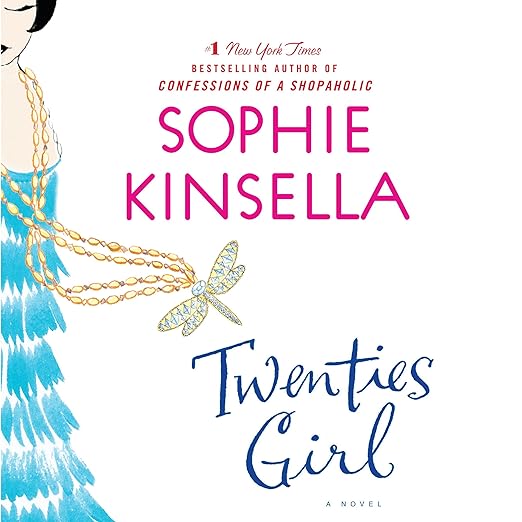
I put on Twenties Girl on an afternoon when I needed to laugh without feeling guilty about it, which is a specific need and one that Sophie Kinsella has reliably served for twenty years. I had read the novel once, years ago, and remembered liking it. What I had forgotten was how fully the book commits to its premise: the ghost of a 105-year-old great-aunt who died in a care home is feisty, opinionated, art deco, and entirely immune to the concerns of her twenty-something great-niece. The dynamic is immediately funny and then, quietly, something more.
Lara Lington is a mess in the most Kinsella-specific way: not a catastrophe, but a person whose life has slid sideways in several directions simultaneously. The start-up company is failing. Her business partner has absconded to Goa. She is not exactly stalking her ex, she is just texting him three or four times a day to understand exactly what went wrong. And then the funeral of a great-aunt she never met becomes the beginning of an increasingly unhinged mission to find a lost necklace.
The joke structure in Kinsella's best work depends on a kind of escalating social mortification, and Twenties Girl has some of her finest set pieces in that vein. Sadie, the ghost, can only be heard and seen by Lara, which means Lara must relay increasingly bizarre instructions in public while appearing to hold completely normal conversations. The slapstick logic is impeccable, and Rosalyn Landor's narration is the mechanism that makes it land.
Landor has been narrating Kinsella's work for years, and the relationship between narrator and material is audible. She understands where the timing requires a pause and where it requires acceleration, and she navigates the shifts from broad comedy to genuine feeling without making the transitions feel abrupt. The reviewer who has read this four or five times over the years and loved every page is describing exactly the kind of book that depends on this kind of narration to sustain its emotional register through multiple encounters.
What Sophie Kinsella Gets Right
Kinsella is consistently undervalued as a writer of feeling. The comedy in Twenties Girl is real and sustained, but what distinguishes this novel from lighter fare in the same genre is what Sadie eventually represents. She is a woman who lived a full century, lost everyone she knew, and ended in a care home with one unfinished piece of business. The intergenerational female friendship that develops between Lara and Sadie, between a woman who has run out of time and a woman who has not yet worked out how to use hers, is genuinely moving.
LCskater's review, written while visiting a 101-year-old aunt in a nursing home, captures this dimension more acutely than any plot summary can. That kind of personal resonance is what the novel is reaching for underneath the ghost comedy, and it arrives without announcement or sentimentality.
Where Sophie Kinsella Loses Some Ground
The novel is fifteen hours at audio pace, which is long for a romantic comedy. It earns its length through set piece accumulation rather than plot complexity: each chapter adds another layer of complication to the central mission while advancing both the romance and the Sadie-Lara relationship. Some listeners may find the middle section, in which the necklace investigation expands and the love interest arrives, slightly over-extended before the final convergence.
The romantic subplot involves a character whose identity and significance is not immediately clear, and Kinsella keeps that question productively open for longer than expected. Listeners who want the romance to be the clear center of the story from early on may find the ghost-adventure material somewhat distracting; listeners who want the ghost-adventure material may find the romance well-timed when it arrives.
Who Sophie Kinsella Is Writing For
Kinsella readers who have not yet encountered this one will want to. It sits alongside Confessions of a Shopaholic as one of her most consistently loved novels, with the additional distinction of being, as one reviewer put it, the most beloved out of all of her books in terms of personal affection. Those new to Kinsella will find this an excellent entry point. Anyone seeking literary fiction without comic intentions should look elsewhere, but those who can hold comedy and feeling simultaneously will find this fifteen-hour listen earns every minute.
Is Rosalyn Landor's narration of Twenties Girl part of a longer collaboration with Sophie Kinsella?
Yes, Landor has narrated a number of Kinsella's novels over the years, and her familiarity with Kinsella's comic style is audible. Her timing is specifically calibrated to the physical comedy and social mortification set pieces that Kinsella relies on, and she handles the emotional shifts with equal confidence.
Does Twenties Girl stand on its own, or is it connected to Kinsella's other books?
It stands completely alone. It has no shared characters with Kinsella's other novels and requires no prior familiarity with her work. It is equally accessible as a first Kinsella listen or as an addition to a longer reading of her catalogue.
Multiple reviewers mention returning to this book several times. What accounts for its rereadability?
The comedy holds up on repeat listening because Landor's timing is precise enough that the jokes still land even when you know they are coming. But the more durable element is the Sadie-Lara relationship, which accumulates emotional weight that is easier to feel on a second listen than a first. The ending, in particular, tends to land harder when you know where the book is going.