Quick Take
- Narrator: Steve White sustains a controlled, non-sensational tone across fifty-one hours that serves Green's inside-the-killer perspective without veering into exploitation.
- Subjects: Criminal psychology from the inside, geographic isolation as a predator's tool, scale of human darkness across eras
- Tone: Relentlessly dark and forensic, with occasional flashes of genuine psychological insight
- Bottom line: A well-researched anthology that holds its quality across twelve cases better than the genre average, though the runtime demands a specific kind of listener.
Anthology true crime presents a particular craft challenge: how do you write twelve distinct cases, each with its own geography, psychology, and body count, without the entries collapsing into a numbing sameness? Ryan Green has now produced three volumes of this format, and what becomes clear listening to Twelve from Hell 3 as an audiobook is that the answer lies in perspective. Green narrates from inside the killers' heads, which is uncomfortable by design, and in audio the choice lands with an unsettling immediacy that the page version can soften.
Steve White's narration is the critical variable here. He reads with a controlled evenness that refuses to editorialize, which is precisely what Green's approach demands. When the text sits inside the thought patterns of Paul John Knowles or Herbert Mullin, a narrator who pushed dramatic emotion would tip the material into exploitation. White keeps it clinical without letting it become cold. Across fifty-one hours, that tone holds more consistently than most narrators could manage across a single audiobook of normal length.
A Killer Who Believed He Was Preventing Earthquakes
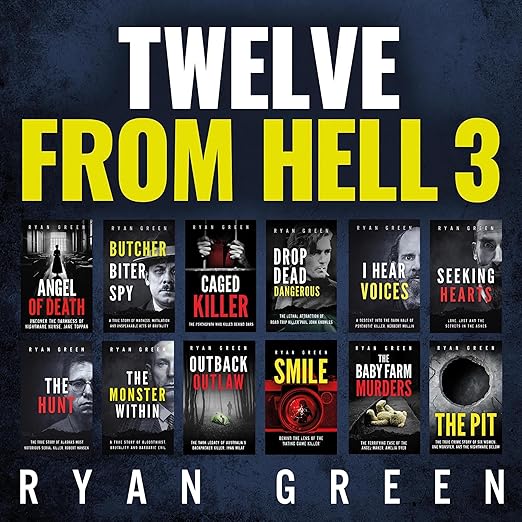
The collection spans an extraordinary geographic and typological range: Alaska's Robert Hansen hunting his victims in wilderness he knew they couldn't navigate, Amelia Dyer running a Victorian baby-farming operation of staggering scale, Jane Toppan using her nurse's access to poison patients for decades, Ivan Milat dispatching backpackers in the Australian outback. Green is not interested in any one criminal profile; he seems genuinely committed to understanding what varies across killers who might superficially appear to share a category.
The strongest entries tend to be the ones where Green's access to documented psychology is richest. The Herbert Mullin chapter, covering a psychotic killer who believed his murders were preventing earthquakes, is particularly well-researched and genuinely disturbing in a way that goes beyond the physical horror. Green reconstructs Mullin's internal logic with enough fidelity that the reader understands, without approving, how a fractured mind reaches catastrophic conclusions. That kind of insight separates Green's work from the more sensational end of the true crime market.
Well Researched, Compelling, and Respectful
At over fifty-one hours, this is a substantial commitment, and it rewards listeners who approach it as a rotating series of case studies rather than a single narrative. The format is similar to an anthology television series: each story is self-contained, the through-line is Green's authorial sensibility rather than a shared set of characters. Listeners who found volumes one and two rewarding will find the same structural logic here, with a comparable distribution of strengths across entries.
One reviewer called it 'well researched, compelling, and respectful,' and the word 'respectful' is doing real work there. True crime as a genre has a complicated relationship with its subjects, both killers and victims, and Green makes a consistent effort to humanize the people who died, not just the people who killed. That's not always easy when narrating from the killer's perspective, but the cases where he threads that needle most successfully are genuinely memorable.
Long-Form Background Listening Across Fifty-One Hours
The anthology format means quality varies across the twelve entries. Some cases are more extensively documented than others, and the chapters where Green has less to work with feel thinner, relying more on reconstruction and inference than on the archival depth that makes the best entries stand out. The 'Smile' chapter on the Dating Game Killer, Rodney Alcala, is one where the material is so widely covered elsewhere that listeners familiar with the case may find Green's account less revelatory. The Alaska and outback cases, perhaps because they're less saturated in popular true crime coverage, feel fresher.
White's narration is consistent, but the sheer runtime means listeners should approach this as long-form background listening rather than something to absorb in focused sessions. The individual chapters run long enough to work as standalone listens during commutes or exercise, which is actually the format's practical strength.
The collection's structural approach, alternating between geographic and psychological diversity across the twelve cases, prevents the tonal sameness that anthology true crime often falls into. The Australian outback and the Victorian baby-farming operation occupy such different moral and physical landscapes that each case resets the listener's frame of reference. Green understands that sustained darkness without variation becomes numbing rather than affecting, and the anthology's range is the editorial intelligence that keeps the material from collapsing into undifferentiated horror across fifty hours of listening.
Green's prose style across the anthology is consistently functional: clear, chronological, and resistant to the ornate sensationalism that lesser true crime writers lean on when the facts alone seem insufficient. That restraint is part of what keeps the collection's overall quality high even across cases with uneven source material. Listeners who want lurid dramatic license will find Green disciplined to a fault; those who prefer documentation over dramatization will find the approach exactly right.
This Asks for the Listener's Full Attention
Dedicated true crime listeners who have already worked through the earlier volumes in this series will find the third installment a solid continuation. The format rewards genre regulars who have the stomach for sustained darkness and appreciate research over dramatization. Newcomers to Green's work can start here without having read the earlier volumes, since each case is self-contained, but they should know the content warnings on the box are serious: several of these cases involve children, sexual violence, and sustained psychological horror. This is not ambient listening; it asks something of the listener's attention and emotional equilibrium in return.