Quick Take
- Narration: Adrian Hull delivers clean, professional narration that keeps the promotional material grounded.
- Themes: AI monetization, freelance income, prompt engineering
- Mood: Optimistic and practical, though lightly padded
- Verdict: A serviceable entry point for AI-income beginners, but experienced readers will find the depth disappointing.
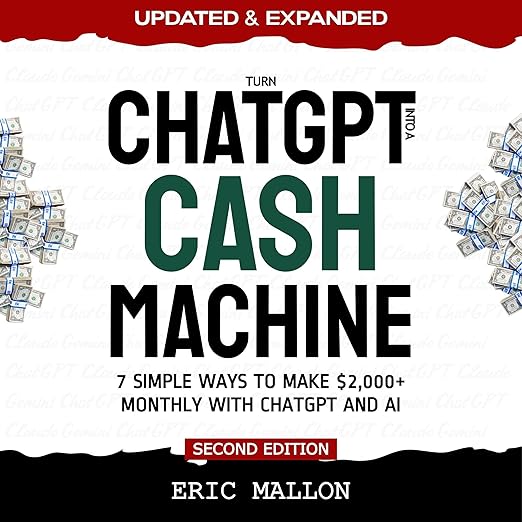
I picked up this one on a Tuesday afternoon when I was sorting through a backlog of AI-related titles that had been sitting in my queue. At just over four hours, Eric Mallon’s Turn ChatGPT into a Cash Machine promises to be the practical shortcut that a lot of longer, denser business titles don’t manage to be. Mallon, narrated by Adrian Hull, pitches a second edition with expanded content covering tools like Sora, Nano Banana, and Descript alongside ChatGPT. The setup is straightforward: here is how you use AI to earn money, and here is proof it works, with the author citing his own monthly income of three to four thousand dollars from client projects, writing, and marketing.
The appeal is obvious. The concern is equally obvious. A book with a 3.6 average rating on a promising premise is almost always a book where the gap between title and substance is wider than it should be.
Our Take on Turn ChatGPT into a Cash Machine
Mallon’s core argument is genuinely useful, even if it isn’t new. AI tools can dramatically reduce the time cost of producing content, handling client communication, and running small freelance operations. The second edition has clearly been updated to reflect the expanding AI tool ecosystem, and the inclusion of specific workflow examples and income scenarios gives readers something concrete to work with. For someone who has never thought systematically about integrating AI into their earning life, this audiobook covers the ground efficiently within its four-hour runtime. Hull’s narration is measured and professional, making even the more promotional passages feel grounded rather than breathless.
Why Listen to Turn ChatGPT into a Cash Machine
The primary reason to spend time with this title is its accessibility. Mallon writes for people who are not technical, and that discipline pays off. He covers prompt engineering without requiring any coding knowledge, and his business plan framework is designed for someone starting from zero rather than someone with an existing company. The section on income scenarios for creators, retailers, educators, and freelancers is the most practically grounded part of the book, and listeners who fall into one of those categories will likely find specific ideas they can act on immediately. The author’s willingness to disclose his own earnings adds a transparency that many business titles deliberately avoid.
What to Watch For in Turn ChatGPT into a Cash Machine
The rating tells part of the story. At 3.6 stars across 106 ratings, this is a book that clearly works for some readers and frustrates others. The likely dividing line is expectations. Listeners hoping for a sophisticated, data-backed business strategy will find the content thin. The promised income claims (breaking free from the weekly grind, multiple income streams) lean promotional, and the coverage of third-party tools like Sora and Nano Banana is necessarily surface-level given how quickly that landscape changes. This is a book of ideas and starting points, not a complete operational manual. The four-hour runtime also means depth is limited throughout, some sections feel more like chapter headings than fully developed arguments.
Who Should Listen to Turn ChatGPT into a Cash Machine
This works best for listeners who are new to the idea of monetizing AI tools and want a low-commitment, accessible introduction to the possibilities. Freelancers, side hustlers, and career-changers who are curious but not yet informed will get genuine value from the overview. If you already have a functioning AI workflow or you’ve read more substantial business titles on this topic, the content will feel familiar and rushed. The short runtime makes it a reasonable gamble, but go in knowing what you’re getting: a wide-angle survey, not a technical guide.
One element worth noting separately: Mallon’s transparency about his own workflow and income is genuinely unusual in this genre of book. AI monetization titles tend to traffic in vague possibility rather than disclosed specifics, and the decision to name actual monthly figures and describe concrete client work gives this book a credibility that its title alone would not earn. Whether that credibility extends throughout is a question the 3.6 rating leaves open, but it is a meaningful distinguishing feature compared to the broader category of AI income guides flooding the market in 2025.
Frequently Asked Questions
Is the second edition significantly different from the first?
Mallon describes the second edition as expanded with new content, specifically the addition of tools like Sora, Nano Banana, and Descript alongside core ChatGPT strategies. If you’ve read the first edition, the new tooling coverage and updated income scenarios are the main reasons to revisit.
Do you need any technical background to follow along?
No. Mallon writes explicitly for non-technical listeners. The prompt engineering sections assume no coding knowledge, and the business frameworks are designed for beginners starting from scratch.
Is Adrian Hull a good fit for this kind of business content?
Hull delivers a clean, professional narration that suits the material. He keeps the pacing steady without making the promotional sections feel overwrought, which is a real risk with AI monetization content.
Why is the rating only 3.6 given the optimistic pitch?
The gap between the book’s title promises and its depth of coverage seems to be the consistent complaint. Listeners expecting a detailed operational playbook tend to find the content too surface-level. Those who come in looking for an accessible overview of possibilities tend to rate it much higher.