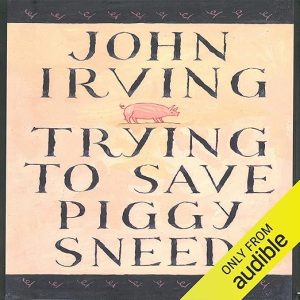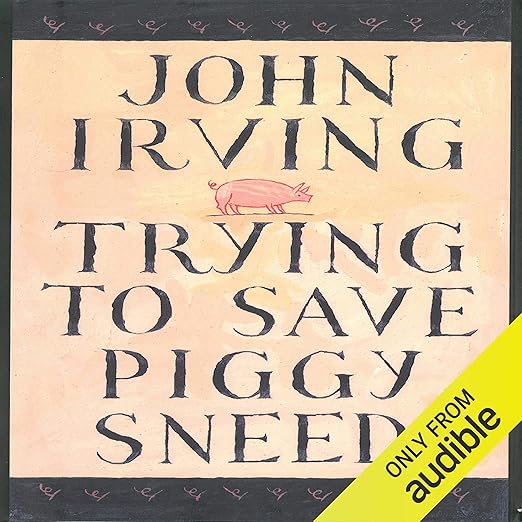
A 3.7 average on a John Irving title is unusual enough to be worth explaining before anything else, and the explanation turns out to be structural rather than a matter of quality. This audiobook is not a novel. It is a twelve-piece miscellany of memoir, short fiction and literary appreciation, assembled and annotated by a writer at the height of his fame, and a substantial share of the people who rated it clearly arrived expecting the thing Irving is famous for. Knowing what is actually in the eight hours changes the experience completely.
Half a Dozen Stories in Twenty Years
The architecture is three-part and deliberate. It opens with three memoirs, including an account of Irving's dinner with President Ronald Reagan at the White House, and the longest of them, The Imaginary Girlfriend, functions as the core of the collection and as a compact autobiography. The middle section is fiction: half a dozen stories, which the publisher notes are all the short stories Irving considers finished across a career of thirteen novels. The final section holds three essays of appreciation, one on Grass and two on Charles Dickens.
That last figure deserves a moment. Half a dozen finished stories in more than two decades of working life is a startling ratio, and it tells you something about Irving as a craftsman that no interview ever would. One of them, Interiors, won the O. Henry Award. Another was, according to the author's own notes, presented and sold to Playboy as the work of a woman. These are not offcuts swept into a volume to satisfy a contract. They are the survivors of a very heavy filter, and the collection is honest about the filtering.
The device that holds all of it together is Irving's Author's Notes, one attached to each of the twelve pieces, explaining the circumstances of composition. An election-year diary of the Bush and Clinton campaigns accompanies the Reagan memoir. The notes on the Playboy story explain the pseudonymous submission. This is where the book becomes something other than a clearing of the desk drawer, because the notes turn a miscellany into an argument about how a working writer's mind operates across forms.
Notes That Narrate the Seams Between Pieces
The reviewer who understood the book best is Graham Gersdorff, who gave it five stars specifically for its construction. "I gave this book five stars in part for the way it was organized", he writes, and then makes an argument I have not seen anyone else make about short fiction: "Virtually all short story collections have 10-12 stories, and that's it, which may be one reason that short story collections generally don't sell as well as novels." His point is that a story collection offers the reader no scaffolding between pieces, and that Irving's notes supply exactly that.
In audio, that structural insight matters more than it does in print. A listener cannot see the table of contents, cannot flick ahead to gauge how long a piece runs, and cannot tell by page thickness where one thing ends and the next begins. Irving's notes solve that navigation problem by talking to you between the pieces, and the effect is closer to an author reading with commentary than to a straight anthology. Eight hours of otherwise unlabelled short fiction would be a difficult listen. This is not, because the seams are narrated.
Joe Barrett reads it, and the assignment demands a particular kind of flexibility. Within a single file the narrator moves from wrestling-room memoir to White House anecdote to a story published under a false gender to two essays about Dickens, and the register has to shift without ever tipping into performance. Irving's humour is dry, delivered flat, and dependent on the reader not signalling it. What the material needs is a narrator comfortable holding a level, literate tone across genuinely disparate content, which is what carries a collection this varied. None of the visible reviews assesses the narration, so I am describing the demand rather than the delivery.
A Good Way to See Inside His Head
The expectation problem is real and it is the main reason for the rating. Case Quarter, who writes in lower case throughout and had read half a dozen Irving novels first, describes the trap exactly: "having read a half dozen of his novels, my impression was that he did not write in other forms", and the title read to him like a novel he was looking forward to. He gave it four stars anyway. Others were less forgiving, and I suspect a good share of the ratings below four come from listeners who thought they were buying fiction.
The second complaint is one you should weigh honestly. Deni Lou, at three stars, writes that "At times he tends to go on and on about some little detail you just couldn't care less about", before conceding: "But if you are a fan of John Irving's writing it is a good way to see inside his head. I just wish it was more interesting in there." That is a hard sentence, and it is also a fair description of the risk in any writer's miscellany. Author's Notes about the composition of a story are fascinating if you care about the writer and tedious if you do not.
So this is not the entry point. Anyone meeting Irving for the first time should start with one of the novels the publisher lists on this very page, then come back here once the voice is familiar enough that the annotations mean something. Two practical notes as well: the running time of seven hours and fifty-nine minutes covers twelve separate pieces, so expect an average of well under an hour each and plan your sessions around the seams rather than around chapters. And the memoir-and-biography category placement is accurate for the first third and not for the rest.
Better Company Than Its Rating Implies
Committed Irving readers are the obvious audience, particularly anyone who has finished several novels and wants to understand how they were made. Writers and writing students get more here than from most craft books, because the Author's Notes describe process without ever posing as instruction. Listeners who enjoy literary miscellanies, and who like the sensation of an author talking between the pieces, will find the format more companionable than a straight story collection.
Anyone new to Irving should go elsewhere first, and so should listeners who want a sustained narrative rather than twelve separate ones. If detail about the circumstances of composition strikes you as inside baseball, one reviewer's warning about going on at length applies directly to you. Read as what it is, though, a working novelist showing his filing system and explaining each item in it, this is considerably better company than its average rating implies.
At a Glance
- Voice: Joe Barrett takes on a collection that swings from wrestling memoir to Dickens essay and needs a level, dry register throughout
- Big ideas: A writer's process, memoir and autobiography, short fiction, literary appreciation, fame and its odd errands
- Atmosphere: Dry, discursive, companionable
- Worth it?: An annotated miscellany that rewards existing Irving readers and frustrates anyone expecting a novel
Good to Know
Is Trying to Save Piggy Sneed a novel?
No, and this is the single most common misunderstanding about it. The collection holds twelve pieces: three memoirs, half a dozen short stories and three essays of literary appreciation, each with an Author's Note attached. One reviewer admits he assumed from the title that he was buying a novel, which explains a large part of the rating pattern.
What explains the 3.7 average rating?
Mostly expectation rather than execution. Listeners arriving from Irving's novels find a miscellany instead, and the reviews reflect that directly: one reviewer expected fiction, another found the digressions on small details wearing. The five-star review praises the same structural choices the three-star review objects to, which is the signature of a format mismatch.
Does the audiobook include the Author's Notes?
The publisher copy presents the notes as an integral part of the book, one attached to each of the twelve pieces, and gives no indication they were cut for audio. Nothing on the listing confirms it outright, so if the notes are your main reason for buying, sample the recording first. They are what makes the collection cohere.
Is this a good first John Irving audiobook?
Not really. The pleasures here depend on already knowing the voice, since the Author's Notes explain the making of work you have not read yet. Start with one of the novels the publisher lists on this page and come back afterwards, when the annotations will read as illumination rather than as background to something unfamiliar.