Quick Take
- Narration: No narrator listed; if author-read, Shermer’s long history as a public skeptic would lend the material immediate authority.
- Themes: Epistemology and critical thinking, misinformation and conspiracy, myside bias and motivated reasoning
- Mood: Clear-eyed and purposeful, occasionally combative
- Verdict: A rigorously framed guide to thinking more carefully about evidence, best for readers willing to apply its tools to their own beliefs as readily as others’.
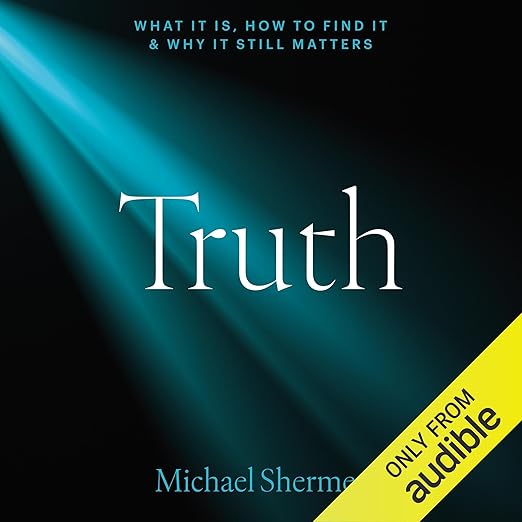
I picked up Truth in January, somewhere in the middle of a news cycle that had briefly made rational discourse feel like a minority sport. Michael Shermer has been making the skeptical argument in various forms for decades, first through Skeptic magazine, then through a string of books tackling everything from why people believe weird things to the psychology of conspiracy. This book, released in early 2026, is his most direct attempt to synthesize that project into something actionable. At thirteen hours, it’s a significant commitment, and whether it rewards that commitment depends partly on how much of Shermer’s prior work you’ve already absorbed.
The book’s central claim is both simple and genuinely difficult: truth still matters, it remains discoverable through evidence and reason, and our failure to commit to it is eroding the foundations of functioning democratic societies. That argument could easily become a comfortable sermon for people who already agree. Shermer is too careful a thinker to let that happen entirely, though a few of the reviews suggest some listeners arrive with particular political axes to grind and experience the book as validating those axes, which is probably not what Shermer intended.
Our Take on Truth
The book’s most useful sections are the ones where Shermer gets concrete about the mechanisms of false belief. He introduces readers to concepts like myside bias, the tendency to evaluate evidence more critically when it challenges our existing views than when it supports them, and Bayesian reasoning, which offers a framework for updating beliefs in proportion to the quality of new evidence. These aren’t novel ideas in the skepticism literature, but Shermer explains them with clarity and applies them to contemporary examples that feel genuinely relevant rather than illustrative exercises.
The chapters on UFOs, conspiracy theories, and miracles draw on Shermer’s long experience investigating these claims through the Skeptics Society, and they’re the most confident sections of the book. The chapters on consciousness and God are necessarily more speculative; Shermer is honest about the limits of what empirical reasoning can resolve in those domains, which gives those sections intellectual integrity even when they don’t fully satisfy.
Why Listen to Truth
Thirteen hours is a substantial listen for a work of popular philosophy, and the question of whether it justifies that length is real. The book is comprehensive in ways that feel earned rather than padded. Shermer moves from the foundational epistemology through specific case studies, covers scientific history, and ends with a genuinely earnest argument for why truth-seeking is a civic practice, not just an intellectual hobby. The range works because each section builds on the prior one rather than simply adding more examples.
One strong reviewer described the experience as feeling like Shermer had written the book specifically for them. That personal quality, the sense of a voice that is genuinely engaged with the listener rather than performing expertise, is Shermer’s real strength as a communicator. He writes with wit and without condescension, which is harder to sustain over thirteen hours than it sounds.
What to Watch For in Truth
The book’s handling of politically charged topics is the place where Shermer’s project gets most complicated. A one-star review takes pointed issue with his positions on COVID-19 vaccination; a five-star review defends him against charges of transphobia on an entirely separate topic. Both reviews demonstrate the exact dynamic Shermer is writing about: people encountering a call for evidence-based reasoning and immediately testing it against their existing political commitments. That’s not entirely Shermer’s fault, but it does suggest the book will read very differently depending on where you’re starting from.
Listeners who want a politically neutral text on epistemology will not find one here. Shermer has views, and they surface. The tools he provides are genuinely useful for evaluating any claim, but applying them symmetrically requires more intellectual honesty than most readers bring to any book.
Who Should Listen to Truth
This is a strong listen for anyone interested in epistemology, science communication, or the psychology of belief who wants accessible rather than academic treatment. Educators, journalists, and anyone who regularly has to evaluate conflicting claims in their work will find useful frameworks here. Approach it with some skepticism of your own: the book works best when you apply its tools to Shermer’s own arguments as you go, not just to the targets he identifies.
Frequently Asked Questions
Is Truth appropriate for listeners who are new to Shermer’s work, or does it assume familiarity with his previous books like Conspiracy?
It stands alone. Shermer provides enough context throughout that prior reading isn’t required. Readers who know his earlier work will recognize recurring themes but won’t find the material repetitive.
How does Shermer handle topics like UFOs and conspiracy theories without dismissing the questions listeners might genuinely have?
He approaches these through his Bayesian framework, asking what evidence would be needed to shift belief rather than simply declaring the claims false. It’s a more intellectually generous approach than simple debunking.
Does the book address how to have productive conversations with people who hold false beliefs, or is it primarily about individual reasoning?
The book’s primary focus is on personal epistemology and the frameworks for evaluating claims. There are sections on civic implications, but it’s less a communication guide than a thinking guide.
Given that this was released in 2026, does it engage with very recent misinformation events or stick to established case studies?
It draws on contemporary examples including post-2020 political and scientific controversies, which gives the material immediate relevance but also means some references may feel time-stamped in ways that earlier Shermer books do not.