Quick Take
- Narration: Rebecca Gunn delivers the instructional content with clarity and appropriate authority, the clean, professional performance keeps focus on the ideas rather than the reading, which is exactly right for technical material.
- Themes: Collaborative performance, pattern recognition in comedy, listening as the foundation of improvisation
- Mood: Energetic and instructive, with the enthusiasm of true believers making a methodological case
- Verdict: The foundational text on long-form improv remains essential for anyone who performs or wants to understand the form, audio works well as a companion to practice but cannot replace being in a room where the Harold is actually happening.
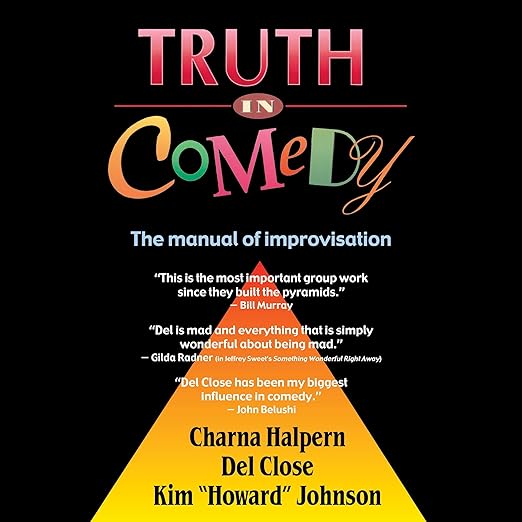
I first read Truth in Comedy years ago when I was trying to understand why certain comedy worked and other comedy did not, and coming back to it in audiobook form this past winter was an unexpectedly revelatory experience. Listening to Charna Halpern and Del Close articulate the principles of the Harold while going through your day, rather than reading them at a desk, does something to the theoretical content: it starts to feel less like doctrine and more like description. The distinction matters for a book that is fundamentally arguing that good improv is less about technique than about presence and trust.
Del Close and Charna Halpern co-founded long-form improvisational theater as a formal tradition, and the Harold they describe in this book has become one of the most widely taught and performed structures in comedy worldwide. The claim the book makes for it is ambitious: that the Harold is non-linear entertainment that remembers everything and wastes nothing, that it emphasizes pattern recognition and the subversion of expectations, and that it can produce genuine comedy without any of the devices conventional comedy relies on, including punchlines. That is a significant claim, and the book spends its considerable credibility on making it as clearly as possible.
The Harold as Structure and Philosophy
The six-to-seven-player, multi-scene Harold format requires performers to sustain multiple disparate threads simultaneously, trusting that the connections between them will emerge through association and pattern rather than through planning. This is anti-intuitive for performers trained in scripted work, and Halpern and Close spend a good portion of the book on the trust problem: trusting your scene partners, trusting the process, trusting that the audience will follow a logic that is not being explained to them. Reviewer Joseph Gaffney’s characterization of the book as requiring intelligence to apply is accurate but slightly misleading. The intelligence required is primarily social and associative rather than analytical, and the book is better understood as an argument for a specific kind of awareness than as a technical manual.
The name-dropping concern flagged in some reviews is addressed by reviewer Walter Ezell, who describes what others saw as name-dropping as something more precise: the book mentions Mike Myers, Chris Farley, and John Belushi in the context of establishing the form’s lineage and credibility, not as a prestige exercise. The Chicago improv tradition that produced these performers is the direct context for the Harold, and acknowledging that lineage is part of the book’s argument about what the form can produce rather than an advertisement for the authors’ social standing.
What the Audio Format Does to Instructional Comedy Writing
Reviewer Chris Leary noted something useful: coming to this material in a non-classroom, non-performance context allows the theory to settle in ways the high-energy environment of an actual improv class can prevent. Audio is genuinely good for this. You can listen to the explanations of the Harold’s various scenes, games, monologues, songs, skits, during a commute, and then bring that passive absorption to whatever practice context you are working in. The transfer is not automatic, but prior exposure helps.
Rebecca Gunn’s narration is professional and appropriate. She reads the material straight, which is correct for instructional content that has its own energy from the ideas rather than from performance. The audio engineering by Allie McSwain is clean, and this Echo Point Books production reflects that independent press’s consistent care with its catalog.
What Has Changed Since 1993
Truth in Comedy was first published in 1993, and while the Harold is timeless as a structure, some of the cultural context has shifted. The book occasionally reads as a manifesto for a still-emerging tradition, which was accurate when written and is less accurate now that long-form improv has become a standard training path for professional comedy. The energy of the manifesto is still valuable; the urgency has evolved. At 4 hours and 22 minutes, it is a short and efficient listen that rewards more than one pass. The 4.6 rating across 561 reviews is one of the more substantial listener samples in this format, and it reflects sustained usefulness to working performers across three decades.
Frequently Asked Questions
Is Truth in Comedy useful for someone who wants to understand improv as an audience member rather than a performer?
Yes. The book’s analysis of pattern recognition, audience expectation, and the mechanics of why the Harold works is accessible to non-performers. Understanding the structure makes watching long-form improv significantly richer, and the theoretical sections are written clearly enough that no performance background is required.
Does the audio format work for instructional material like this, or is reading it better?
Both formats have value. The audio version allows passive absorption of the principles during other activities, which several reviewers describe as helpful before applying the ideas in practice. The print version allows readers to annotate and reference specific passages easily. For active study, print may be preferable; for initial exposure or review, audio works well.
Does Truth in Comedy go beyond the Harold, or is the book primarily about that one format?
The Harold is the central focus, but the broader principles of listening, trust, and pattern recognition are applicable beyond that specific format. The book’s real argument is about what good collaborative performance requires, and the Harold is the primary vehicle for that argument rather than its only subject.
How has Truth in Comedy aged since its 1993 publication?
The structural principles have aged well and are still taught as foundational. Some of the cultural positioning feels dated, as the book was written when long-form improv was still claiming territory it now largely occupies. The core argument about the Harold’s mechanics and the philosophy of collaborative comedy remains current and practically useful.