Quick Take
- Narration: Adam North delivers a clean, authoritative read that suits the policy-briefing tone of the material, though he rarely varies pace to emphasize key arguments.
- Themes: Supply-side economics, populist trade policy, Washington insider perspective
- Mood: Confident and polemical, written to persuade rather than interrogate
- Verdict: A useful primary source for understanding the intellectual scaffolding behind Trump’s first-term economic agenda, but readers expecting balanced analysis will need to bring their own skepticism.
I came to this one during a stretch of reading around the 2016 policy period, curious less about the politics than about the economic logic that Moore and Laffer were actually defending. I’d read enough of their separate work to know both men are serious supply-siders with long track records, even if their conclusions don’t always match their data. What I found in Trumponomics was something more revealing than I expected: not a rigorous economic treatise, but an insider’s account of how policy ideas get simplified, messaged, and sold to a candidate who had limited patience for nuance.
Stephen Moore and Arthur Laffer traveled with Trump’s 2016 campaign team, worked on speeches, and were embedded in the economic advisory circle. That proximity gives the book a texture most policy books lack. You get the feeling of a campaign in motion, of ideas being shaped and reshaped around a candidate whose instincts were often at odds with conventional conservative economics. The result is a portrait of an unusual hybrid: tax cuts and deregulation from the Republican playbook, trade protectionism and infrastructure spending borrowed from the other side, and a populist overlay that neither party had really tried before.
Our Take on Trumponomics
The central thesis is that Trump’s economic model was not incoherent but rather a coherent break from the post-Reagan consensus. Moore and Laffer argue persuasively that eight years of Obama-era policy produced stagnation rather than recovery, and that the conditions were ripe for a disruptive alternative. Their defense of the 2017 tax cuts is detailed and confident, leaning heavily on supply-side theory and historical comparisons to Kennedy and Reagan. Whether you find that convincing depends largely on your priors about how tax cuts transmit through an economy, and the book makes little effort to engage seriously with the counterarguments.
Where the authors are most interesting is in their account of the internal tensions within Trump’s economic team. The push-pull between trade protectionists like Navarro and more traditional free-market voices like Gary Cohn surfaces briefly but is never fully examined. The book was written before those tensions fully resolved, and rereading it now with knowledge of how things played out adds a layer of unintentional irony to several passages.
Why Listen to Trumponomics
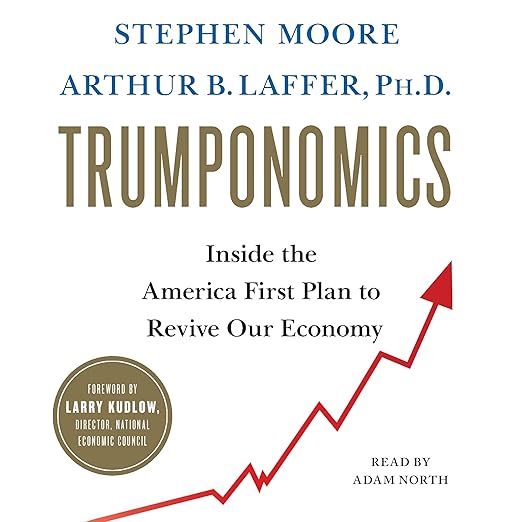
This audiobook works best as a primary source document. If you want to understand what Trump’s economic advisors believed they were doing and why they believed it would work, Moore and Laffer explain it clearly and without academic jargon. Narrator Adam North keeps the pace brisk across just under nine hours, which is the right call for material that is essentially a long policy argument. He does not try to inject drama where there is none, and the delivery suits the conversational, insider-briefing tone that Moore and Laffer adopt throughout.
One reviewer described it as a valuable read for both pro- and anti-Trump readers seeking a clear perspective, especially heading into Trump’s second term, and that framing is essentially correct. You do not need to agree with Moore and Laffer to benefit from understanding their reasoning. The book also includes a foreword from the then-Chairman of the National Economic Council, which reinforces its status as a semi-official intellectual document of the first administration.
What to Watch For in Trumponomics
The book was published in October 2018, when the tax cuts were still being absorbed and before several of the trade disputes had escalated. Some passages read as optimistic projections that subsequent events did not validate. The treatment of immigration as primarily an economic issue is compressed and will frustrate readers who want a fuller accounting. And while the authors are honest that Trump has liabilities as a leader, they do not dwell on them. This is advocacy, not analysis, and it should be received accordingly.
The climate passage that prompted one reviewer to dock a star is worth mentioning: Moore and Laffer acknowledge that cap-and-trade could theoretically have some economic impact on emissions, which a reader found objectionable from a skeptic’s perspective. It is a minor moment in the broader argument, but it illustrates how the book occasionally wanders into territory where the authors are less confident.
Who Should Listen to Trumponomics
Listen if you want to understand the supply-side and populist economic arguments that drove Trump’s first term from the perspective of advisors who were in the room. Skip if you are looking for a balanced or critical examination of those same policies. This is a book written by true believers, and its value lies precisely in that unguarded conviction rather than in any pretense of objectivity.
Frequently Asked Questions
Does the book cover Trump’s trade war with China in detail?
Only partially. The book was published in 2018 before the trade conflict with China fully escalated, so it covers the theoretical rationale for protectionism and early tariff moves but does not address the full arc of the trade war or its outcomes.
Are Moore and Laffer critical of Trump anywhere in the book?
They acknowledge Trump has personal liabilities as a leader, but the book is fundamentally a defense of his economic agenda. Critical engagement is limited and brief. The authors present themselves as advocates with insider access, not independent analysts.
How does this compare to other books about Trump’s economic policies?
It sits closer to official advocacy than to journalism or scholarship. Books like Bob Woodward’s ‘Fear’ or Philip Rucker’s accounts cover the same period with more critical distance. Trumponomics is best read alongside those for a fuller picture.
Is the economic content accessible to non-economists?
Yes. Moore and Laffer write in clear, conversational language and avoid technical jargon. The supply-side arguments are presented with historical comparisons to Reagan and Kennedy that most listeners will follow without difficulty.