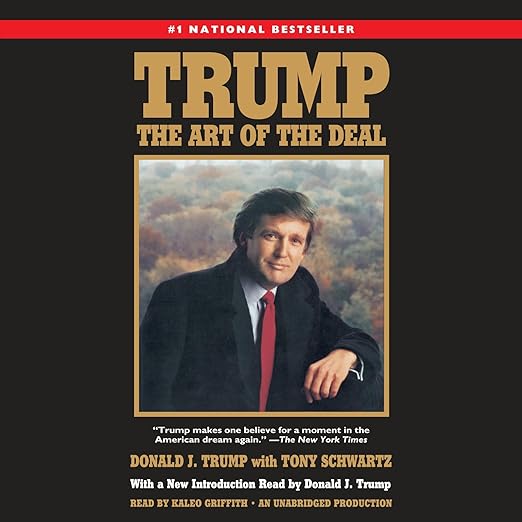
Kaleo Griffith is the credited reader on this audiobook, which matters more here than it usually would, because most listeners can already hear the author in their heads before pressing play. Nine hours and fifty-nine minutes of first-person business memoir delivered by a professional voice is a different proposition from the same text delivered by the person who wrote it, and the listing does not remark on that difference anywhere. Random House Audio put this edition out in May 2016, into a market that had recently developed opinions about the byline.
A Sample of One Voice, a Sale of Another
Here is Trump in action, says the copy, and what follows is unusually concrete for a book of this kind: how the organization runs, how the days go, who gets met and why, which enemies get fought and which conventions get ignored. One response describes arriving at the book in 2016 for reasons that had nothing to do with business, wanting to understand a public figure after political leaders that reader respected had endorsed him, and needing to decide what to do about it. That is a common route into this title and it deserves naming, because the book was not written to answer that question, and a listener carrying it will be reading against the grain the whole way through.
Random House Audio hired a reader for a book that quotes its author's speaking voice directly on the page. I like thinking big. I always have. To me it's very simple: if you're going to be thinking anyway, you might as well think big. That passage sits in the description as a pull-quote, in the author's own cadence, which means the listing hands you a sample of one voice and then sells you a recording in another. Both approaches are defensible. A neutral professional reading keeps the argument in front of the personality; an imitation would put the personality in front of the argument; and the page indicates which one you are getting only by naming somebody who is not the author.
What It Takes to Make a City Function
Ten hours, one minute short of it, is a generous runtime for a book built out of episodes rather than argument. The description promises that the author isolates the common elements in his greatest accomplishments, shatters myths, names names and spells out the zeros, which is a list of four different books. What holds them together is the deal as a unit of storytelling: a problem, a counterparty, a maneuver, a result. Repeated at that length the structure is either hypnotic or exhausting, and which one it turns out to be will say more about the listener than about the book.
Business readers are not the only ones who get something from it. One response, written by somebody who spent most of a life in New York City, reports that the interesting part was the behind-the-scenes account of what it actually takes to make a city function. That is the strongest case for treating this as a document rather than as advice: permits, financing, negotiations with institutions that have no wish to negotiate, and the sheer mechanical difficulty of putting anything large onto an expensive piece of ground. Whatever you make of the author, that material is specific and it is first-hand. Nothing in the description pretends this is anything other than one person's version of events. The value sits in the specificity rather than in the fairness, and specificity is the harder of the two to fake.
Lions Are Carnivores, Water Is Wet
Chicago Tribune supplies the only outside testimonial on this page, and it repays close reading. Donald Trump is a deal maker, it says, a deal maker the way lions are carnivores and water is wet. That is a sentence about a person. It says nothing about the writing, nothing about the structure, nothing about whether the book is worth ten hours of anybody's attention. The second pull-quote is the author quoting himself. Between them, the two quotations a buyer is meant to read as endorsement contain no assessment of the book at all, which leaves the description doing every bit of the work unaided.
Neither memoir nor manual quite covers what you get, and one response splits the difference by calling it a blend of memoir and practical advice, an immersive education in business and negotiation laid out in a direct, no-nonsense style. The trouble with a blend is that each half quietly undercuts the other. As memoir it is selective, because somebody writing about their own deals decides which episodes count as deals. As instruction it is unrepeatable, because the advantages being described are not available to the person receiving the advice. A listener who wants one or the other will spend the recording waiting for the book to commit.
Which of the Three Doors You Came Through
Entrepreneurs will find it useful in the narrow way any first-hand account of negotiation is useful, which is as a record of how one person behaves under pressure rather than as a method to copy. Business and careers, biographies and memoirs, politics and social sciences: the store puts it on all three at once, and the triple placement is honest, because what you take away depends entirely on which of the three doors you came through. Arrive from the political shelf and you find a document. Arrive from the business shelf and you find a memoir. Arrive from the memoir shelf and you find a sales pitch.
Nobody looking for a balanced account of the events described will get it here, and the book has never pretended otherwise, since a first-person business memoir is an argument by construction. Financial technique is equally out of reach, because the specifics belong to one market at one moment and travel badly. And a listener who cannot tolerate the author's presence for the full length of the recording should understand that the presence is the product rather than a delivery mechanism for something else. Griffith's credit is the only thing this page says about how the book sounds, and for a first-person memoir whose author the copy introduces as President, that single line is the whole of the disclosure.
The Short Version
- Read by: A professional reader stands in for an author the copy introduces as President, with nothing on the page explaining why that choice was made
- At its heart: Deal-making as autobiography, self-promotion as working method, a city rebuilt through negotiation
- Vibe: Brash, anecdotal, relentlessly confident
- Short version: Valuable as a first-hand record of how one person negotiates, and close to useless as a method to copy.
Common Questions
Is the Trump: The Art of the Deal audiobook read by the author?
No. Kaleo Griffith reads it, and Random House Audio produced the edition. The author is not credited with any part of the reading, and the description never refers to the recording at all. If you were expecting the author's own delivery, this listing is not offering it.
How long is the audiobook, and when was it released?
Nine hours and fifty-nine minutes, released in May 2016. The text is considerably older than the recording, which the description acknowledges by calling it a classic work, although the page gives no original publication date to check that against. For a buyer the gap matters, because a business memoir ages differently from a novel.
What shelves is this audiobook filed under?
Three of them: biographies and memoirs, business and careers, and politics and social sciences, with a Politics and Activism tag on top. That spread is unusually wide and it is accurate, since the same pages work as a career record, a collection of negotiating anecdotes and a political document depending on who is listening.
Is this audiobook abridged?
No abridgment is declared anywhere. Neither the title nor the description carries a note about it, and the record holds no ISBN and no page count, so a buyer cannot measure the runtime against a printed length. That silence is the only evidence available.