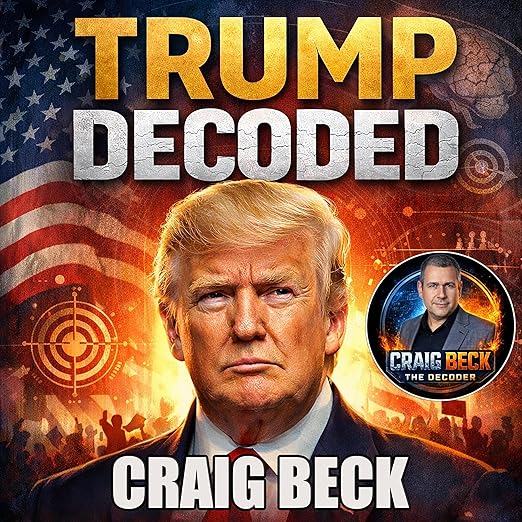
An audiobook that promises to expose persuasion techniques ought to be careful about how persuasively it sells itself, and Trump Decoded doesn't seem especially worried about that irony. Its own synopsis opens by needling the reader directly, "You think you understand Donald Trump? You don't," before promising access to "the psychological machinery" behind his political career.
Craig Beck writes and narrates this one solo, a short listen at 4 hours and 53 minutes given the scope of what it claims to cover: Trump's childhood, his rhetorical techniques, his relationship with scandal, and the psychological mechanics of persuasion generally. Self-narration by the author of a pop-psychology argument like this one at least removes any question of whether the voice behind the theory believes what it's saying. Whether that conviction translates into a compelling listen is something I can't confirm from the page, because no reviews and no star rating currently exist for this title. That's simply the state of the record as of this writing, not a judgment on the audiobook itself.
The synopsis makes a specific promise about scope that's worth noting before you commit: it claims to move past "the surface-level stuff about Twitter and red hats" toward "the deep psychology that makes millions of people ignore their own beliefs." That's an ambitious claim for under five hours of runtime, and it's the kind of promise a listener has to take on faith without prior reviews to check it against. The synopsis also promises an origin story for that psychology, describing "the brutal childhood that created a man incapable of showing weakness," and pairs that biographical claim with something more specific and testable: "the specific words and phrases that stick in your brain like songs you can't stop humming."
Your Boss Uses Them, So Does Your Spouse
Persuasion as a transferable skill, rather than Trump specifically, is the actual pitch here. The synopsis argues that "refusing to apologize became a superpower instead of a character flaw" and that a "ghostwritten book manufactured a myth so convincing it carried Trump into the White House," framing the entire subject as a case study in technique rather than a political endorsement or takedown. By the closing lines, the synopsis widens its net considerably: "Your boss uses them. Your spouse uses them. That friend who always wins arguments? They're using them too." That pivot, from one specific public figure to persuasion tactics you might recognize in your own life, is clearly the book's real hook, with Trump serving as the highest-profile case study rather than the sole subject. The synopsis also promises specific tactical explanations along the way: how "being attacked actually made him stronger while his opponents withered under scrutiny," and how "culture war battles everyone else avoided" became, in the book's telling, one of his most effective weapons. It even promises to explain "the reason traditional politicians keep losing to someone who breaks every rule they were taught to follow," treating that pattern as the book's organizing question.
Beck states plainly that this "isn't another book screaming that Trump is brilliant or evil," positioning the project as analysis rather than advocacy in either direction. Whether the finished audiobook actually holds that line is, again, something no outside review currently confirms one way or the other. The synopsis makes one more claim worth flagging as a listener rather than just a marketing hook: that a "ghostwritten book manufactured a myth so convincing it carried Trump into the White House." That's a specific, checkable-sounding historical argument about the role of a particular publication in a political career, and it's the kind of claim I'd want backed by real sourcing inside the audiobook itself rather than asserted and moved past quickly.
Direct-Address Hooks and Escalating Rhetorical Questions
What's missing, rather than what's present, is the most useful thing I can tell you here. No star rating, no written reviews, and no badges are attached to this listing, which means you're deciding entirely on the strength of the synopsis and whatever you already know about Craig Beck as an author and narrator. The synopsis itself closes with a bare website address, CraigBeck.com, tucked in after the marketing copy, a small but telling sign that this is a self-published, self-promoted project rather than one carried by a traditional publishing or marketing apparatus.
A structural tension is also worth sitting with: a book that promises to teach you to recognize manipulation techniques is, by its own synopsis, built almost entirely out of those same techniques, direct-address hooks, rhetorical questions, escalating promises about what you'll "discover." That doesn't make the underlying analysis wrong, but it's worth listening with the same critical ear the book claims to be training in you. Given the release date of March 5, 2026, this is also a very recent addition to the catalog, which is likely part of why the review and rating fields are still empty; a title without much time on the market simply hasn't had the chance to accumulate feedback yet, distinct from an older listing that has gone unreviewed despite years of availability.
Beck's Self-Narration, for Better or for Worse
Listeners specifically interested in the mechanics of political persuasion and rhetoric, treated as a subject in its own right rather than strictly partisan commentary, are well served here, provided they're comfortable going in without any prior reader reaction to calibrate expectations. Beck's self-narration means you're hearing the argument delivered by the person who most believes in it, for better or worse. Skip it if you need outside validation, reviews, ratings, critical buzz, before trying an audiobook, since none of that currently exists for this title, or if a book explicitly built around persuasion techniques applied to persuade you sounds more exhausting than illuminating. Approach it as an open question rather than a settled recommendation, because right now, that's genuinely what the data allows. Given the compact runtime, it's also a low time commitment relative to most political nonfiction, which may make it easier to justify taking a chance on a title without an established track record yet.
Are there any reviews or ratings for this audiobook yet?
No. As of this writing, Trump Decoded has no star rating and no written reviews attached to its listing. That means you're evaluating the audiobook purely on its synopsis and Craig Beck's own reputation as author and narrator, without outside reader reactions to weigh.
How many hours is the Trump Decoded audiobook?
Craig Beck's self-narrated audiobook runs 4 hours and 53 minutes, a relatively compact runtime given the wide territory the synopsis claims to cover, from Trump's childhood to broader theories of persuasion and rhetoric applicable well beyond politics or any single public figure.
Is Trump Decoded a traditionally published audiobook?
It appears to be self-published. The synopsis closes with the author's own website address, CraigBeck.com, listed as the publisher, rather than a conventional publishing imprint, which is worth knowing before you form expectations around editorial vetting, fact-checking, or the promotional reach a larger publishing house would typically provide.