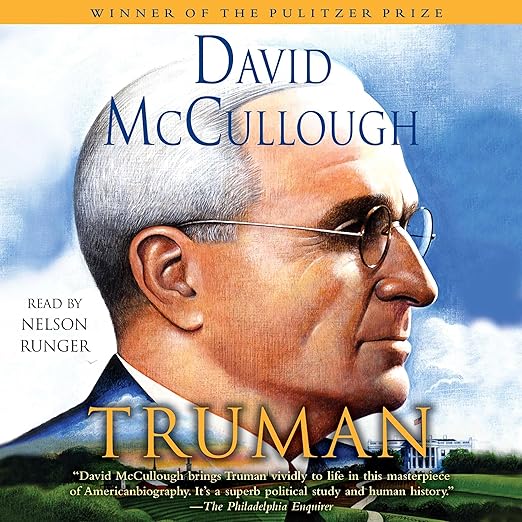
Fifty-four hours is not a number you skim past. That is the length of this audiobook, eleven minutes over the mark, and it is the most important fact on the page. David McCullough's Pulitzer Prize winner is a book you can set down and pick up again; as a recording read by Nelson Runger it turns into something closer to a season of listening. Anyone weighing it should start by deciding whether they want to spend that much time with one president, because every other consideration follows from the answer.
Is Truman Worth Your Time?
A biography this size earns its length from material rather than padding. McCullough worked from newly discovered archival documents and extensive interviews with Truman's family, friends, and Washington colleagues, and the span runs from the raw Missouri frontier through World War I, the Pendergast machine of Kansas City, the Whistle-Stop Campaign of 1948, the decision to drop the atomic bomb, Potsdam with Stalin, troops sent to Korea, and the firing of General MacArthur. Half a dozen distinct books sit inside the one title. The blurb's own shorthand, the seemingly ordinary man from Missouri who turned out to be perhaps the most courageous president in the country's history, tells you where the sympathies land well before the first hour is out.
Listeners will not find a word about the recording anywhere in the review column, and the silence is louder here than it would be on a shorter title. All five written responses describe reading. Roger DeBlanck, writing in 2013, savored each page. Jonathan W White calls the work an intimidating 992 pages long. Marcelo Costa signs off with three imperatives: buy it, read it, appreciate it. The one question nobody touches is what fifty-four hours of Runger's delivery is actually like.
This matters because one voice is carrying an enormous cast. Roosevelt, Churchill, Stalin, Eleanor Roosevelt, Bess Wallace Truman, George Marshall, Joe McCarthy, and Dean Acheson all move through the narrative, and Runger is the sole name in the narrator credit. No full-cast production is indicated, and no second voice appears for the documentary passages. Across a runtime this long, your tolerance for a single performer's range becomes the deciding variable, and the page offers no guidance at all on that point.
When the responses do describe the book, they converge on the same quality. Patronio, filing from Spain, frames the whole life as an endless concatenation of failures: failure as a student, as a farmer, as a businessman, even as a politician, always standing in someone more charismatic's shadow, until perseverance turns into the foundation of everything that followed. That is a genuinely useful way in, and it explains how a biography of an unglamorous man holds attention for the length of a workweek doubled. It also sets up the one structural warning worth giving in advance: the presidency, which is what most buyers are here for, does not begin until a long way into the recording.
Where the record shows its age is in the fields around the edges. This recording dates from April 11, 2011, issued by Simon & Schuster Audio, and the responses on the page run from January 2013 to February 2026, so the column has been accumulating for more than a decade. Three of the five arrive from outside the United States, filed in Spain, Brazil, and India. The most recent of them, from Dhruv Agarwal, consists of a single word.
Anyone hoping for a tight political history should recalibrate. McCullough's method is accumulation: the Pendergast machine gets its own weather, the 1948 campaign gets its train stops, the family gets its letters. That is the pleasure for some listeners and the obstacle for others. The blurb's promise of a more complex, informed, and determined man than anyone had imagined is delivered through sheer volume of detail rather than through argument, and volume is exactly what fifty-four hours permits.
Before You Commit to Truman
Nothing here hides behind jargon, and no prior reading is assumed. Truman arrives as a boy on the Missouri frontier and leaves as the president who authorized the bomb, faced Stalin at Potsdam, and fired the most famous general in the country. A listener who knows the Cold War only as a phrase will follow every turn without help. What the book asks for is not background knowledge. It asks for time, and it asks for a great deal of it.
Most of the risk in buying this is finishing it. An hour a day gets you to the end in under two months. The 992-page figure one response supplies makes the runtime look proportionate to a complete reading rather than a condensed one, though the listing itself never says so outright. The practical question is whether your listening habit survives a commitment on this scale, given that Korea and MacArthur arrive deep into the second half. Chapter navigation becomes a practical necessity at this scale, and anyone listening in short sessions should expect to lose their place at least once along the way.
The author's name is misspelled twice in the most detailed response on the page, which is a small thing that says something about how these columns get built. Jonathan W White writes McCollough on both mentions while praising the meticulous research. Patronio's entry carries its own scattering of typos. None of that damages the judgments underneath, and those judgments are unanimous, but this page is not a curated document and should not be read as one.
Should You Listen to Truman?
That leaves a clear recommendation. Listeners who already read presidential biography for pleasure, who know they can hold a narrative across weeks, and who want the twentieth century viewed from the desk where the decisions landed will get precisely what they came for. Anyone studying Potsdam, Korea, the 1948 campaign, or the machine politics that produced a senator from Kansas City gets an account built on archives and on interviews with people who were in the room. The international spread of the column is its own small signal: responses filed from Spain, Brazil and India suggest the appeal survives distance from American domestic politics.
What should give you pause is the shape of your own calendar. This is a commitment on the scale of a course rather than an evening, and a single credited voice carries every minute of it while the star column, unanimous as it is, was written by people holding a book. Sample Runger first and let the delivery decide it. Fifty-four hours asks for a decision, not an impulse.
- Voice: Nelson Runger carries all fifty-four hours alone, with no second voice credited for a cast running from Churchill to MacArthur
- Big ideas: Missouri frontier to Cold War, machine politics, decisions taken alone
- Atmosphere: Patient and accumulative, a long haul by design
- Worth it?: The gold standard of presidential biography, sold here as a season-length commitment rather than an evening's listening.
Good to Know
How long does the Truman audiobook take to finish?
Fifty-four hours and eleven minutes, which works out to under two months at an hour a day. That length is the main thing separating this from the print edition as a purchase decision. Plan it the way you would plan a course rather than an evening, because the Korea chapters sit deep in the back half.
Does the audiobook cover the complete book or a shortened version?
The listing never labels the edition either way. What can be said is that the runtime sits comfortably against the 992 pages one reviewer counted, which points toward a full reading rather than a condensed one. Anyone who needs certainty should confirm with the publisher before spending a credit.
Who narrates it, and is this a full-cast production?
The credit names Nelson Runger and nobody else, with no second voice anywhere on the listing. That means one performer handles Roosevelt, Churchill, Stalin, Marshall, McCarthy and Acheson across the whole span. Whether that range holds up is the biggest single variable in a recording of this length.