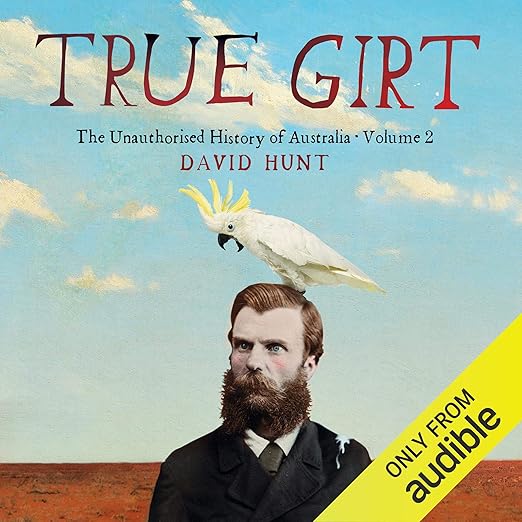
Quick Take
- Narration: David Hunt self-narrates, and this is one of those cases where the author’s performance is the only viable option. Hunt’s comic timing is precise and the footnotes land like they were written for audio.
- Themes: Australian frontier mythology versus reality, colonial violence in the laughing register, the gap between official history and actual events
- Mood: Raucously funny with genuinely dark undertones
- Verdict: The sequel that earns its place alongside the original, though read Girt first and take a break between the two volumes.
I came to True Girt having already spent considerable time with Girt, David Hunt’s first volume of what he calls the Unauthorised History of Australia, and I needed approximately thirty seconds of his self-narration to remember why this approach to history works. Hunt has a birthmark that looks like Tasmania, only smaller and not as far south, the author biography reads. That tells you everything about the register you are entering. This is history that trusts its own research enough to perform it as comedy, and the comedy is the honesty.
The series structure matters. True Girt is volume two, focused on the Australian frontier, and one reviewer’s advice deserves repeating: read Girt first, then take a break before starting True Girt. The density of information, delivered at Hunt’s characteristic pace of assured irreverence, compounds across volumes. Moving directly from one to the other risks losing the texture of individual characters and events in a blur of well-researched absurdity. The books deserve better than that.
Thomas Davey, Captain Moonlite, and the Wild South
True Girt covers the Australian frontier, which Hunt frames as the Wild South with the same structural audacity that the American West myth has been applied to its own version of colonial violence. The characters are extraordinary by any measure: Thomas Davey, the Tasmanian governor who invented the Blow My Skull cocktail; Captain Moonlite, described as Australia’s most infamous LGBTI bushranger, whose story is given genuine dignity inside the comedy framework; William Nicholson, the Melbourne hipster who gave the world the secret ballot. Hunt has a gift for finding the figures that conventional histories skip or flatten, and a talent for making them vivid without simplifying them.
The Myall Creek Massacre is here, contextualized through a Hall and Oates reference as a deadpan entry point into something that is not at all funny. Hunt’s approach to colonial violence is one of his more interesting calibrations: he does not use comedy to diminish it, but he uses comic juxtaposition to make the gap between settler mythology and settler practice legible. When the humor drops for a moment, the drop is deliberate and effective.
Hunt Narrating Hunt
I have no doubt that a professionally trained narrator reading True Girt would produce a technically excellent audiobook. I also think it would be substantially worse than Hunt reading Hunt. The footnotes are written for the author’s own voice. The comic timing in the main text, the pauses before a punchline that arrives in the form of a historical detail, the deadpan delivery of genuinely horrifying facts, is calibrated to how Hunt himself speaks. One reviewer described the footnotes as having them in stitches and sending them to Google repeatedly. That is exactly what they do in Hunt’s own performance.
One caveat from the reviews is worth taking seriously: the sheer volume of information across sixteen-plus hours, delivered at this pace and density, can become overwhelming if you approach it as passive listening. True Girt rewards active attention. It is history that is doing serious work under the comedy, and the more you notice the serious work, the better the comedy lands.
Hunt and Bryson: Different Things, Complementary
One reviewer came to Hunt after Bill Bryson’s Down Under, and the comparison is instructive. Bryson’s Australia is an outsider’s affectionate portrait, funny and warmly observational. Hunt’s Australia is an insider’s reckoning, equally funny but more willing to look at the things that are genuinely not funny. They are complementary rather than competing, and if you have read Bryson, Hunt is the natural continuation rather than a replacement. The 919 ratings and 4.4 average on this volume reflect a genuinely enthusiastic audience that has made the full series commitment and found it worthwhile.
Who Should Listen and Who Should Skip
True Girt is for anyone who has read or listened to Girt and wants more. It is also an excellent entry point into Australian history for listeners who find conventional survey histories airless. Australian listeners will recognize their own history in it. International listeners will discover a history they were not taught and probably should have been.
Skip it, or at least defer it, if you have not started with Girt. The series has an accumulating character logic that pays off best when read in order. The 919 ratings and 4.4 average across both platforms confirm that this is a genuinely cross-border success for a book of specifically Australian history, which says something about the universality of Hunt’s method. He has found a way to write about colonial brutality and national mythology that does not require you to be Australian to care about the pattern. The Wild South is everyone’s wild frontier, and what Hunt does is show you what lurks behind the mythology when you pull it apart carefully and then reconstruct it honestly. The footnotes alone, audible only in Hunt’s own performance, are worth the price of the audiobook.
Frequently Asked Questions
Is True Girt Book 1 or Book 2 of the Unauthorised History of Australia series?
Book 2. The first volume, Girt: The Unauthorised History of Australia, covers the colonial origins of New South Wales. True Girt continues the story into the frontier period. Readers should start with Girt before attempting this one.
Does Hunt’s self-narration work better than a professional narrator would?
For this material, unambiguously yes. Hunt’s comic timing, particularly in the footnotes, is written for his own voice and delivery. His background as a comedy writer means the pauses and the deadpan moments are calibrated in a way that a hired narrator cannot replicate.
How does True Girt handle serious subjects like the Myall Creek Massacre?
With deliberate calibration. Hunt uses the comic register to establish how official history has minimized colonial violence, and then shifts tone when the events themselves demand it. The Myall Creek Massacre is not played for laughs; the comedy frames it rather than diminishing it.
Should I take a break between reading Girt and True Girt?
Yes, based on reviewer experience. The density of information and the sustained comedic register compound across volumes. Taking time between them allows each book’s specific characters and events to settle before the next wave arrives.