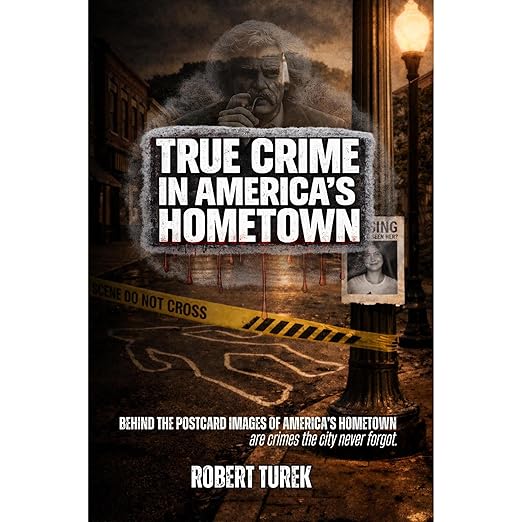
Court records, newspaper archives, police reports and firsthand accounts. That is the sourcing this audiobook claims for itself, and it is a serious claim to make. Four hours and thirty-five minutes is what you get to hold it up: the entire criminal history of Hannibal, Missouri, murders and disappearances and scandals across generations, compressed into a single afternoon of listening. Nobody has written a word to tell you how that compression went.
A Single Line Discloses How This Was Made
Hannibal is known around the world as the boyhood home of Mark Twain, and the description leans on that hard: a picturesque river town, postcards, museums, storybook streets, and beneath all of it "a far more unsettling legacy." Good hook, familiar shape. The promise underneath it is that these cases are documented, pulled out of records and not out of ghost stories, and that many of them "have never been fully examined until now." The phrase America's Hometown does a great deal of work in this pitch. It is the title, it opens the description, and it returns twice more, paired each time with the darkness underneath it. That repetition is the whole sales argument in miniature: a familiar nickname, then the reversal.
Virtual Voice is what the narrator field says. That is a synthesis, not a person, and it is the single most consequential line on this listing, because it is the only thing this listing discloses about how the book was made. No human reader is named. No producer, no director, no studio. The publisher is given as Independently Published. Whatever you make of synthetic narration in the abstract, this is what the purchase involves, and the page states it nowhere except in that one field.
Four hours and thirty-five minutes is brisk for the scope on offer. The copy promises brutal murders, unexplained deaths, disappearances that haunted families for generations, and scandals quietly erased from public memory, spanning a town's whole recorded past. Each chapter, it says, pulls the reader deeper into the shadows. At this length that means a sequence of case summaries. Sustained investigation needs far more room than five hours allows, which is a calibration and not a complaint.
Two Votes, Eight Points, and No Writing
Missouri true crime is a genuine subgenre, and this is the fifth entry in a run called Stories of True Crime in the Midwest. Fifth matters. It means four earlier volumes exist and somebody kept making them, which is the nearest thing to a track record this page provides. It is also the only external signal available, since not one written response is attached to the title itself. The series name promises the Midwest and this volume delivers a single town in Missouri, which is either admirable focus or a sequence running short of road, and nothing here lets you tell which.
Nobody has reviewed it. The counter registers two votes and displays no writing whatsoever, which is an odd condition for a page to be in: two people cared enough to grade and neither cared enough to say why. Those two votes total exactly eight points out of a possible ten. That is the whole of what the arithmetic yields. Whether it represents two fours or a five and a three, the listing keeps to itself.
Once you know these stories, you'll never see Hannibal the same way again, the copy promises, and that is the sentence worth weighing. It is a claim about effect, made by the party selling the effect, with no listener on record to confirm or deny it. Independent true crime succeeds or fails on whether the cases really are as unexamined as advertised, and this page gives you no way to check.
This Book Names No Victim, No Case, No Year
Neither the release date nor the review chronology helps. The recording went out on January 25, 2026, and the two votes arrived, uncommented, at some unmarked point afterward. Nothing timestamps them. For a title this new an empty column is not evidence of anything beyond newness, which is the fairest reading available and simultaneously the least useful one you could be handed.
Without a single written response, the description is the only witness, and descriptions have interests of their own. This one uses the phrase "hidden in plain sight," promises documentation four separate ways, then claims the pace of modern true crime alongside the depth of historical investigation. Those two claims pull against each other. A book cannot move at the speed the copy advertises and deliver archival depth in under five hours, and nothing here says which one won. It also names nobody. Not one victim, not one case, not one year appears in the description of a book built entirely on documented crimes. A true crime blurb that withholds every specific is asking to be taken on faith, and with an empty column, faith is the only currency on offer.
Eight points from two votes produces the 4.0 badge, and that badge is carrying more weight than any badge should. It represents every recorded response to this audiobook and none of the explained response, because no explained response exists. If you are the kind of buyer who reads before committing, this page has nothing to read, and no amount of looking at the number will change what it does not contain.
One Voice Vouching and Selling at Once
Twain tourists and Midwest true-crime readers are the natural audience, and the pitch is aimed squarely at them: a town whose entire public identity is American innocence, examined from underneath. If you have walked those streets or read the books that made them famous, the inversion carries real force. Under five hours is an easy commitment for a curiosity purchase, and the series position at least suggests the author has done this several times before. The framing has one concrete advantage for audio: discrete cases, one to a chapter, survive interruption far better than a continuous narrative does. Drop out for a day and the structure has not moved on without you.
Readers who need a human voice should stop at the narrator field, because that decision has already been made and is not softened anywhere else on the page. Buyers who want proof of quality before spending will find no proof of any kind. Until someone writes in, the only voice vouching for this book is the voice selling it.
Good to Know
Who narrates the True Crime in America's Hometown audiobook?
The narrator field reads Virtual Voice, meaning synthesized speech in place of a credited human reader. No performer, producer or studio is named anywhere on the listing, and the publisher is given as Independently Published. That one field is the entirety of what this page discloses about the recording itself.
Does this audiobook cover real documented cases?
That is the claim: court records, newspaper archives, police reports and firsthand accounts, with an explicit statement that these are not legends or ghost stories. Many cases are described as never fully examined before. No reviewer has confirmed or disputed any part of it, so the claim stands entirely unverified.
Do I need the earlier books in the Midwest series?
Nothing suggests you do. This is numbered five in Stories of True Crime in the Midwest, but the subject is one town and the structure runs chapter by chapter, case by case. No earlier volume is named on the listing and no continuing thread is described. Treat it as a standalone entry.
Is four and a half hours enough for a whole town's crime history?
That is the open question. The description promises murders, disappearances and erased scandals spanning generations, against a runtime of four hours and thirty-five minutes. At that length, expect case summaries instead of a deep dive into any single story. The copy also promises historical depth, and the two sit uneasily.