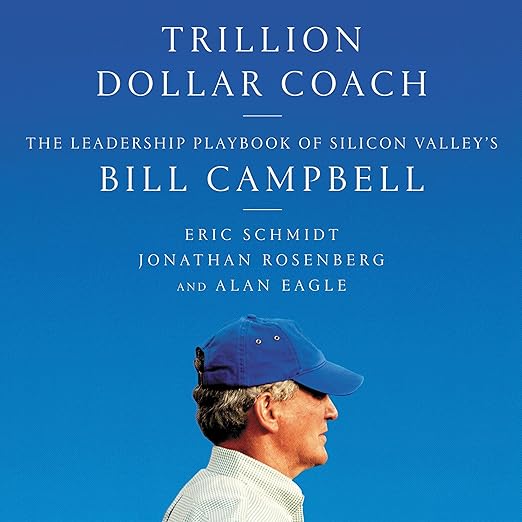
Dan Woren narrates Trillion Dollar Coach the way a good executive coach might run a meeting: brisk, warm, no wasted motion. That matter-of-fact delivery suits a business audiobook built almost entirely from other people's memories of Bill Campbell, the Silicon Valley coach who helped build enormous value at Google, Apple, and Intuit without ever taking the CEO title himself.
Eric Schmidt, Jonathan Rosenberg, and Alan Eagle, the same team behind How Google Works, base this account on interviews with more than eighty people who knew Campbell personally, including Steve Jobs and Larry Page among the Silicon Valley figures he mentored. Campbell died in 2016, and this book reads as both a leadership manual and a tribute, organized around the specific habits and principles that made him, in the authors' telling, indispensable to some of the most valuable companies in the world.
Part Hagiography, Part Insight, and Worth Reading
The book's structure moves through Campbell's core principles one at a time, trust, listening, team-first thinking, rather than following a strict chronological biography, and Woren's pacing keeps that structure from feeling like a checklist. Each chapter draws on specific, named anecdotes from the eighty-plus interviews, which gives the book a texture closer to oral history than management theory.
Not every reviewer reads the tone the same way. Wally Bock, who rated the book four stars, describes it directly as part hagiography, part insight, and worth reading, a genuinely useful summary of the book's core tension: this is an admiring account written by people who loved Campbell, not a critical biography, and listeners should calibrate expectations accordingly even as they take the leadership lessons themselves seriously.
Schmidt and Rosenberg Weren't Neutral Observers
Eric Schmidt served as Google's CEO and later as executive chairman of its parent company Alphabet, and Jonathan Rosenberg ran product management at Google for years under Schmidt, which gives their account of Campbell's coaching real insider standing rather than secondhand reporting. That proximity is both the book's greatest strength and the exact source of the hagiography critique some readers raise; the authors are not neutral observers of the man who coached them personally for over a decade.
Alan Eagle, the book's third author and Google's longtime director of executive communications, brings a writer's instinct for pacing to material that could easily have collapsed into a shapeless list of Campbell quotes; instead, each chapter builds toward a specific, memorable takeaway, which is part of why the book reads faster in audio than its subject matter might suggest.
A Simple Guide of Things Not to Forget
At five hours and forty minutes, this is a genuinely quick listen for a business audience with limited time, and the interview-driven structure means it rarely drags into abstract theory without a concrete story to anchor it. Thomas M. Loarie, a longtime CEO himself, calls it an excellent book in his review, specifically noting its resonance for anyone who has coached or advised founders and executives.
One reviewer's Spanish-language comment translates roughly to calling it a very practical, simple-to-read guide of things not to forget, and that assessment lines up well with the book's format: short, principle-driven chapters built for practical reference rather than one continuous argument that needs to be absorbed in a single sitting.
Readers who enjoyed Ben Horowitz's The Hard Thing About Hard Things or Kim Scott's Radical Candor will recognize a similar Silicon Valley leadership-book register here, practical, story-driven, and skeptical of corporate jargon, though Trillion Dollar Coach is more singularly focused on one person's specific relational philosophy than either of those broader management texts.
The book's title makes a specific, quantifiable claim, that Campbell's influence helped generate over a trillion dollars in combined market value across the companies he touched, and while that figure is more a rhetorical anchor than a precise calculation, it does capture something real about how concentrated his influence was across Google, Apple, Intuit, and the dozens of individual executives he coached one on one.
A Supplemental PDF the Audiobook Won't Replace
This listing notes that a supplemental enhancement PDF accompanies the audiobook, and listeners should track that down before starting, since business books built around named organizational relationships and specific frameworks often lean on visual reference material that a straight audio listen alone will not fully replace.
Wally Bock's hagiography critique deserves real weight here. Readers wanting a warts-and-all account of Silicon Valley culture, or a more skeptical treatment of the outsized influence one unelected coach had over some of the most powerful companies in tech, will not find that version of the story in this book. The authors clearly loved Campbell, and the book reflects that affection throughout.
The short runtime is a real strength for busy listeners but also means breadth wins out over depth in places. Campbell's influence touched dozens of companies and executives, and a five-and-a-half-hour audiobook cannot dwell on any single relationship for very long before moving to the next illustrative anecdote.
The book's chapter structure, organized by theme rather than chronology, works well in audio precisely because each chapter can largely stand alone; listeners who want to jump back to a specific principle, on running effective meetings, say, or on giving direct feedback, can do so without losing a larger narrative thread, though this also means the book rewards revisiting more than a single linear listen captures fully.
Coaching and People-Management Roles Get the Most Use
Managers, founders, and anyone in a mentorship or coaching role within a company will find genuinely practical value here, particularly listeners already familiar with How Google Works who want the same team's follow-up perspective on leadership through relationships rather than process.
Skip this one if you want a more investigative or critical business biography, or if the idea of an admiring tribute to a beloved insider figure feels like the wrong lens for understanding Silicon Valley's concentration of power. This book knows exactly what kind of book it is, and it is not that one.
Listeners who already work in a coaching, HR, or people-management capacity specifically, not just general managers, will find Campbell's specific techniques, insisting on team-first thinking even among brilliant individual performers, more immediately applicable than listeners in purely individual-contributor roles.
Quick Take
- Narration: Dan Woren keeps the pace brisk and conversational, which suits a book built from dozens of short, quoted memories rather than one continuous narrative voice.
- Themes: Trust as a leadership strategy, mentorship without ego, Silicon Valley's hidden power broker
- Mood: Warm and admiring, closer to tribute than analysis
- Verdict: A quick, practical listen for anyone managing people, though listeners wanting a more critical account of Bill Campbell should adjust expectations going in.
Before You Listen
Does the Trillion Dollar Coach audiobook include the supplemental PDF mentioned in the listing?
The listing states that a supplemental enhancement PDF accompanies the audiobook purchase, so listeners should look for that download alongside the audio file rather than assuming the narration alone covers every reference the authors mention.
How long is the Trillion Dollar Coach audiobook, and is Dan Woren's narration well suited to a business audience?
At five hours and forty minutes, it is a compact listen, and Woren's brisk, conversational pacing fits the book's short, anecdote-driven chapters well for listeners fitting it into a commute or a few focused sessions.
Is this book only useful for tech executives, or does it apply to other industries?
While the specific examples come from Silicon Valley, the underlying principles, trust, active listening, putting the team first, are framed broadly enough to apply to management and mentorship roles well outside the tech industry.