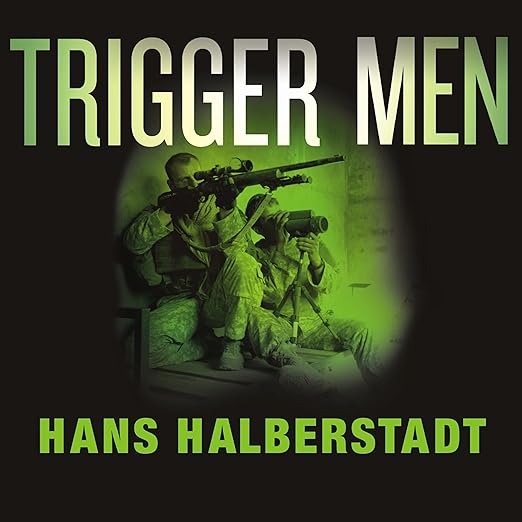
Quick Take
- Narration: Johnny Heller brings an assured authority to this military nonfiction, calibrating the tone correctly between documentary and tribute without slipping into either sentimentality or gratuitous detail.
- Themes: Sniper psychology and training, elite unit culture, the human cost of sustained combat operations
- Mood: Visceral and precise, with genuine emotional weight concentrated in the Headhunter Two section
- Verdict: A rigorously reported entry into the military memoir genre that earns its intimacy with difficult material through hundreds of hours of direct interviews rather than secondhand reconstruction.
There is a particular register in military nonfiction that is very easy to get wrong: the place where clinical precision and human consequence overlap. Hans Halberstadt writes from that intersection throughout Trigger Men, and the result is one of the more honest books I have listened to about what the role of a sniper actually demands from the people who occupy it. I finished the shorter first section, the Shadow Team material, during a lunch break, and then sat in my car for an extra twenty minutes because I did not feel quite ready to return to the rest of the day.
Halberstadt is a combat veteran and military author who spent hundreds of hours in direct interviews with the people he writes about. That foundation matters enormously. This is not a genre that forgives secondhand reconstruction, and the specific credibility of Shadow Team’s account, the most productive sniper team in American military history with 276 confirmed kills in six months and a record-range shot with a 7.62mm rifle, comes entirely from the directness with which team members describe their own experience. For the first time, as the synopsis notes, they explain what it is like to kill a man and what it takes to become one of the elite. Halberstadt does not editorialize their answers.
Two Stories, One Book, Nothing in Common
The structure of the book is defined by its two central subjects, and the contrast between them is where most of the emotional power lives. Shadow Team represents an account of extraordinary effectiveness: a sniper unit that performed its mission with a precision that military historians will study for decades. The story of Headhunter Two is altogether different in the starkest possible way: four members of a sniper team from the regiment known as the Magnificent Bastards were killed in Ramadi in 2004. Their deaths were not just a loss; they prompted a fundamental reevaluation of sniper tactics and, eventually, an act of vengeance executed nearly two years later.
The Headhunter Two section is what the book does best. Halberstadt reconstructs the context of their deaths, the tactics they were using, the decision-making that put them in that position, and the response of the unit afterward, with the kind of specificity that only direct access to surviving members could produce. The emotional weight here is significant without being performed. Halberstadt is not writing grief journalism; he is writing military history. That restraint makes the material land harder, not softer.
What Halberstadt Gets Right About the Interior Experience
A reviewer with military family background described this as the most accurate book they had read about the sniper’s world, noting both the insider detail and the rare quality of the snipers themselves speaking directly about their inner experience. That quality, the willingness to ask the difficult questions and the willingness of the subjects to answer them, is not standard in this genre. The standard is either tactical detail without interiority or personal memoir that contextualizes the tactical within individual psychology. Halberstadt moves between both layers without privileging one over the other.
The book also covers the mechanical and tactical dimensions: how missions are planned and executed, how the weapons function, and what occurs when a bullet reaches its target. A reviewer noted wanting more terminal ballistics detail, which is a legitimate preference, but the balance Halberstadt strikes between operational and psychological material gives the audiobook broader appeal than a purely technical account would have.
Johnny Heller and the Tone This Material Requires
Johnny Heller is one of the more reliable performers in the military nonfiction space, and his work here is exactly what the material needs. He is not dramatizing these accounts; he is presenting them with the gravity they warrant. The slight roughness in his delivery suits Halberstadt’s direct prose. He does not soften the difficult passages or inflate the impressive ones. At seven and a half hours, the runtime is efficiently managed, and Heller maintains consistent energy throughout without the mechanical consistency that would make the listening experience feel processed rather than witnessed.
The book’s 4.3 rating across 135 reviews reflects a wide range of listeners, from combat veterans and their families to civilians with no military background curious about a world they will never enter. Across those different starting points, the core value holds: direct testimony, earned intimacy with the subject, and an honesty about cost that makes this something other than a celebration.
Where to Go After This
For listeners who respond to Trigger Men and want more in the same vein, Brandon Webb and Jack Murphy’s work on SEAL snipers covers adjacent territory from a first-person perspective. For a broader historical context on the role of snipers in American military history, Martin Pegler’s Out of Nowhere provides the longer arc. For anyone specifically drawn to the Headhunter Two story, the Marine Corps after-action analysis of Ramadi 2004 is available in various secondary sources that expand the tactical context Halberstadt covers in the book.
Frequently Asked Questions
Is this primarily about Iraq, or does it also cover Afghanistan?
The primary focus is on operations in Iraq, specifically Ramadi in 2004, though Halberstadt’s broader discussion of sniper training, selection, and psychology covers the American military sniper program more generally.
How graphic is the content about the reality of killing?
The book is explicit about the physical and psychological reality of sniper work, including what happens when bullets strike their targets. It is not gratuitous, but it is direct. Listeners who want the operational story without that level of detail should know what they are entering.
Does Halberstadt provide a moral or political perspective on these operations?
No. The book presents the snipers’ own perspectives and experiences without political editorializing about the wars they served in. The moral complexity of their work is present in what they say about it themselves, not in authorial judgment.
Is Shadow Team’s record of 276 confirmed kills in six months verified by independent sources?
Halberstadt presents it as the most productive sniper team in American military history, based on his direct interviews with team members. Independent military verification of sniper records is not typically made public in full, so this figure reflects the participants’ own accounting rather than declassified official documentation.