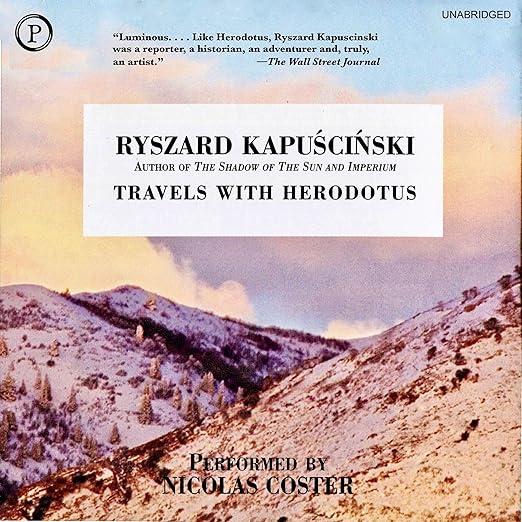
Quick Take
- Narration: Nicolas Coster gives Kapuscinski’s layered, reflective prose the kind of measured gravity it deserves, never hurrying through passages that reward being heard slowly
- Themes: the journalist as witness, ancient history as traveling companion, the limits of Western perception
- Mood: Contemplative and wide-ranging, with a quality of accumulated wisdom
- Verdict: One of the most unusual travel narratives ever written, and a far better audiobook than most of its genre, for listeners willing to surrender to its unhurried doubling of time frames.
There is a particular pleasure in discovering a book you should have found years ago. I came to Ryszard Kapuscinski’s Travels with Herodotus late, which is embarrassing given my background in literary journalism, and I came to it on a long train journey where I had nothing else planned and three hours to fill before my connection. I did not put it down at the connection. I sat in the station and kept listening. By the time I finished, a day and a half later, I had taken three pages of notes and sent the title to five people.
This is the kind of book that restructures how you think about other books, about travel, about the relationship between historical witness and contemporary observation. Nicolas Coster’s voice was the right container for it.
The Man Who Wanted to Cross the Border
The organizing premise of Travels with Herodotus is deceptively simple. Kapuscinski, one of the great foreign correspondents of the twentieth century, received a copy of Herodotus’s Histories from his editor when he was sent on his first international assignment. He had hoped for Czechoslovakia. He got India. He was overwhelmed, understood almost nothing, and began reading Herodotus as a companion and a model. The book that results from this lifetime of parallel reading is part journalism memoir, part meditation on historical method, and part investigation into what it means to go somewhere you do not understand and attempt to describe it honestly.
The reviewer H. Schneider captures the book’s emotional core in their note that Kapuscinski’s early exposures to India and China were failures for his worldview. This is not a travel writer who arrives with confidence and leaves with copy. This is a writer who documents his own incomprehension as scrupulously as he documents the places he visits. That humility, what the reviewer calls the recognition that the world teaches humility, is what makes this book different from conventional travel writing.
Herodotus as a Traveling Companion
The structural move that elevates Travels with Herodotus above standard memoir is the ongoing dialogue Kapuscinski maintains with his ancient source. He tests Herodotus’s methods against his own. He finds the fifth-century historian making the same discoveries that a twentieth-century foreign correspondent makes: that you have to wander, look, talk, and listen, that curiosity is the primary journalistic instrument, that what seems obvious from the outside of a culture is rarely what matters to the people inside it.
The reviewer Judy Polhemus, writing on the first day of 2009 after calling this the best book she read in 2008, describes a man landlocked and controlled by communism whose greatest dream was simply to cross the border. When he finally does, and the border turns out to be the border of an entirely different world, the encounter with Herodotus provides the only adequate framework for making sense of it. There is something quietly thrilling about watching a contemporary journalist discover that the most useful guide to the developing world in the 1950s and 60s was written in ancient Greece.
Nicolas Coster and the Weight of Kapuscinski’s Prose
Kapuscinski’s writing has a quality that defies easy summary. The reviewer Marco Antonio Abarca describes him as an immensely gifted writer who left vivid portraits of peoples and nations, which is accurate but incomplete. He also has a philosophical density, a tendency to pause inside an observation and turn it over until something new appears. That is a quality that reading can accommodate easily and that audio narration can accommodate only with care.
Nicolas Coster accommodates it with care. His delivery is measured without being slow, invested without being performative. He gives the longer reflective passages the space they need without letting the rhythm sag. For a ten-hour audiobook that moves between contemporary memoir and ancient history and back again without warning, Coster’s consistency of tone is what holds the listener’s orientation intact. This is the kind of narration that disappears into the text, which is the highest compliment I know how to give.
Who Should Spend Ten Hours with Herodotus and Kapuscinski
If you have ever been interested in the intersection of journalism and history, or in what it means to be a witness to events you only partially understand, this is essential listening. If you have read and admired Herodotus and want to encounter him through the eyes of someone who read him obsessively in the field across four decades, this is the companion that experience deserves.
If you need travel writing that tells you about places in the conventional sense, that delivers information about destinations and cultures efficiently, this is the wrong book. Kapuscinski is writing about the experience of encountering the unknown and trying to find language for it. The destinations are real. The point is the reaching, not the arriving.
I want to note one thing about Nicolas Coster’s reading that I did not fully address earlier: his treatment of the moments where Kapuscinski quotes or paraphrases Herodotus directly. These passages are the heart of the book’s structural conceit, the places where 2,500 years collapse into a single insight. Coster does not perform these transitions dramatically. He allows them to land quietly, which is exactly right. Kapuscinski’s meaning accumulates over the full ten hours. You cannot rush it, and Coster does not try.
Frequently Asked Questions
Do I need to have read Herodotus’s Histories before listening to Travels with Herodotus?
No, but familiarity with Herodotus adds a significant layer of resonance. Kapuscinski explains enough about the Histories as he goes that newcomers will follow his argument. However, listeners who have spent time with Herodotus will find the parallel reading experience considerably richer.
Is this a conventional travel memoir with descriptions of places and cultures?
Not primarily. Kapuscinski is more interested in the experience of encountering incomprehension and trying to process it than in providing information about the countries he visits. His destinations include India, China, Iran, El Salvador, and Angola, but the book’s center of gravity is philosophical and methodological rather than descriptive.
Kapuscinski died in 2007. Has his reporting faced any credibility challenges since publication?
Yes. After Kapuscinski’s death, questions were raised about the factual accuracy of some of his reporting, particularly regarding composite characters and scenes he may have reconstructed or embellished. Readers should approach his work as literary journalism in the tradition that prioritizes the quality of witness and reflection over strict factual reportage.
Why does Nicolas Coster work particularly well as narrator for this book?
Kapuscinski’s prose operates at a philosophical register that requires a narrator with the patience to let reflective passages breathe. Coster’s measured, unhurried delivery gives the text space without losing momentum. For a book that moves between autobiography, historical scholarship, and cultural meditation without warning, Coster’s consistency of tone is what keeps the listener oriented.