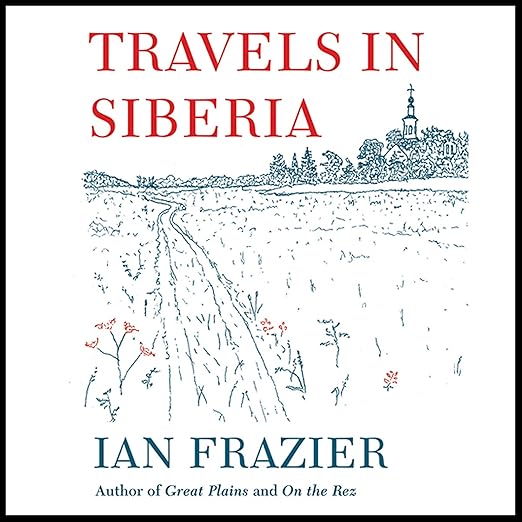
I started Travels in Siberia the way you have to start anything twenty hours long, with a deliberate commitment to a different kind of listening than I usually bring to audiobooks. Ian Frazier is not interested in moving quickly. He is interested in Siberia the way certain writers get interested in particular places: with a borderline irrational devotion that keeps drawing them back regardless of rational justification. He made five trips to Siberia over a period of years, and this book is the account of all five. The result is a work that rewards exactly the same kind of patient attention that Siberia itself demands of its visitors.
Frazier trained his eye on the Great Plains before turning it on Russia, and there is a similar quality to both books: an interest in the overlooked, the vast, and the historically layered that does not resolve into simple conclusions. Siberia takes up one-seventh of the land on Earth. Its history encompasses the fur-seeking Russians who first pushed east, the Decembrist revolutionaries exiled there in the 1820s, the People's Will movement of the nineteenth century, the Soviet gulag system that killed in numbers still imperfectly documented, and the post-Soviet present Frazier encountered on his trips beginning in the 1990s. He writes about all of it, sometimes in the same paragraph, which is either maddening or thrilling depending on your tolerance for association as an organizational principle.
One reviewer described this as a work for history and interesting-fact lovers who do not mind literary departures from strict travelogue. That is a generous but accurate framing. Frazier is a New Yorker writer, and the book has the New Yorker's characteristic willingness to follow an idea or an image wherever it leads, even if that means twenty pages on the ecology of Siberian mosquitoes or a sustained meditation on the horror of Russian public restrooms. A reviewer who found this charming described laughing at his descriptions of things encountered; the same material frustrated readers expecting a tighter narrative focus.
The key to enjoying this audiobook is accepting that Frazier's relationship to Siberia is personal and somewhat inexplicable, and that the book's pleasures are distributed unevenly across its twenty hours. There are sections of pure comedy, the mosquitoes, the restrooms, the various indignities of traveling in Russia with inadequate Russian, and sections of genuine historical darkness, as when Frazier writes about the gulag with the seriousness it demands. The tone shifts are deliberate, and they mirror Siberia itself: a place that is simultaneously absurd and tragic, comic and vast.
The Strengths
The author reads his own work, which is a double-edged choice. Frazier is not a trained narrator, and there are moments in the first few hours where the performance is clearly that of a writer reading rather than an audiobook narrator performing. But by the midpoint it stops mattering, because his voice has exactly the quality his prose has: a dry, affectionate, unhurried authority that makes you trust him as a guide. One reviewer who lived in Russia for twelve years noted that they could relate to the stories, suggesting that Frazier gets the texture of Russian life right in ways that a more polished performance might have flattened.
At twenty hours and twenty-six minutes, this is a genuine commitment. The reviewer who described reading the book over a year, noting that the narrative breaks allow you to put it down and return without losing the thread, was giving accurate advice. The audiobook's chapters function similarly. You can listen in long sessions or short ones without losing coherence, which makes it a natural candidate for commutes and long walks over an extended period.
Things to Know Before Starting Travels in Siberia
The historical passages are among the strongest in the book. Frazier brings genuine affection to Russia, a country that still somehow manages to be funny, as he puts it, while refusing to sentimentalize what happened there in the Soviet period. The gulag history is handled carefully, with attention to the scale of the suffering and the difficulty of grasping numbers that resist comprehension. He does not lecture. He observes, documents, and then steps back, trusting the reader to feel the weight without being told to. This is a harder thing to do than it sounds, and Frazier does it well.
The post-Soviet sections are fascinating in a different way, capturing a country mid-transformation in the 1990s and early 2000s, when the old systems had collapsed and the new ones were not yet legible. That historical moment is increasingly distant, and Frazier's account of it has taken on the quality of primary source material.
Recommended For
Listen if you have a genuine interest in Russia, Siberian history, or the travel memoir as a literary form, and if you are comfortable with a book that prioritizes texture and association over forward momentum. Skip if you need a tighter narrative structure, if twenty hours of unhurried prose sounds exhausting rather than appealing, or if you are looking for a contemporary account of Russia rather than a historical and personal one rooted in the 1990s and 2000s.