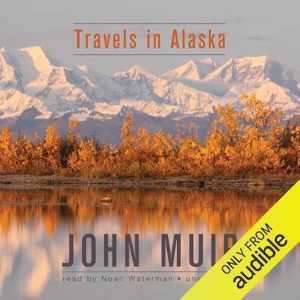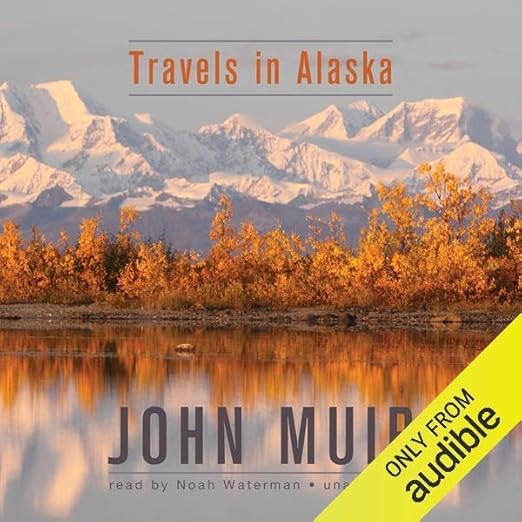
I came back to Travels in Alaska after several years away from Muir's prose, and I was reminded immediately of why he requires a particular kind of listening. This is not a book you can half-attend to. Muir writes with the focus of someone who has trained himself to see more precisely than the people around him, and the prose reflects that training: dense with botanical and geological observation, slow to move through landscape because moving quickly would mean missing something. Noah Waterman's narration honors this quality. He doesn't rush Muir toward contemporary pacing, which would be the easy failure, and he doesn't perform the century-old prose in ways that make it feel like period theater. The result is something close to what I imagine Muir's own voice to have been: serious and specific and occasionally overwhelmed by what he's describing.
The book is Muir's account of his three journeys to Alaska, beginning in July of 1879 when he first sailed through the Inside Passage and encountered, as he wrote, scenery so hopelessly beyond description. It was published posthumously in 1915, assembled from journals that Muir had kept but never fully organized into publishable form. That compositional history matters to the reading experience: the book has a fragmentary quality in places, a sense of notes being gathered toward a book rather than a book fully written. The great passages, the glacial descriptions, the encounters with the natural world that have the quality of religious experience, stand alongside more dutiful record-keeping that was presumably intended for later revision.
What We Made of It
The recurring complaint among reviewers who find the book monotonous, one glacier after another in the words of one critic, is technically accurate and misses the point entirely. Muir's Alaska journals are obsessively focused on glacial geography because glacial geography was how he understood the geological history of the landscape he loved in California. He had spent years arguing that Yosemite Valley was carved by glacial action rather than formed by cataclysm, and in Alaska he found the evidence still in motion. What reads as repetition to a general reader was, for Muir, the accumulating proof of a theory he had spent his scientific life defending.
Understanding that context transforms the glacier passages. You are not reading a travel writer noticing scenery. You are reading a scientist conducting fieldwork in conditions of extreme physical difficulty, taking notes on natural processes that he understood more thoroughly than almost any other person alive at that moment. The passion in those passages comes from that understanding, not from tourism. Readers who come to Travels in Alaska without some prior acquaintance with Muir's intellectual project will be, as one thoughtful reviewer advised, better served by starting with My First Summer in the Sierra or a biography like Michael P. Cohen's The Pathless Way before attempting this one.
Why Travels in Alaska Works as an Audiobook
One dimension of Travels in Alaska that warrants attention is Muir's engagement with the Tlingit and other Alaska Native communities he encountered during his journeys. He traveled extensively with native guides, particularly on his later expeditions, and his accounts of those relationships are more complex than the standard nineteenth-century naturalist's dismissal of indigenous presence as background. Muir is genuinely interested in the people he meets, even if his frame of reference is inevitably the frame of his era. That complexity makes the book a richer historical document than a purely ecological account would be.
The chapters involving his relationships with missionaries, particularly S. Hall Young, reveal the tensions of the period as Muir navigated between scientific naturalism and the Christian frameworks that shaped most of the other non-Native people in the region. Muir's own relationship to institutional religion was complicated, and Alaska brought those complications into focus in ways his Sierra writing doesn't always reveal.
What Might Not Land
At 7 hours and 39 minutes, the audiobook moves through considerable territory without feeling rushed. Waterman's pacing is deliberate in the best sense: he gives the description-heavy passages space to land. The nineteenth-century syntax, which can feel laborious on the page, actually benefits from being read aloud by someone who understands that Muir's sentences are built for breath rather than for scanning. The long, accumulating clauses that are characteristic of his best descriptive writing work better in audio than in silent reading, which is a genuine argument for choosing this format for this text.
The 4.4 rating reflects a healthy range of responses to a genuinely challenging book. Listeners who love Muir and came looking for the sustained astonishment of his best California work will find it here in concentrated form. Those who wanted a conventional travel narrative and found themselves inside a scientific expedition will feel the mismatch. That mismatch is worth knowing about before you commit 7 hours to the Inside Passage.
Who Should Pick Up Travels in Alaska
If you have read My First Summer in the Sierra or know Muir from the Yosemite writings, Alaska is the natural next step and a meaningful deepening of the portrait. If you are new to Muir, heed the advice of the experienced reader who wrote that the place to start is with his California work, where the emotional and scientific architecture of his project is established more accessibly. Travels in Alaska is a book for people who already understand what he's trying to say and want to watch him say it in conditions of maximum difficulty. On those terms, it is indispensable.
Common Questions
Is Travels in Alaska a good starting point for readers new to John Muir's writing?
Experienced Muir readers recommend starting with My First Summer in the Sierra or a biography like Michael P. Cohen's The Pathless Way first. Alaska assumes familiarity with Muir's project and worldview. It rewards those who arrive with that context and can be difficult for those who don't.
Why does the book spend so much time on glaciers? Is there a unifying argument or scientific framework?
Yes. Muir's glacier focus in Alaska was tied to his lifelong argument that Yosemite Valley was formed by glacial action. In Alaska he found glaciers still actively at work, providing evidence for his theory. The passages read differently once you understand that context.
How does Noah Waterman's narration handle Muir's nineteenth-century prose style?
With appropriate seriousness. Waterman doesn't modernize the delivery or perform the period. The measured pacing suits Muir's long, accumulating sentences, which actually work better in audio than in silent reading because they are built for breath.
This was published posthumously from journals. Does the unfinished quality affect the listening experience?
Somewhat. The book moves between the sustained intensity of Muir's best descriptive writing and more dutiful record-keeping that was presumably intended for later revision. The fragmentary quality is real but doesn't undermine the passages that represent his finest work.