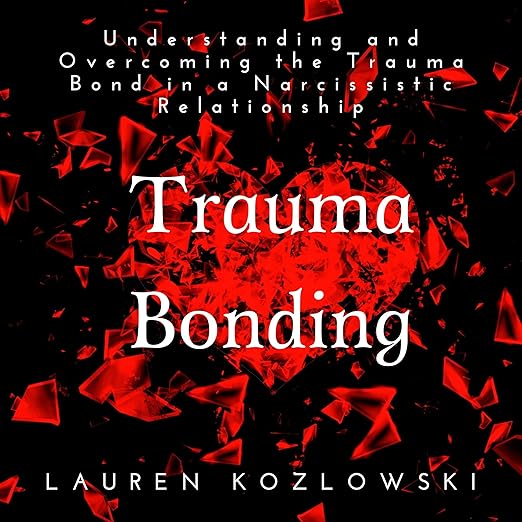
Lauren Kozlowski's Trauma Bonding: Understanding and Overcoming the Trauma Bond in a Narcissistic Relationship opens with a series of questions many survivors will recognize immediately - the blunt, ignorant demands of people on the outside who cannot understand why someone would stay, why they would not ask for help, why leaving seemed impossible when the relationship was so clearly damaging. The audiobook, narrated by Stephanie Murphy, is Kozlowski's answer to those questions, drawing on her own experience as a survivor of a trauma bonded relationship as well as the accounts of other survivors who reached out to her. At just under two hours, it is a short listen by any measure, but it uses its brevity deliberately rather than apologetically.
The Verdict, Briefly
Kozlowski covers a meaningful amount of conceptual ground in the available runtime: the seven stages that lead to a trauma bond forming, the parallels between trauma bonding and Stockholm syndrome, the five-stage cognitive process of accepting you are in a trauma bond, the cognitive dissonance a trauma bond produces, and the mechanics of breaking free. Each of these is a significant topic, and she treats them with clarity and genuine emotional intelligence, but the treatment is introductory rather than comprehensive. Readers who finish the audiobook and want to go deeper on any of these threads will need additional resources. Kozlowski is honest about this rather than inflating the scope of what a short book can accomplish.
What Kozlowski does particularly well is close the gap between the clinical concept and lived experience. She does not present trauma bonding as a pathology that happens to passive people who should have known better; she presents it as the predictable outcome of specific abuser tactics applied over time, and she situates her own experience within that framework without making the book a memoir in disguise. The distinction matters: the personal material is deployed strategically to make the framework concrete, not to center her own story at the expense of the reader's. Several reviewers note reading the entire text in a single sitting and finding that over half of every page resonated so directly with their situation that they highlighted it - a response that reflects how specifically Kozlowski has calibrated her language to the experience of being inside a trauma bond rather than observing one from outside.
Why Trauma Bonding Works as an Audiobook
Stephanie Murphy's narration is quietly significant for this particular material. Kozlowski's writing has an intimacy to it - she is directly addressing someone who may be in or recently out of a painful relationship - and Murphy delivers that address with warmth rather than clinical distance. The effect is of being spoken to rather than lectured at, which is exactly right for a book that asks readers to recognize themselves on the page. The audio format, with Murphy's steady and unhurried delivery, extends the sense of direct engagement that makes the text feel personal rather than generic.
The seven stages framework is the book's most useful structural contribution. Kozlowski names them clearly enough that listeners can locate themselves within the sequence, which is itself a form of help - knowing that what you are experiencing has a name, a pattern, and a documented arc is often the first step toward being able to act. The comparison with Stockholm syndrome is handled carefully, avoiding the sensationalism that topic can attract while making clear the neurological and psychological parallels that make trauma bonding so difficult to exit through willpower alone. One reviewer who had spent nine years in an abusive relationship before finding the courage to leave describes the book as removing the self-blame that had made leaving feel impossible, which captures the framework's practical value accurately.
Points to Consider
The audiobook's approach to the breaking free section is honest about its own limitations: Kozlowski does not promise a clean sequential recovery process, and she is clear that the invisible chain tethering someone to an abuser can be weakened and eventually broken but requires sustained effort and usually support beyond a single short book. Listeners in the middle of an abusive relationship or early in the process of leaving should treat this as a starting point and seek additional support rather than a complete guide.
The book's framing is specifically oriented toward narcissistic relationship dynamics. Trauma bonding occurs in other contexts - cult involvement, certain parenting relationships, institutional settings - and listeners whose experiences do not map directly onto the narcissistic partner framework may find some of the specific descriptions less resonant, even if the core psychological mechanism is the same. The book is also primarily oriented toward the survivor's perspective rather than the therapeutic or clinical one, so those approaching from a professional standpoint will want to supplement with more technical resources.
The Right Listener for Trauma Bonding
People who are currently in, recently out of, or trying to understand a relationship that felt impossible to leave will find Kozlowski's framework immediately useful and her tone genuinely supportive rather than judgmental. Friends, family members, and therapists trying to understand why people stay in abusive relationships will find the seven-stage model a practical way to think through what they are observing. Those who need a comprehensive treatment of recovery or who are looking for clinical-depth psychology should supplement this with longer, more technical resources rather than relying on this short introduction alone.
Key Details
- Narrator: Stephanie Murphy delivers the material with steady, empathetic warmth, maintaining a tone that feels supportive rather than clinical across the full runtime - an important quality for content this personally sensitive.
- Subjects: Trauma bond formation and rupture, narcissistic relationship patterns, self-recovery and cognitive dissonance
- Tone: Honest and grounding, written from inside the experience
- Bottom line: A short, accessible introduction to trauma bonding that combines Kozlowski's own survivor perspective with the psychological framework - useful as a first resource for anyone trying to understand why leaving an abusive relationship feels impossible.
Is this audiobook useful if I am currently in a relationship I think might involve trauma bonding?
Yes, as a starting point. Kozlowski's seven-stage framework and her explanation of why leaving feels impossible despite knowing you should can help name what you are experiencing. She is also clear that a short book is not a complete guide to recovery, and she encourages readers to seek additional support beyond the audiobook.
At under two hours, does this audiobook cover enough ground to be genuinely helpful?
For an introduction to the concepts, yes. Kozlowski covers the formation stages, the Stockholm syndrome parallel, the cognitive dissonance of acceptance, and the mechanics of breaking free with clarity and emotional intelligence. Those who want deeper treatment of any single topic will need additional reading, but as a first resource the audiobook punches above its runtime.