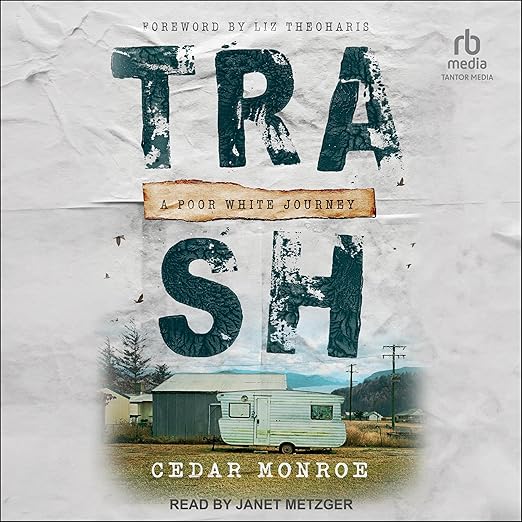
Sixty-six million poor white people, the description says, pay the price every day for failing whiteness. That figure opens the book and it sets the terms for the audiobook that follows: eight hours and forty minutes of reporting out of one small county in Washington, written by a chaplain and activist working among the people it describes, arguing that a population taught to think of itself as almost-white has been quietly discarded by the arrangement. Cedar Monroe is not writing about that population from a safe distance.
Sixty-Six Million Who Pay for Failing Whiteness
The reporting stays local and specific. On the banks of the Chehalis River sits what the description calls the largest homeless encampment in the country, and its residents are the book's principal subjects: swept, evicted, targeted by vigilantes, and eventually in federal court. A small Washington town that once cut timber for the nation supplies the frame. Everything larger in the argument, and the argument reaches a long way, gets built upward from that one riverbank rather than argued down onto it from a lectern.
One response files the book where it belongs, calling for it as assigned reading in economics, political science and social science classes, and identifying the mix that makes it work: the author's own experience, plus research, statistics and political theory, delivered in prose that same entry describes as easy to read because it is so well written. That combination is the real achievement here. Testimony on its own would have been affecting and forgettable; theory on its own would have been unreadable outside a seminar room.
Solidarity is the ask, and the copy puts it as a question rather than a program: what would happen if poor white folks rejected the empty promises of white supremacy and stood alongside other poor people instead. Capitalism and colonialism stole land from Indigenous people, forced workers into dangerous jobs and then left them to die once their labor was no longer needed, the argument runs, and the same machinery is now finishing the job on the population it once flattered. The choice gets put to the reader directly.
Metzger Holds Three Registers in One Voice
The column registers something unusual about this book, and one October response says it out loud: regardless of the pronouns used, that entry writes, the pages hold many truths. What you are watching is a reader working past a discomfort in order to reach the material, described honestly rather than hidden. The same response then names the substance it found there, which is children thrown away, people in pain who get ignored, and human beings in plain sight treated as trash for no better reason than being perceived as different.
A one-word title carries a great deal of weight here, and the word is the one this book's subjects have had thrown at them for a lifetime. Using it on the cover is a deliberate act of retrieval, the same operation the text performs on the phrase failing whiteness. In audio that title arrives spoken, out loud, in a reader's voice, rather than printed on a jacket a listener can turn face down. The effect is blunter than print, and the book gives every sign of wanting it that way.
Janet Metzger has the narrator credit, and the material makes a specific demand of a single reader. Three registers run through the text at once: a chaplain's first-person account, the quoted speech of encampment residents, and a reasonably dense theoretical argument about capital, land and colonial history. One voice has to hold those apart from start to finish with none of the typographic help a page provides, since nobody listening can see where a block quotation opens or closes. Sample a passage of reported speech rather than the introduction.
A Five-Star Review Calls It Trauma Voyeuristic
Caveats concentrate inside a single five-star, which is where the sharpest one on this page sits. That entry calls the book hard to put down and a challenging read in the same breath, records not agreeing with every single thing the author wrote, and then lands the phrase a prospective listener most needs to weigh: it could be a little trauma voyeuristic at times. That is a genuine hazard of the genre and it deserves consideration before an eight-hour commitment. The same response recommends the book anyway, as a resource for understanding current events.
Content sits heavier than the shelf implies. Sweeps, evictions, vigilante targeting, and people left to die once their labor stopped being wanted are all named in the description itself, and the book reports from inside those events instead of summarizing them from a distance. The listing carries no content warning at all. Anyone working in social services, housing or ministry should factor that in, since this material lands closest to the bone for exactly the people most likely to go looking for it.
Category placement is the one thing here likely to mis-sort a buyer. The record sits under biographies and memoirs with a Cultural and Regional tag, a combination that promises one life story from one particular place. What arrives instead is reported argument: a chaplain's testimony provides the spine, but statistics, land history and political theory occupy at least as much room, and the book asks a reader to do something rather than to understand somebody. Browsers shopping for memoir will get considerably more than they came for.
A Response That Organizes Instead of Rating
One response answers the book the way the book asks to be answered, with an organizing step rather than a star rating: it names the Poor People's Campaign, supplies the number to text in order to join it, and calls readers co-conspirators for justice. Whatever you make of that as a review, it demonstrates precisely the effect the text is engineered to have. This is advocacy writing that expects a reply, and the rating average sitting above it is measuring something the book is not really competing for.
Wrong reader for this: anyone wanting a policy book with a numbered set of recommendations at the end, or a memoir with an arc that resolves in the final chapter. Even-handedness between the positions on offer is not available either, because the case is argued from a stated position and never pretends otherwise. And the statistics arrive in speech rather than on a page, so a listener who needs figures, land history and sources in front of them has nothing here to check against afterward.
Readers whose politics assume this constituency is already understood are the ones who most need the full runtime. What the book does best is refuse both of the stories currently available about poor white America, the one that pities and the one that blames, and replace them with people who have names, a river, a courtroom, and a set of decisions that remain open to them. That refusal is what makes the whole of it worth anybody's attention.
At a Glance
- Narration: Janet Metzger takes a text braiding chaplain's testimony, quoted residents and dense theory, with none of the typography that keeps them apart on a page.
- Themes: White poverty and the American dream, encampment sweeps and evictions, land and labor history, cross-racial solidarity
- Mood: Angry, tender, unrelenting
- Verdict: Close to essential for anyone working in housing or ministry, demanding for everyone else, and honest about how close to the bone it goes.
Good to Know
Does the audiobook carry the research apparatus?
Nothing on the listing says so. No supplementary file is offered, and no note describes what becomes of endnotes, figures or sources in the recording. On a book that argues from statistics and land history, that gap is worth knowing about: you will hear the claims and have nowhere on this page to trace where they came from.
How difficult is the material to sit with?
Considerable. The description names sweeps, evictions, vigilante targeting and people left to die once their labor was no longer wanted, and the book reports from inside those events rather than summarizing them from somewhere comfortable. The record offers no advance warning. Anyone with direct experience of housing loss should approach it deliberately rather than casually.
Would this audiobook work for a classroom or a reading group?
It is close to built for one. The argument is structured, the local reporting gives a group something concrete to hold on to, and the closing question about solidarity is designed to be answered rather than admired. The length means you will need to split it across sessions, and the lack of a bibliography anywhere on the record is the one real obstacle for coursework.